Endothelial Cells - In Depth Notes
Endothelium:
Inner layer of all blood vessels and lymphatic system.
One cell layer thick, in contact with fluids (blood and lymph).
Largest organ in the body (endocrine), weighing over 1 kg in adults.
Composed of 1-2 trillion cells, covering 4000-7000 m² (equivalent to 8 tennis courts).
Structural Features of Endothelial Cells:
Appearance:
Flat, 1-2 μm thick, and 10-20 μm in diameter, resembling cobblestones.
Glycocalyx:
Composed of proteoglycans with carbohydrate chains (glycosaminoglycans).
Protects intercellular junctions, crucial for maintaining vessel integrity.
Toxic substances can disrupt these junctions, leading to diseases.
Tight intercellular junctions to maintain integrity of the vessel wall:
Toxic substances (e.g. nicotine) open up these junctions and allow large molecules to pass through the wall.
This can lead to disease (future lectures).
Cell Functions:
Vesicle Transport:
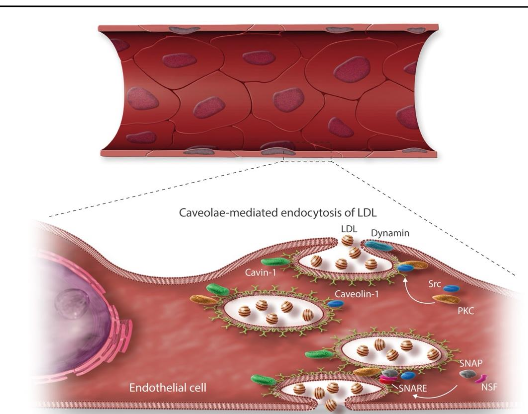
Contains many vesicles utilized for pinocytosis and macropinocytosis for solute and fluid transport.
Caveolae: Special type of vesicle that contains caveolin, associated with various cellular functions.
Endothelial Cell Roles:
Vascular Tone Management:
Responds to hormones and vasoactive factors, controlling dilation and constriction.
Vasodilatory Factors:
Nitric Oxide (NO), Prostacyclin (PGI2), Endothelium-derived Hyperpolarizing Factor (EDHF).
Vasoconstrictive Factors:
Thromboxane A2 (TXA2), Endothelin-1 (ET-1), Catecholamines.
Coagulation and Thrombosis Regulation:
Produces both activators and inhibitors of thrombus formation:
Anticoagulants: Thrombomodulin, Protein C, TFPI.
Produces factors to inhibit platelet function: NO, PGI2.
Inflammation Regulation:
ECs interact with leukocytes, enabling attachment, rolling, and transmigration during inflammation.
Mechanism:
Tethering (selectins), slow rolling/arrest (integrins).
Mechanical Forces on Endothelial Cells:
ECs experience various forces:
Contact-Derived Stresses: Influence of topography and curvature, stiffness (2 kPa - 2 MPa).
Flow-Derived Stresses: Shear stress (0.1-5 Pa), pressure variations in arteries (120/80 mmHg).
Mechanosensation in Endothelial Cells:
Cells utilize several mechanisms for sensing their environment:
Glycocalyx, ECM via integrins, tight junction proteins, and ion channels.
Shear stress induces conformational changes, activating signaling pathways, and affecting gene transcription.
Endothelial Dysfunction:
Causes: Oxidative stress, inflammation, and various risk factors (hypercholesterolemia, diabetes, etc.).
Leads to impaired endothelial function contributing to diseases such as atherothrombosis, myocardial infarction, and stroke.
Symptoms of Dysfunction: Decreased NO signaling, increased inflammation and permeability, and vascular stiffness.
Summary of Key Points:
ECs maintain cardiovascular health through multiple mechanisms including regulating vascular tone, preventing thrombosis, and managing inflammatory responses.
Mechanical and biological factors influence their functionality and overall health.
Assessment Question Example:
Question: Describe 1 biological and 1 mechanical mechanism by which the glycocalyx has a signalling role on endothelial cells.
Biological Mechanism: Glycocalyx sequesters growth factors which modulate receptor accessibility that leads to intracellular signaling.
Mechanical Mechanism: Structural changes in glycocalyx components leading to cytoskeletal rearrangement via integrin interactions.
Next Lecture:
Focus: Smooth Muscle Cells