Unit 3 Homework
 Introduction (Greeting + Your Name)
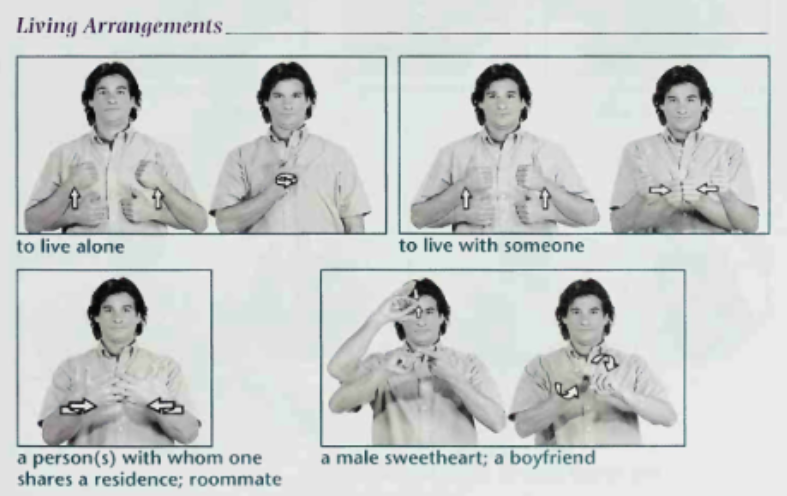
Type of Residence and Size:
What is near the Area:
How long have your lived there:
Live with who including pets (names, and types)
Work (Place, how long you've worked there)
How do you get to work:
How long it takes to get to work from home:
How do you get to class:
How long does it take to get to class:
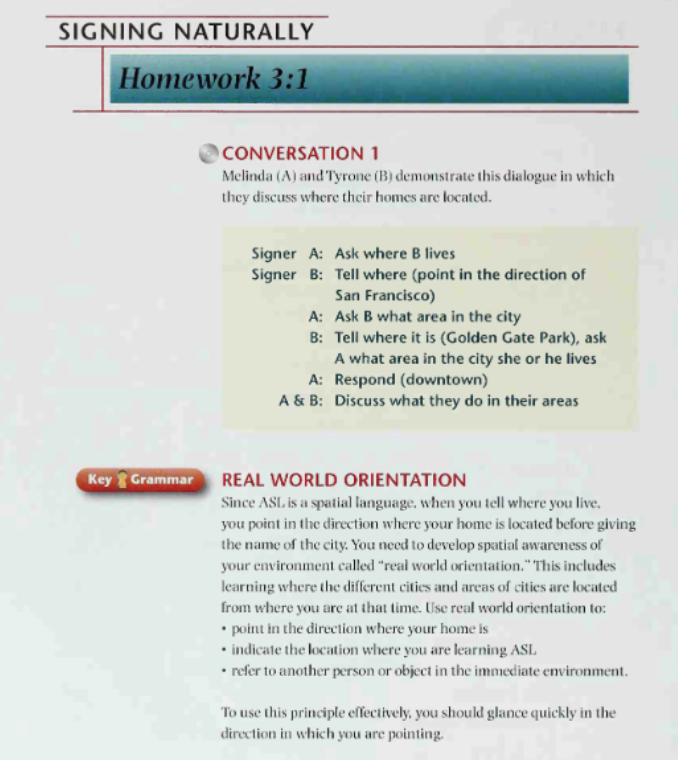
- ASL is a ___ language: spatial
- Since ASL is a spatial language when you tell where you live, you point in the direction where: your home is located before giving the name of the city
- Real-world orientation: Spacial awareness of your environment
- Use real world orientation to: point in the direction where your home is, indicate the location where you are learning ASL and refer to another person or object in the immediate environment
- In order to use the principle of real world orientation effectively, you should: glance quickly in the direction in which you are pointing
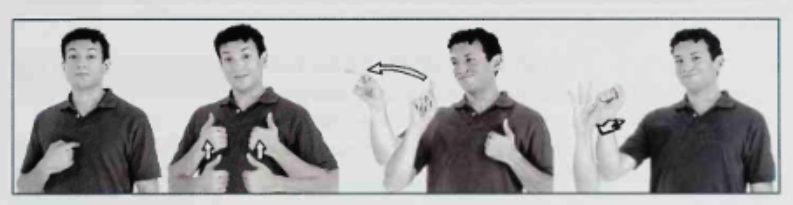
- Example of real world orientation: Tyrone demonstrates how to use “real-world orientation” from conversation 1. Notice how Tyrone glances as he points to the location.
Question 2 1 pts
Turn to Page 111.
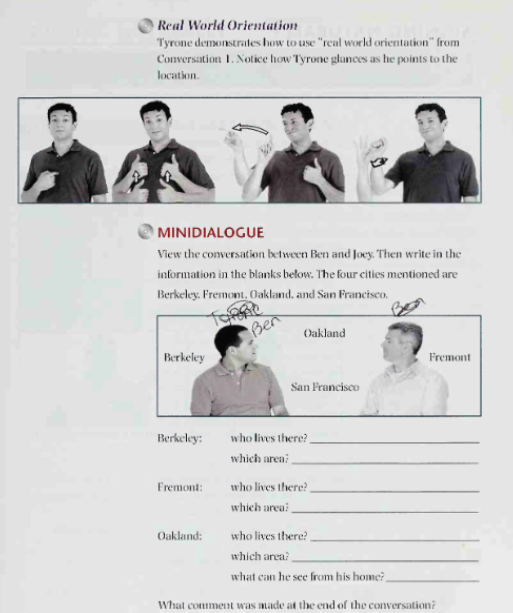
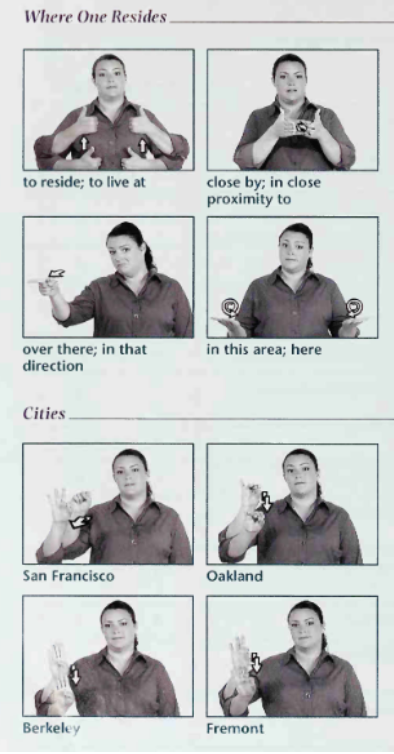
View the conversation between Ben and Joey. Make sure to put the correct information in the blanks below. (3.1)
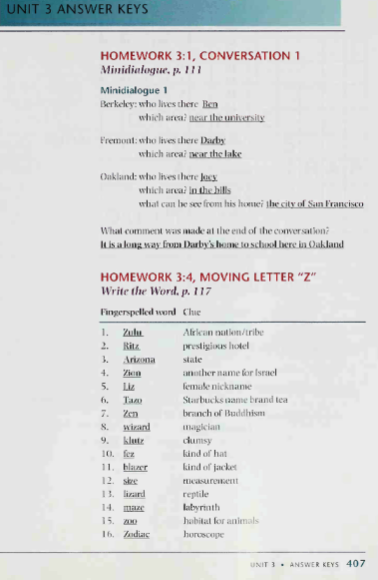
Who lives at Berkeley [ Select ] ["==Ben==", "Beth", "Darby", "Daren", "Joey", "Johnny"]
Who lives at Fremont [ Select ] ["Ben", "Beth", "==Darby==", "Daren", "Joey", "Johnny"]
Who lives at Oakland [ Select ] ["Ben", "Beth", "Darby", "Daren", "==Joey==", "Johnny"]
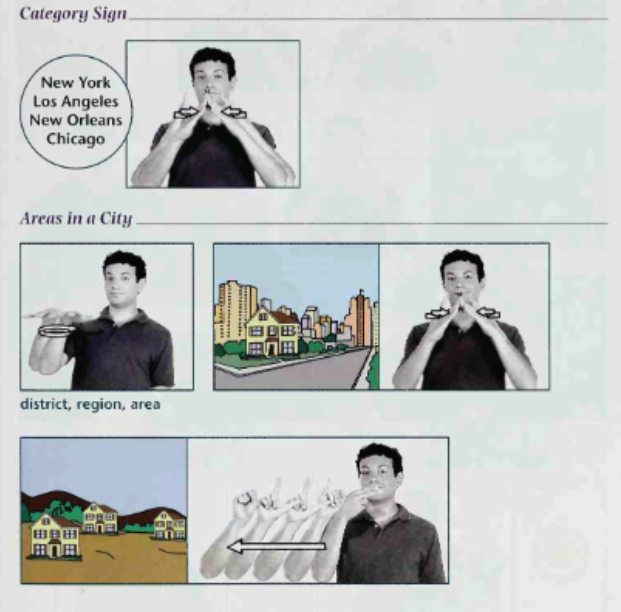
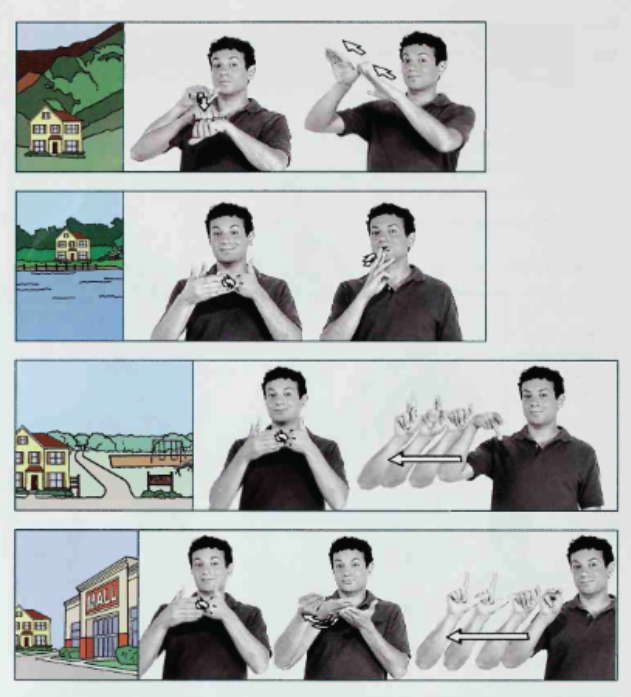
What area does the Berkeley person live? [ Select ] ["==Near the University==", "Near the Lake", "in the hills", "Near town", "Near the park", "Near the mall"]
What area does the Fremont person live? [ Select ] ["Near the university", "==Near the lake==", "In the hills", "Near town", "Near the park", "Near the mall"]
What area does the Oakland person live? [ Select ] ["Near the university", "Near the lake", "==In the hills==", "Near town", "Near the park", "Near the mall"]
What can the Oakland person see from his home? [ Select ] ["==San Fancisco==", "Water", "A Bridge", "San Antonio", "A lake", "The Ocean", "Highway", "Town"]
What was the last comment made at the end of the conversation? [ Select ] ["==It's far from home to school==", "Everything is really close", "Everything is far from his friend", "It's close to home and school"]
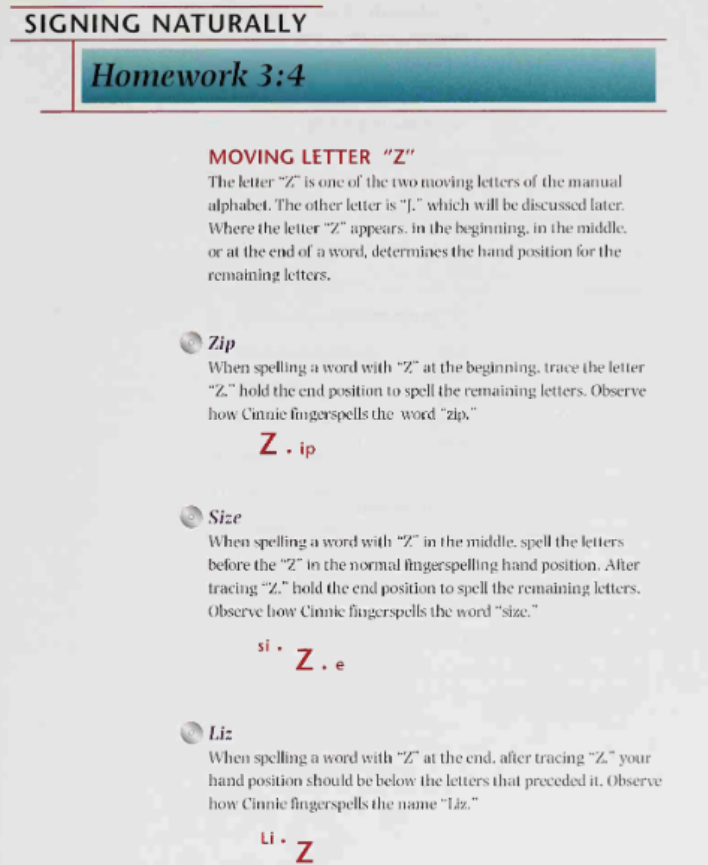
- The letter “Z” is one of the two ___ letters of the manual alphabet: moving. The other letter is J.
- Where the letter “Z” appears, in the beginning, in the middle, or at the end of a word, determines the: hand position for the remaining letters
- When Z is in the beginning: trace the letter “Z” hold the end position to spell the remaining letters
- When Z is in the middle: the letters before the “Z” in the normal fingerspelling hand position. After tracing “Z” hold the end position to spell the remaining letters
- When Z is at the end: After tracing “Z”, your hand position should be below the letters that preceded it.
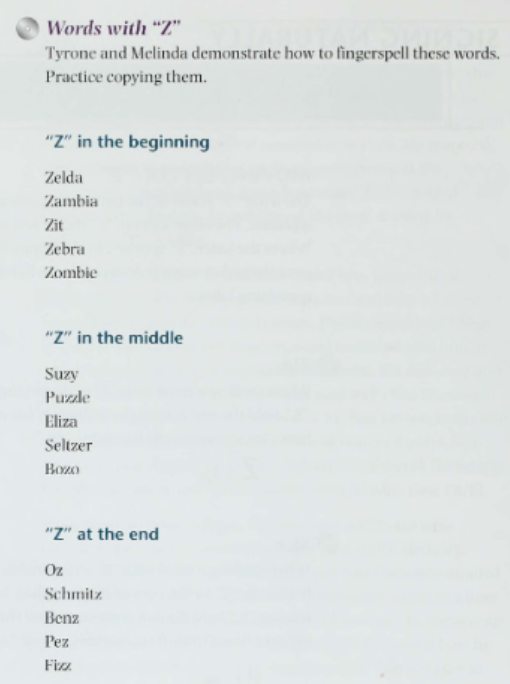
- Words with Z in the beginning: Zelda, Zambia, Zit, Zebra, Zombie,
- Words with Z in the middle: Suzy, Size, Puzzle, Eliza, Seltzer and Bozo
- Words with Z at the end: Oz, Schmitz, Benz, Pez, Fizz, Liz
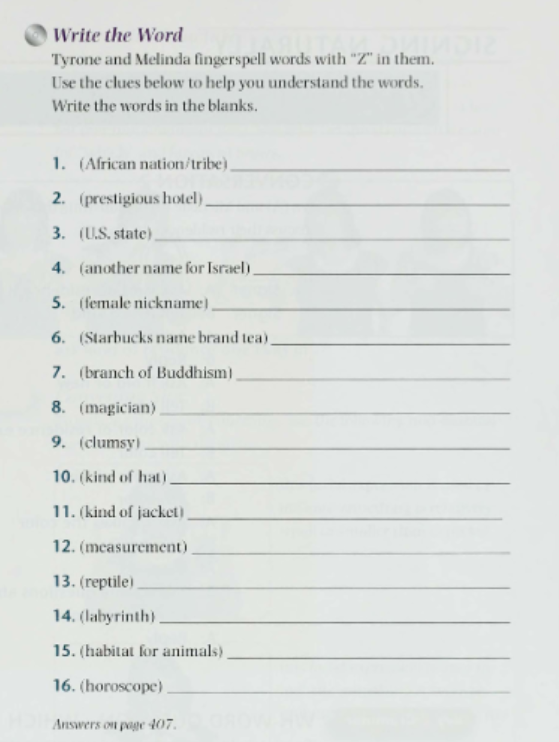
- Zulu
- Ritz
- Arizona
- Zion
- Liz
- Tazo
- Zen
- Wizard
- Klutz
- Fez
- Blazer
- Size
- Lizard
- Maze
- Zoo
- Zodiac
| Question 4 | Part 1 |
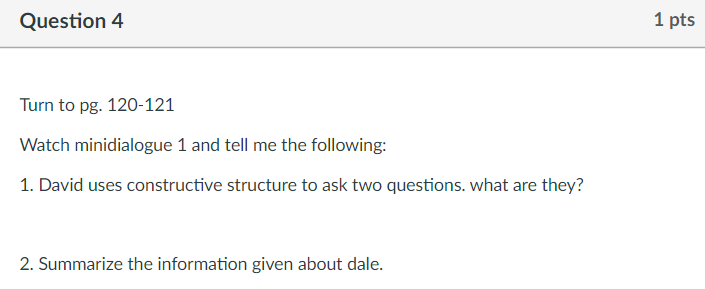
- Which person is Dale?
- Is he wearing an orange shirt?
| Question 4 | Part 2 |
- Dale is a man wearing glasses and an orange shirt
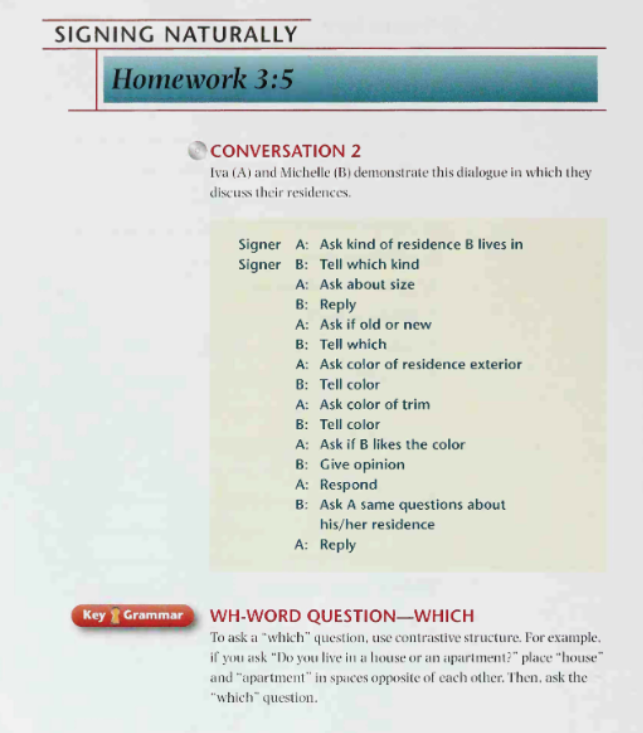
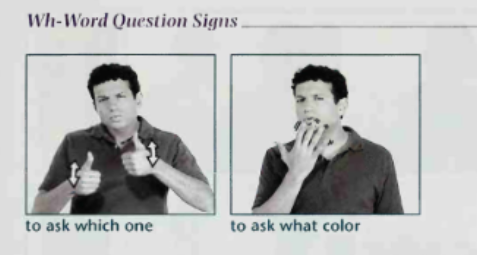
- To ask a “which” question, use: contrastive structure
- Contrastive structure example: If you ask “Do you live in a house or an apartment?” place “house” and “apartment” in spaces opposite of each other. Then, ask the “which” question
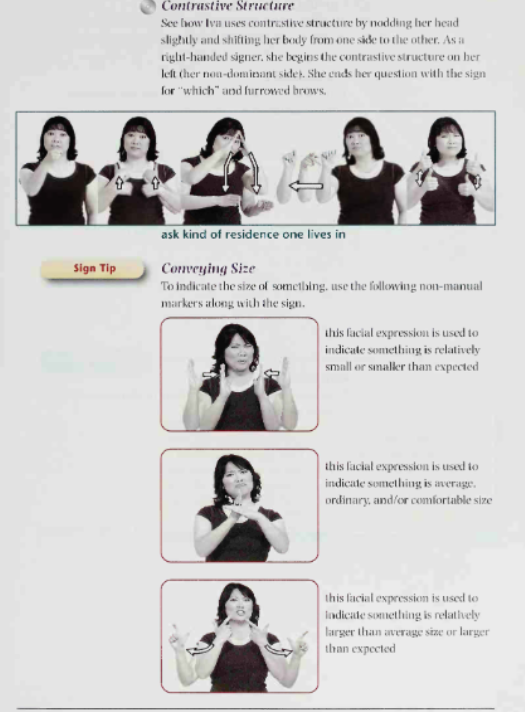
- Head nodding slightly and shifting your body from one side to the other is utilizing: contrastive structure
- A right handed signer would: begin contrastive structure on their left non-dominant side. Then they end their question with the sign for “which” and furrowed brows
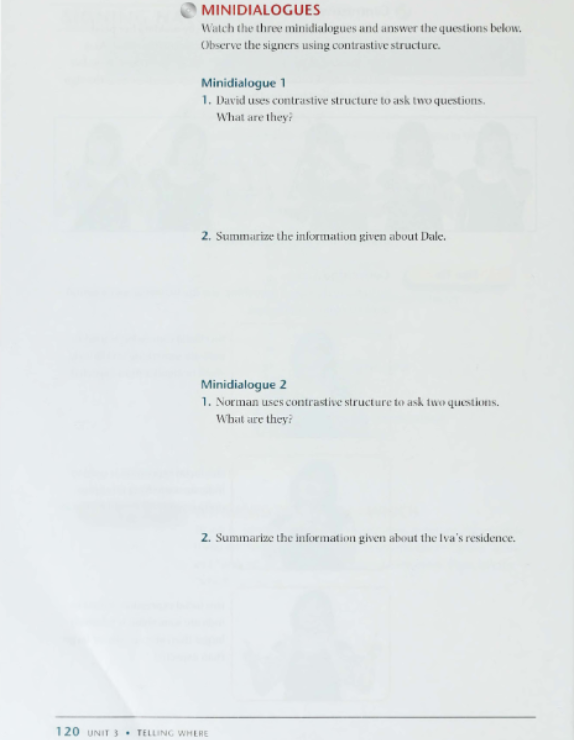
- Converying Size: To indicate the size of something, use the following non-manual markers along with the sign.
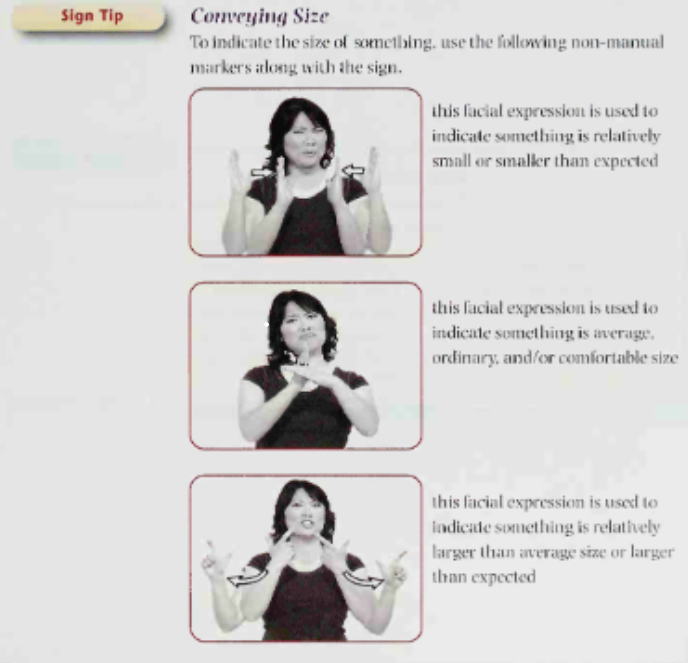
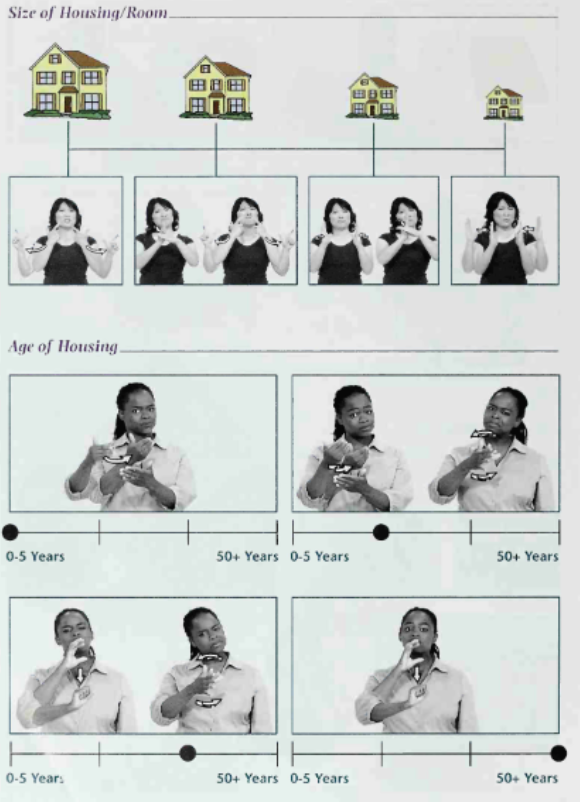
Leaning left, then leaning right and then furrowing your eyebrows is utilizing: contrastive structure
Minidialogue 2 Time Stamp: 3.5 02:54
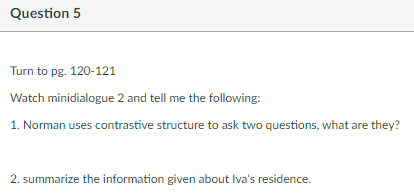
Turn to pg. 120-121
Watch minidialogue 2 and tell me the following:
Norman uses contrastive structure to ask two questions, what are they?: “Do you live in (F sign city (San Francisco?) ) or (I/d (Denver?) (Indianapolis?) sign city), which?” “Is your house green or brown, which?”
summarize the information given about Iva's residence.: Iva lives in the (F sign city) , her house is green and her windows (walls?) are brown, and she wants to paint it pink
Mini Dialogue 3 Time stamp: 3.5 03:51
Turn to pg. 120-121
Watch minidialogue 3 and tell me the following: (3.5 03:51)
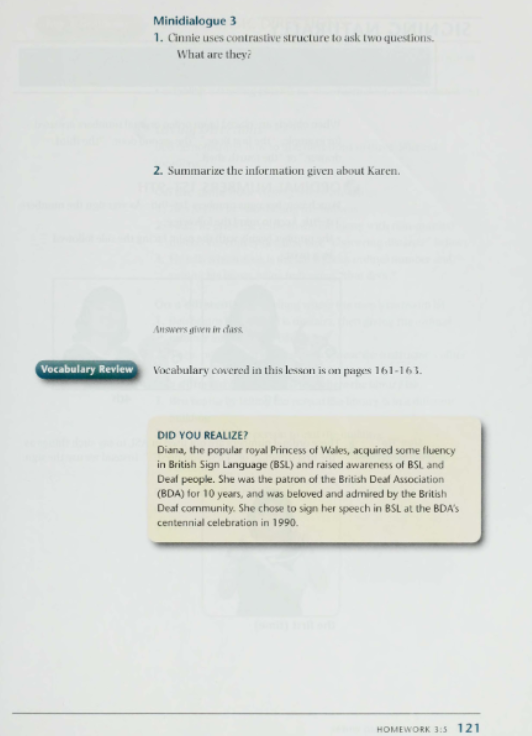
Cinnie uses contrastive structure to ask two questions what are they?
- Does Karen like reading or writing?
- Does she read French or Spanish?
- Summarize the information given about Karen.
- → Karen likes reading and she reads a little bit of French and mostly Spanish.
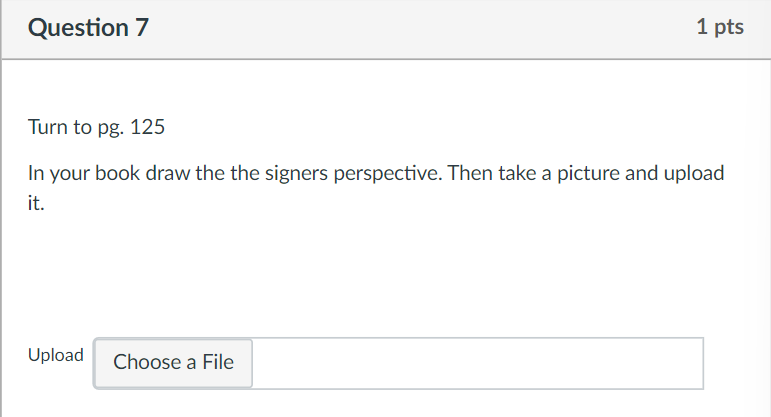
- When objects are placed in an order, _____ are used: When objects are placed in an order, ordinal numbers are used.
- Examples of ordinal numbers include: “the first floor.”, “the second door.”, “the third drawer.”, or “the fourth shelf.”
- Ordinal numbers 1st-9th are signed this way: Ordinal numbers begin with the palm facing the side followed by a twist
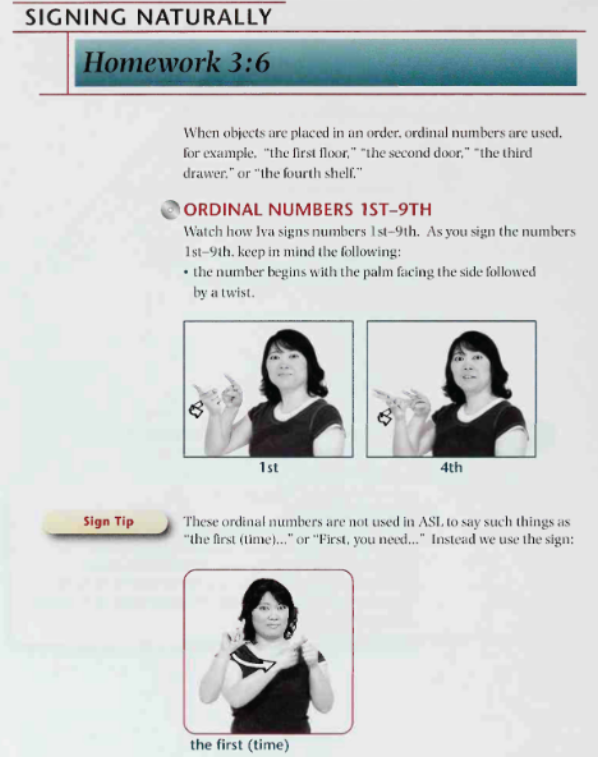
- These ordinal numbers are not used in ASL: Ordinal numbers are not used in ASL to say such things such as “the first (time)…” or “First, you need…” Instead we use the sign “the first (time)
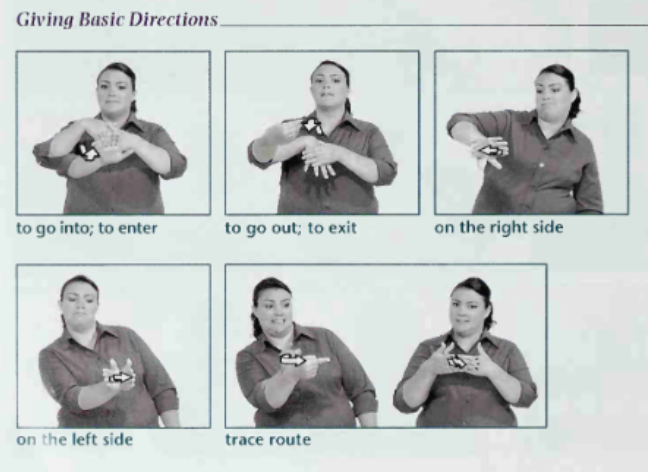
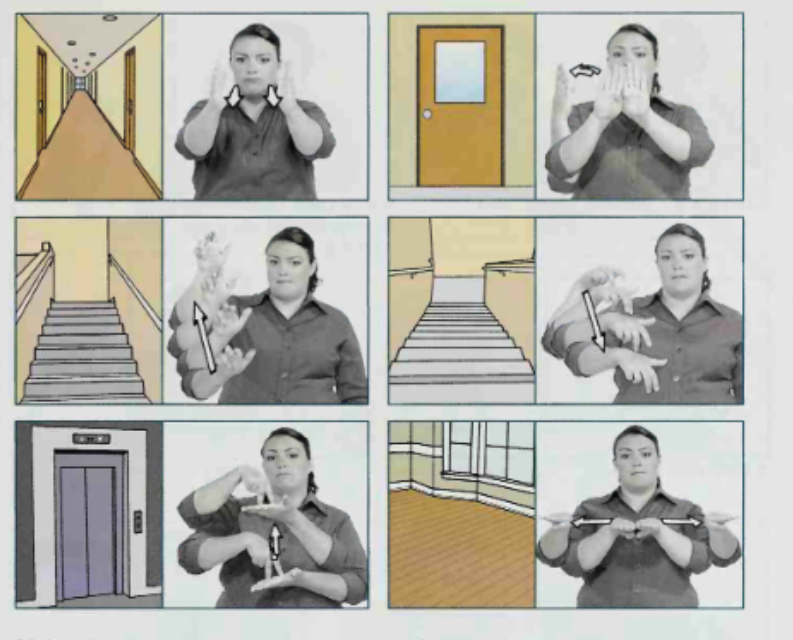
- Do the following to give basic directions to a place: To give basic directions to a place, determine where the place is in relationship to where you are at the moment and establish a starting point (i.e. classroom door, or the main door)
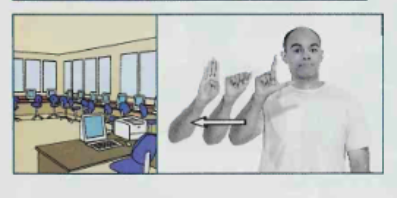
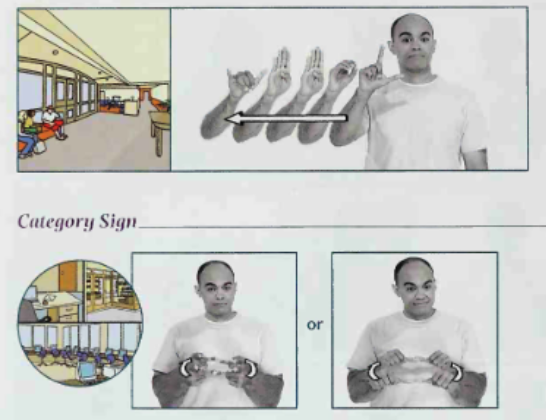
- How to demonstrate giving directions to a lab on the same floor: To demonstrate giving directions on the same floor, begin by establishing the hallway, Then, five the route to the lab along with non-manual markers to convert distance. Afterwards, tell which door is the lab with an ordinal number and raise your brows when indicating “that door.”
- How to demonstrate giving directions to the men’s restroom on a different floor: To demonstrate giving directions to the men’s restroom on a different floor, begin by telling it is upstairs, then giving the ordinal number for the floor. Then, indicate that the restroom is near the instructor’s office.
- How to demonstrate giving directions to the library in a different building: To demonstrate giving directions to the library in a different building, begin by telling the person that the library is in a different building. Next, tell the person to exit the building. Indicate where the library is located using real world reference.
- Utilize this to in the beginning of each demonstration when you name the location and directions: Raise your eyebrows in the beginning of each demonstrating when naming the location you will give directions to
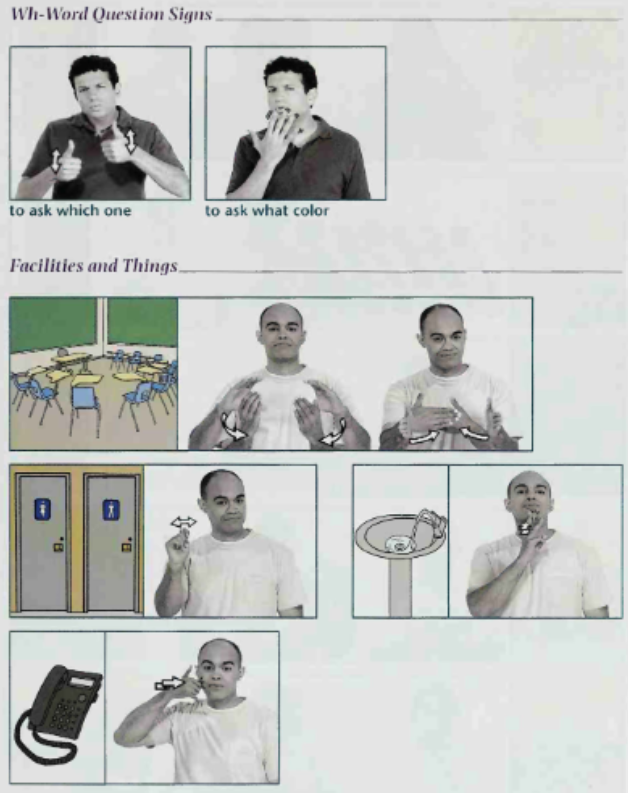
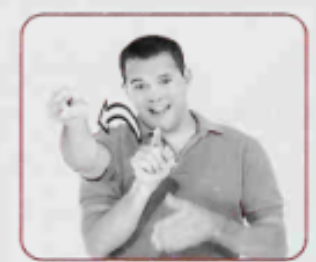
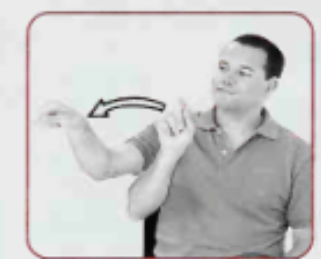
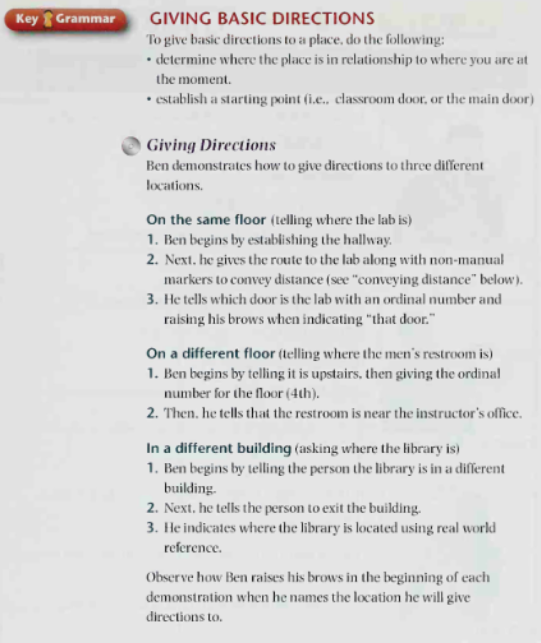
- You can use this to convey distance: You can indicate relative distance with specific non-manual markers- which show “far away”, “moderate distance” or “very near/close.”
- To indicate that something is far away, use these non manual markers (NMMs): TO indicate that a location is far away, use the following non manual markers- tilt your head, squint your eyes, open your mouth slightly, and then tell where something is with your arm fully extended.
- To indicate moderate distance, utilize the following non manual markers: To indicate moderate distance, use the following non manual markers (NMMs)- tilt your head, purse your lips slightly and tell where something is by pointing with your arm moderately extended.
- To indicate that a location is very near, use the following non manual markers (NMMs): To indicate that a location is very near, use the following non manual markers (NMMs)- tilt your head, clench teeth, turn head to the dominant side with cheek almost touching shoulder, tell where something is by pointing with your hand close to your body.
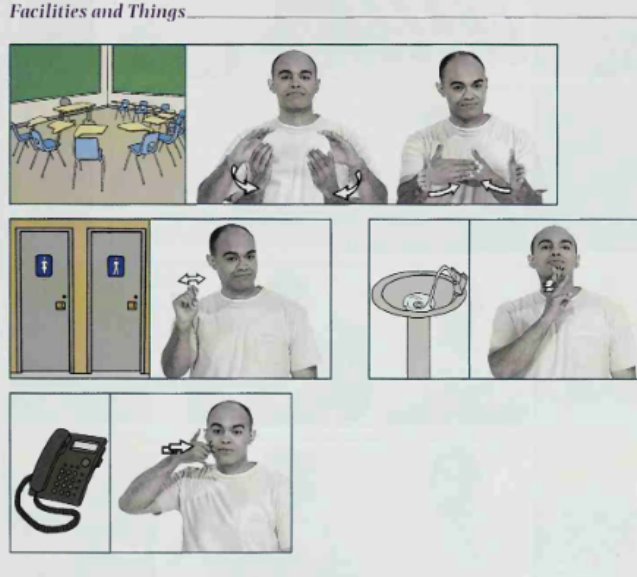
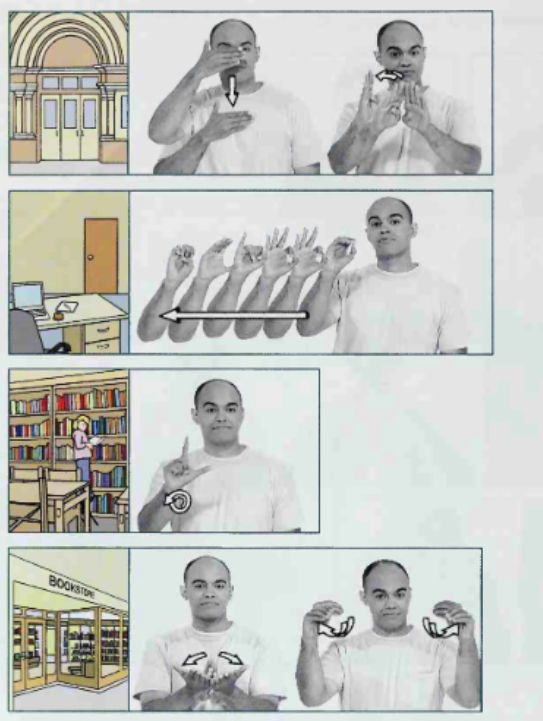
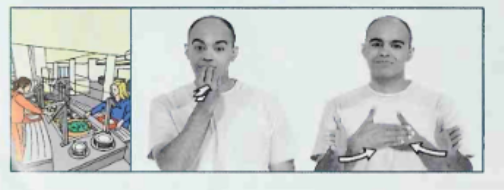
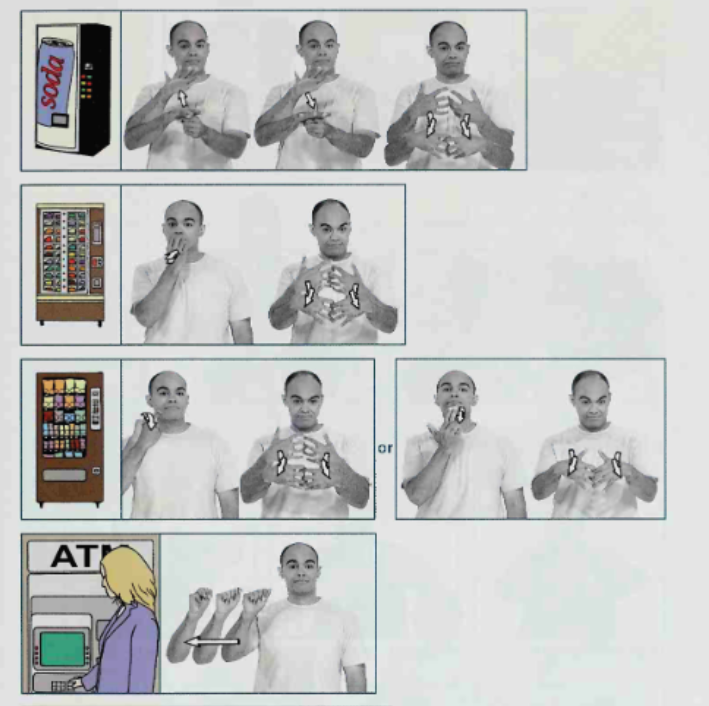
Vocabulary: pages 163-167
Spatial Agreement- Orienting Signs to The Person Being Referred To
- In order to show agreement…: To show agreement, it is important to point to and glance at person you are identifying. To continue to show agreement when sharing information about the person, orient your signs in the direction of the person you are talking about. For example, if you want to share information about yourself and a friend sitting on your right, information about yourself is signed directly in front of your body and information about your friend is signed slightly to the right of your body. To refer to people sitting across from you, sign the information further out in front of you to indicate the information is about the people across from you.
- If you want to share information about yourself: If you want to share information about yourself, information about yourself will be signed directly in front of your body.
- If you want to share information about a friend sitting on your right: If you want to share information about a friend sitting on your right