The Menstrual Cycle
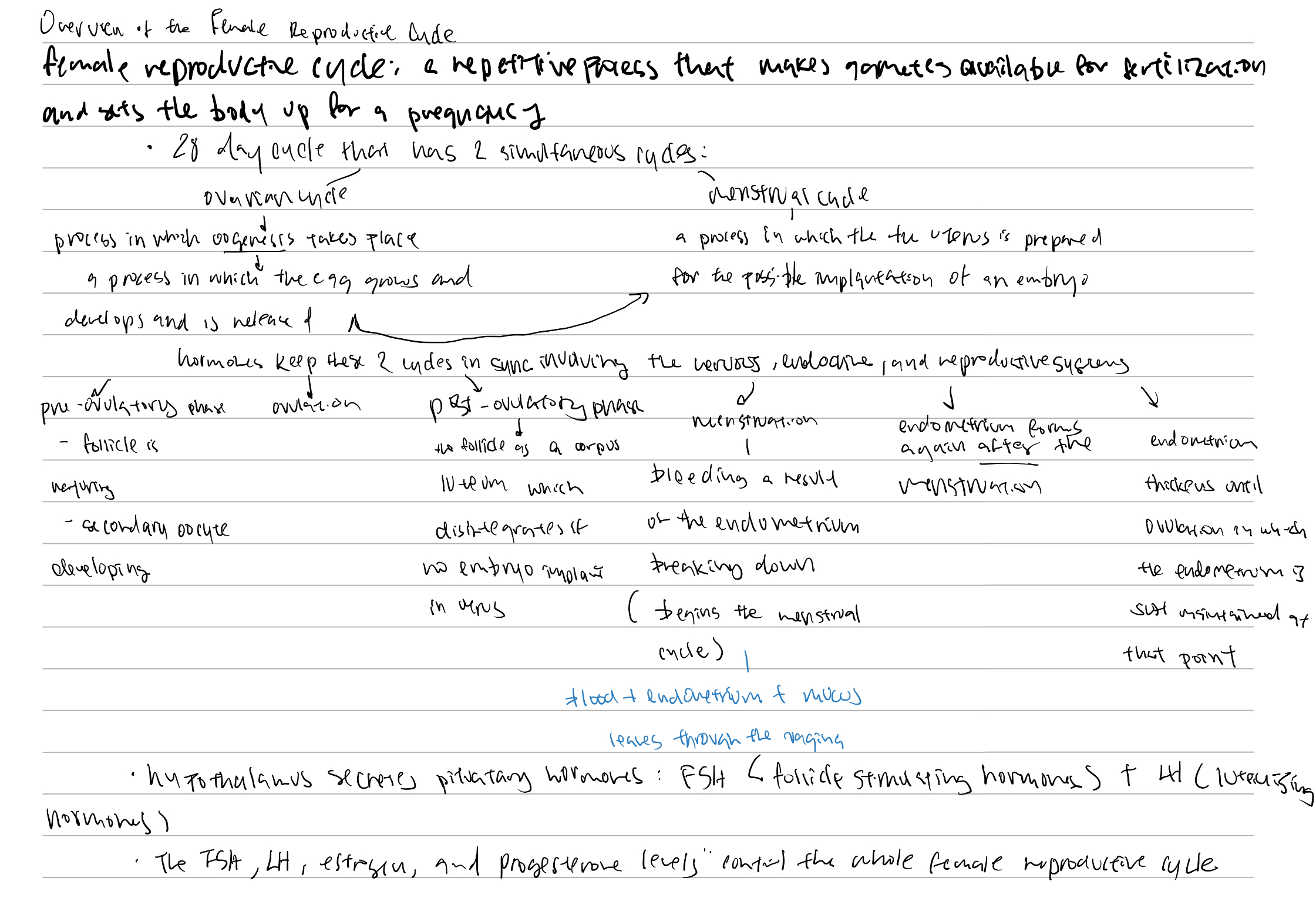
A Deep Dive into the Process of Menstruation:
The start of the menstrual cycle is marked by menstruation (2-7 days). At the same as menstruation, the hypothalamus stimulates the anterior pituitary glands to secrete more FSH and LH.
The follicle stimulating hormone causes another follicle to begin growing. As the follicle begins to grow, more estrogen is released; however, it is still in low levels. The low levels of estrogen keep the levels of FSH and LH low. The rising levels of estrogen cause the endometrium to begin thickening again.
As the time for ovulation approaches, the follicle is big causing the estrogen levels peak stimulating the hypothalamus to release high levels of FSH and LH as well shortly after the estrogen peak.
After all the estrogen, FSH, and LH peak, ovulation begins. The luteinizing hormone causes the oocyte in the follicle to complete meiosis 1, therefore, becoming a secondary oocyte. The luteinizing hormones also cause the enzymes to rupture the follicle —→ release of an egg.
Once the egg is released, the ruptured follicle becomes the corpus luteum that secretes progesterone and estrogen. The endometrium continues to thicken.
With both the progesterone and estrogen, they signal the hypothalamus to tell the pituitary to produce less FSH and LH, so no follicles are growing at this stage. With the lowered LH levels, the corpus luteum starts to degenerate. Unless the embryo implants itself in the uterus, the corpus luteum won’t continue to release estrogen and progesterone. the corpeus luteum will disintegrate a lot faster as compared to if pregnant to which it is slower but will eventually perish.
No embryo is implanted in the uterus; therefore, the corpeus luteum disintegrates, and estrogen and progesterone are not secreted anymore. With low levels of both hormones in the blood, the endometrium is shed, and the hypothalamus is stimulated to create more FSH and LH again.
If the egg is fertilized, the ovarian and menstrual cycle stop while the pregnancy is in progress. The embryo implants in the endometrium, causing a hormone to be released to maintain the corpus luteum which continues to secrete estrogen and progesterone to maintain the endometrium.
contraception prevents pregnancy and are typically taken orally.
way 1: synthetic estrogen and progesterone limit the FSH and LH levels preventing ovulation
way 2: progestin causes cervical mucus to thicken so much that sperm can’t reach the egg, decreases frequency of ovulation, and alters endometrium if fertilization occurs in a way that prevents implantation.
cons: higher chance of some cardiovascular disorders
pros: less chance of ovarian and endometrial cancers, and less mortality chance