Hypoxaemia
Hypoxaemia (low oxygen in the blood) is defined as an arterial partial pressure of oxygen (PaO2) of <80mmHg. This is the concentration of dissolved oxygen in the blood, and can be measured directly via arterial blood gas (PaO2).
The best way to think about hypoxaemia is to think about the travel of oxygen. For oxygen to get to the blood, it needs to get through the upper airway, into the lungs and then diffuse across. The following diagram is adapted from Silverstein and Hopper.
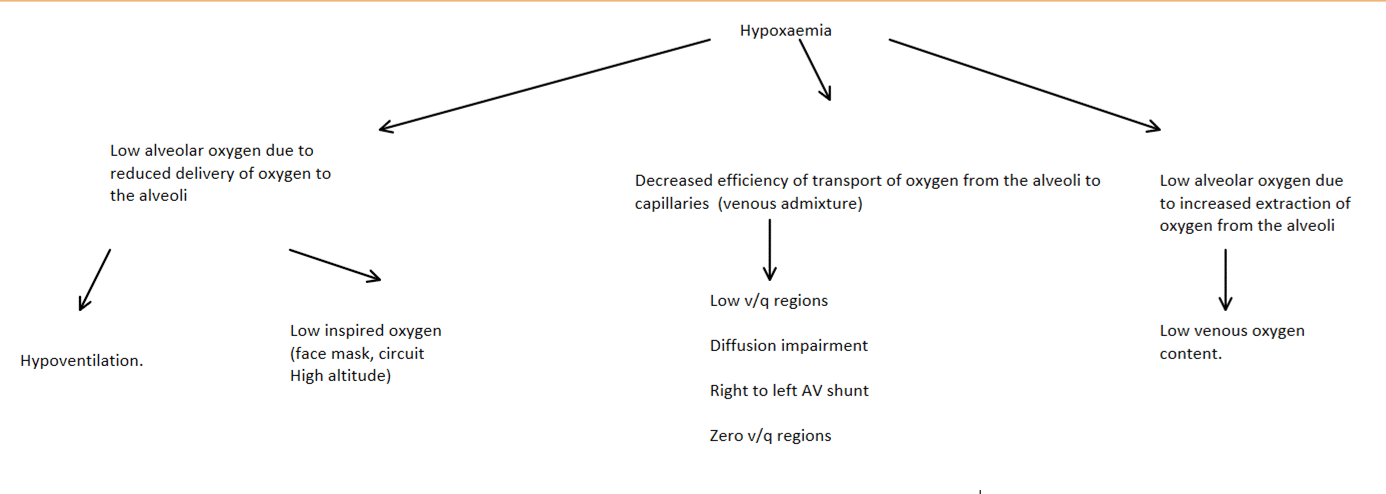
In practice, low venous oxygen content does not contribute to hypoxaemia. And, unless in altitude/using general anaesthetic/using oxygen chamber, low inspired oxygen is not a concern.
Therefore, a revised diagram would be:
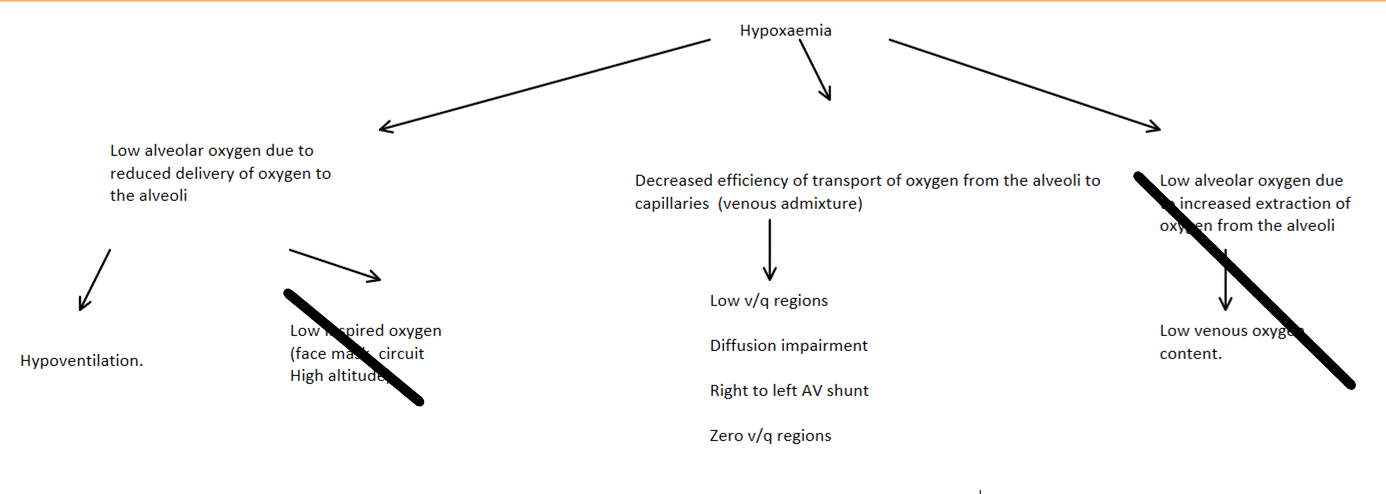
So the common causes of hypoxaemia are either hypoventilation or venous admixture.
What is venous admixture?
A venous admixture is all ways in which venous blood can get from right side to left without being properly oxygenated.
Ventilation (V) to Perfusion (Q) ratios are normally ~1:1 in a healthy lung.
Parenchymal disease (most common)
If the oxygen can’t get there to be diffused due to pus/water/haemorrhage etc
Diffusion defects
Oxygen can get to the lung but can’t diffuse across as well due to thickened diffusion barrier
Think of oxygen toxicity, smoke inhalation, acute respiratory distress syndrome (ARDS)
Right to left shunts
PDA, VSD
So considering a hypoxaemic patient, the common causes are hypoventilation or parenchymal disease.
i.e. if a patient is hypoxaemic in room air and has a normal or low PaCO2, you can infer that venous admixture is occurring and is likely parenchymal disease.
Why does a patient become hypoxaemic due to hypoventilation?
Hypoventilation leads to a decrease in Alveolar Minute Ventilation – a decrease in delivery of oxygen to the alveoli and then the blood. Hypoventilation always causes hypercapnia (high PaCO2), so any patient with elevated PaCO2 is hypoventilating regardless of its pulmonary function.
Increasing inspired oxygen will treat hypoxaemia due to hypoventilation (important to note that it will NOT fix the hypoventilation).
Why?
We cannot measure the gases directly from the alveoli. However, we can calculate the partial pressure of gas in alveoli. If the patient is breathing normal room air (21% oxygen and 79% nitrogen), at sea level, the partial pressure of gases in the alveoli is constant and it is divided into the following:
Water vapour 50mm Hg
CO2 40mm Hg
Oxygen 105mm Hg
Nitrogen 560mm Hg
As there is continuous transfer of oxygen from the alveoli to the blood stream and transfer of carbon dioxide from blood stream to alveoli, with reduced ventilation the partial pressure of CO2 in the alveoli will increase and the partial pressure of O2in the alveoli will decrease.
If CO2 would increase to 60 (60-40 = 20), as the total partial pressure of gases in the alveoli must remained the same, the partial pressure of oxygen will decrease on the same magnitude (105-20) = 85 → hypoxaemia.
This is because nitrogen and water vapour are not utilised in the body, so their partial pressure does not change when the patient is breathing room air.
When you supplement the patient with 100% oxygen (100% oxygen and 0% nitrogen) – the nitrogen is slowly eliminated.
So the nitrogen would decrease to near zero and the oxygen could theoretically get to 665mm Hg (we see PaO2 of 500mg in our ventilated patients with no lung disease).