Performance U-joints
High Performance U-joints
U-joints are critical components in high-performance drivetrains; strength is essential to handle engine torque.
Performance U-joints are strengthened by:
Thicker trunnion design and construction
Heat-treating and hard forging of materials
Racing U-joints often:
Relocate the grease fitting to the end of the bearing caps
Or eliminate grease fittings entirely
Removing or relocating the grease fitting eliminates the need for a hole in the U-joint body, improving strength.
U-joint Design Modifications
Solid Body
Performance U-joints combine advanced metal technology and racing experience to increase durability and longevity.
U-joint body is made of heat-treated, forged metal.
A solid U-joint body maximizes strength against engine torque.
Many performance U-joints are rebuildable, contributing to longer service life compared to stock U-joints.
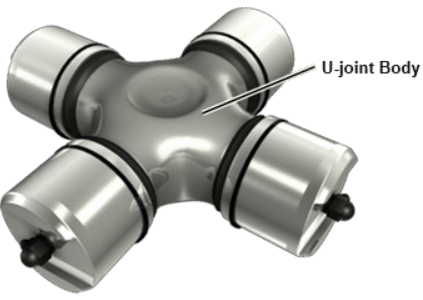
Stronger Trunnion Body
Trunnion refers to both the cross of the U-joint and the ends covered by the caps.
Racing U-joint trunnions are typically solid designs.
Since grease zerks are in the caps, trunnions do not have grease passages, which strengthens the U-joint.
Lubricating grease flows through the end of the U-joint cap to the brass bushings.
Trunnions can be micro-polished to remove abnormalities from the needle-bearing surface, prolonging U-joint life.
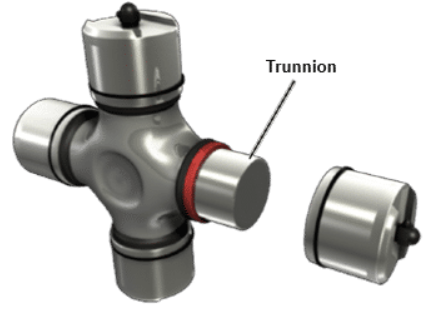
Stronger Bearing Surface
Strengthened bearing surfaces sometimes use brass bushings instead of needle bearings.
High-quality grease is used to pre-lubricate the unit before assembly with the driveshaft.
During a U-joint rebuild, replace if necessary:
Seals
Clips
Bushings
Needle bearings are used depending on the application.
In such cases, U-joints are periodically replaced before the needle bearings wear out.
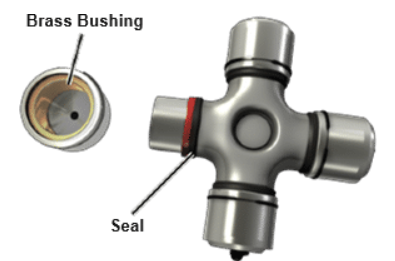
Performance U-joint Design Improvements
Materials
Performance U-joints are made from high-strength steel and then heat-treated.
Some manufacturers further increase strength by cryogenically freezing the trunnion.
Cryogenically frozen metals are stronger than non-frozen metals because:
Molecules compact tightly in the frozen state
Gaps between molecules are tightened, improving overall strength
Seals - Overview
Seal failure can cause major damage due to loss of lubrication.
Teflon is added to seals to enhance strength and pliability, even under extreme conditions.
Clips that fully encircle the U-joint trunnion hold the seal in place, ensuring proper lubrication.
The trunnion is thicker, enabling it to handle larger amounts of engine power
Materials
High-performance U-joint seals are made of waterproof rubber.
Feature an outwardly facing angular groove to trap debris and prevent it from entering the U-joint.
Include a two-seal system:
Primary seal: prevents debris from entering
Secondary seal: prevents lubrication from exiting the U-joint
Needle Bearing - Overview
Needle bearings provide a continuous rolling surface and require lubrication for maximum life.
Typically roll within a case to provide support and alignment.
In certain applications, needle bearings may be more durable than brass or bronze bushings.
Application-specific considerations determine whether to use bearings or bushings.
Neither roller bearings nor bushings are a universal solution for all driveline applications.
Materials
U-joint bearings are located in the bearing caps.
Needle bearings are typically made of high-strength steel rollers.
In some applications, bushings replace needle bearings.
Bushings are made of brass or bronze, similar to engine crankshaft or rod bearings.
Bearings and bushings are not interchangeable and must be used according to application requirements.
Applications - Overview
Performance U-joint applications vary depending on:
Intended vehicle use
Associated driveline components
Racing vehicles upgrade U-joints to handle higher engine power.
Regular rebuilding and replacement of U-joints ensures proper functioning on race day.