biology 9
terms:
individual organisms - each individual organism
species - the same organisms
populations - a group of organisms of the same species living in the same area at the same time
habitat - where the organism lives
communities - all the populations living in the same area at the same time → within a community the species are interdependent and rely on each other for food, shelter, pollination, etc.
diversity
benefits of diversity - keeps the global ecosystem in balance which is important for food, medicine, water and gdp
increases stability of ecosystem → any changes are less likely to have adverse effects
many species provide a specific service, e.g. pollination
many of our medicinal drugs come from wild species
effects on biodiversity:
fish farming - increase available food however can be more expensive and reduce cheaper wild fish
eutrophication:
fertiliser (containing nitrates and phosphorus) from fields runs into ponds/rivers (via leaching) → promotes excessive algal growth → blocks sunlight = less photosynthesis → less oxygen → plant and animal death → less oxygen (also decomposers use up oxygen). this affects the water and therefore crops and people/animals
what is leaching → dissolved mineral ions flowing through soil into bodies water
why do we use fertilisers in agriculture? to replace nutrients in the soil lost through farming
introduction of non-indigenous species - can kill crops which aren’t immune as well as plants or animals which could disrupt the ecosystem thus crops
what are hedgerows and field margins? they provide extra habitats and nutrients so that more species can thrive
what can the government do to prevent harm to the environment from agriculture? prevent or require certain things, pay businesses for doing certain things,
human impacts on diversity:
due to the rapid growth of the human population, there is more waste being produced as well as more resources being used, this can pollute the land, water and air.
water pollution → most caused by sewage from cities and eutrophication/agricultural runoff
air pollution → most caused by smoke and gases from combustion/fossil fuels
land pollution → most caused by landfill and nuclear waste
interdependency
there are two types of interdependent relationships: parasitism and mutualism
parasites are organisms that are adapted to live very closely with another species, known as the host
the parasite lives either on or in the body of the host
the parasite gains resources (i.e. what it needs in order to survive) from the host
this can include, food, shelter and a suitable location to reproduce (where offspring can feed and grow)
the host doesn't get any benefits from this relationship and is often harmed in some way
a mutualism is a type of relationship between two species within a community, where both organisms benefit in some way
for example, bees and many species of flowering plants have a mutualistic relationship
bees gain nectar (i.e. food to provide them with energy) from flowers
when bees visit flowers, pollen is transferred to their bodies
as bees visit multiple different flowers, they spread the pollen to these flowers, pollinating them
in this way, the flowers gain help in reproducing
ecosystem - all the biotic and abiotic factors that interact within an area at one time → abiotic are non-living factors and biotic are living,
→ the biotic and abiotic factors interacting can change the size and distribution of species, a major thing that affects this is pollutants
light intensity - more light leads to more photosynthesis and thus more plant growth
temperature - affects the rate of photosynthesis in plants
water levels - plants and animals need water to survive
soil pH and mineral content - different plants are adapted to different mineral contents and pH
wind speed/direction - affects the rate of transpiration and thus photosynthesis
carbon dioxide levels - affects rate of photosynthesis
oxygen levels for aquatic organisms - some can only survive in high (or even low) oxygen levels
availability of food - more organisms are able to survive and reproduce so their populations can grow
new predators - new predators could unbalance the relationships between current predators and prey
new pathogens - if new pathogens enter, they won’t have immunity and the species will decline or even be fully wiped out
competition - through competition, species can outcompete each other, could completely wipe out a species
trophic levels/energy transfer
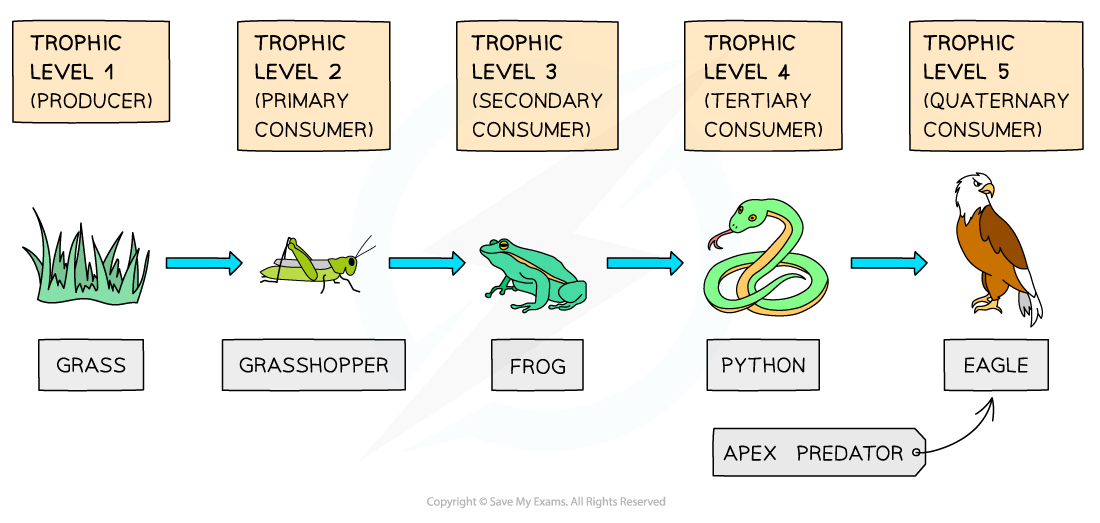
the sun is the original source of energy for nearly all life on earth → producers → primary consumers, etc.
during each step of the trophic level, energy is transferred partially to the next trophic level where it is stored as biomass, and partially to less useful stores such as respiration, heat. this means that as the energy transfers up each trophic level the biomass decreases. only around 10% of the biomass is passed to the next trophic level until eventually all energy has been transferred to non-useful stores, e.g. life processes.
why is only ~10% of biomass transferred to the next trophic level?
the animal may not eat all of the biomass of the previous trophic level
the animal may not absorb all of the biomass of which they eat, e.g. excretion
lots of biomass that’s absorbed is used to release energy, e.g. respiration/movement

calculations:
efficiency of energy transfer = biomass in higher trophic level/biomass in lower trophic level x 100 → usually close to 10%
transects and quadrats:
how to use a quadrat to measure abundance
place tape measures along the length + width of the field (forming a large grid)
randomly generate x pairs of random coordinates
place quadrats at those coordinates and count how many X are found in each quadrat.
calculate the mean number of X per m^2.
estimate the total population size using our mean number of X per m^2 times the total area of the field
how to use a transect to find distribution (for more representative data)
a transect line (tape measure) is laid out in a straight line between the X and X places
X quadrats are placed at regular intervals along the transect line
the distribution of X is measured by counting the number of X in each quadrat along the transect line, (from the lake to the woodland)
repeat this using new transect lines (parallel to the first).
indicator species:
bloodworm - indicate high levels of water pollution as they thrive in adverse, low oxygen conditions
sludge worm - indicate high levels of water pollution as they thrive in adverse, low oxygen conditions
freshwater shrimp - need very clean water to survive
stone fly larvae - will only be laid on clean water as they need very clean water to survive
black spot fungus on roses - blackspot fungus are very sensitive to sulphur dioxide, if there are very high levels in the air then they will not be able to grow - sulphur dioxide is present in polluted air as well as acid rain → sulphur dioxide dissolves into rain to make sulphuric acid
lichen:
bushy lichens need very clean air to survive
leafy lichens can survive in moderately clean air
crusty lichens can survive in very clean air
food security
food security - when all people at all times have physical and economic access to safe, sufficient and nutritious food and is sustainable for the planet into the future → we must meet this without compromising the ability to meet this in the future
conflicts - disrupt production and transportation and make food prices rise
increasing human population - more people increases demand and supply can’t necessarily meet the increase
increasing animal farming and fish/meat consumption - compared with plants is much more expensive and some can’t afford meat, however more meat being grown means less plants
impact of new pests and pathogens - can wipe out plants and food, decreasing food security
environmental change caused by human activity - can wipe out plants and food, decreasing food security
sustainability issues - use of land for biofuel and cost of agricultural input means less food grown globally, decreasing food security
decomposition
what is decay? breakdown of organic matter by decomposers
the best temperatures for decomposition are roughly 10-40 degrees, at colder temperatures decomposing organisms will be less active, thus the rate of decomposition remains low. this is why we keep food in a fridge/freezer. as the temperature increases, decomposers become more active and the rate increases. at extremely high temperatures decomposers will be killed and decomposition will stop
with little or no water there is less decomposition because decomposers cannot survive. As the volume of available water increases, the rate of decomposition also increases. many decomposers secrete enzymes onto decaying matter and then absorb any dissolved molecules. without water these reactions cannot occur. this is why we can dry meat to preserve it or salt/sugar it because it draws moisture out from the food. also decomp is a chemical reaction and can’t occur without water. with too much water, the soil becomes waterlogged and there is not enough oxygen within the soil so the decomposers die/carry out less aerobic respiration and have a lower rate of reaction
decomposers need oxygen to survive and without it there is little or no decomposition because they are aerobic. oxygen is needed for many decomposers to respire, to enable them to grow and multiply. this is why we can package salad in nitrogen gas or can/vacuum pack
composting is decaying bio material (garden or food) waster, which can then be used as a fortifier for other crops as it contains all the mineral ions that were contained within the waste, good compost will be oxygenated well, good temperature and the right amount of moisture
detritus feeders - small animals like worms and woodlice that feed on dead organic matter |
decomposers - microorganisms, such as bacteria and fungi |
calculations:
mean rate of decomposition = mass lost/number of days
measured in grams/day
cycles → water/nitrogen/carbon
nitrogen cycle
nitrogen is needed to make proteins, however while there is nitrogen in our atmosphere, plants and animals can’t access it in the air → plants uptake it from the soil while animals eat it but only when it is in nitrate form
lightning - nitrogen fixation via lightning converts atmospheric nitrogen into AMMONIA and NITRATES by making nitrogen gas (N2) combine with water to form ammonia (NH3) and nitrates (NO3) → then carried to the ground by precipitation
nitrogen fixation (bacteria) - the process in which NITROGEN GAS is converted to AMMONIA in the soil by nitrogen fixing bacteria (found in soil (free-living/non-symbiotic) or in plant root nodules of leguminous plants (symbiotic bacteria)) = ammonification
nitrification - aerobic, nitrifying bacteria convert ammonia into the soil to nitrates
ammonia → (nitrosomonas) → nitrites → (nitrobacter) → nitrates
denitrification - carried out by anaerobic bacteria (denitrifying bacteria) (often in waterlogged soils) → they use nitrates as a food source and release nitrogen gas
decomposition - (by decomposers) produces ammonia from the breakdown of amino acids and proteins
assimilation - process of plants using nitrogen to build biological molecules which is then incorporated into the plants ‘body’
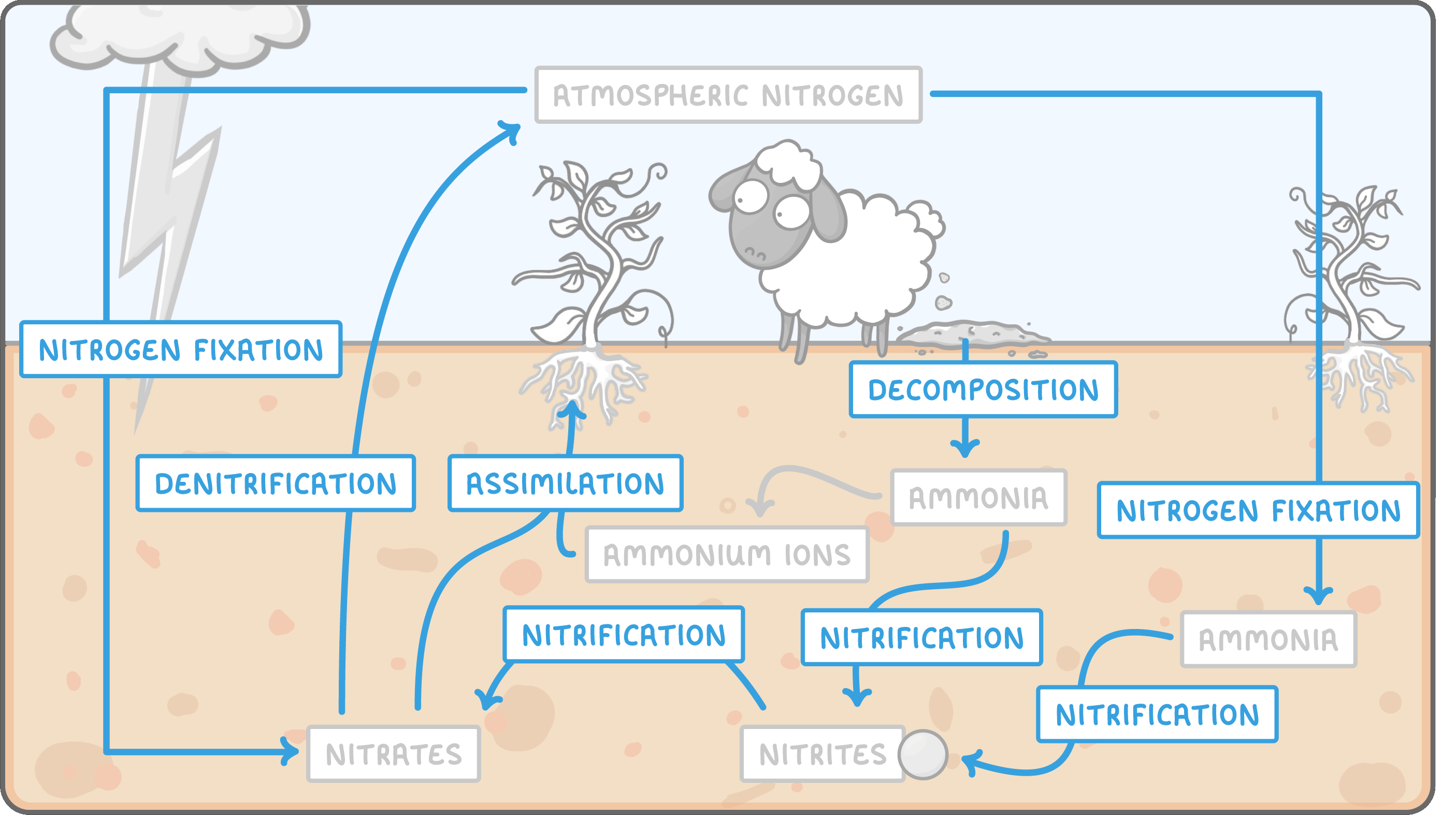
agriculture - nitrogen content of the soil will steadily decrease as crops are harvested rather than decomposed back into the soil (causes plant deficiency and poor growth)
we could use nitrate fertilisers however these are bad for the environment so we use manure or crop rotation
crop rotation - different crops grown on a field during different years - one of the crops is likely to be a nitrogen fixing plant because these increase nitrogen levels in the soil
carbon cycle
carbon is abundant (found in majority of things → rocks, animals, plants, soils, trees) in the air which plants use for food through photosynthesis (autotrophs)
this makes glucose, which can be stored as starch, cellulose, sucrose, for energy or respiration
heterotrophs then feed on this as well as respiration so some carbon dioxide can return to the atmosphere
said heterotroph dies and is eaten by decomposers which also respire
there is also carbon in fossil fuels which we burn
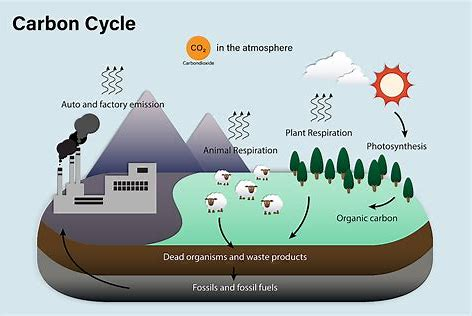
fast carbon refers to plants through photosynthesis makes sugar and carbs and is eaten, slow carbon refers to the integration of carbon in the atmospheres and oceans and human impact is how we change the process by taking the pools and burning it for fuel (from fossil fuels in ground, to atmosphere)
water cycle
the earth is a closed system which means energy can enter and leave the system but matter cannot → thus materials cycle through abiotic and biotic factors in an ecosystem
after this some is absorbed by living organisms (it then later returns to the system) and the rest returns to bodies of water
desalination
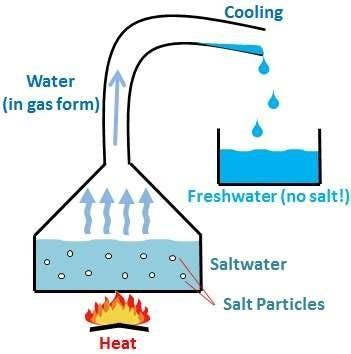
reverse osmosis desalination, salt water is forced through a partially permeable membrane by high pressure, the salt and other impurities can't get through the membrane
more commonly used is reverse osmosis distillation → reverse osmosis desalination, salt water is forced through a partially permeable membrane by high pressure, the salt and other impurities can't get through the membrane