TCP Congestion Control
Goals
Efficiency
High link utilization and low latency
Fast re-convergence upon the arrival/completion of a flow
“Distributedness”
The algorithm must operate without central coordination
Fairness
Split bandwidth proportionally between flows
Many ways to define fairness for more than 2 hosts
Max-min fairness - increase of the bandwidth of a flow, does not decrease the rate of a smaller flow
Approaches Towards Congestion Control
End-End Congestion Control
No explicit feedback from network
Congestion inferred from observed loss, delay
Approach taken by TCP
Network-Assisted Congestion Control
Routers provide direct feedback to sending/receiving hosts with flows passing through congested router
May indicate congestion level or explicitly set sending rate
TCP ECN, ATM, DECbit protocols
TCP Sending Behaviour
roughly - send cwnd bytes, wait RTT for ACKS, then send more bytes
TCP rate ~~ cwnd/RTT (bytes/sec)
TCP sender limits transmission - LastByteSent- LastByteAcked < cwnd
cwnd is dynamically adjusted in response to observed network congestion (implementing TCP congestion control)
AIMD
Senders can increase sending rate until packet loss (congestion) occurs, then decrease sending rate on loss event
Sawtooth behaviour - probing for bandwidth
Additive Increase - increase sending rate by 1maximum segment size every RTT until loss detected
Multiplicative Decrease - cut sending rate in half at each loss event
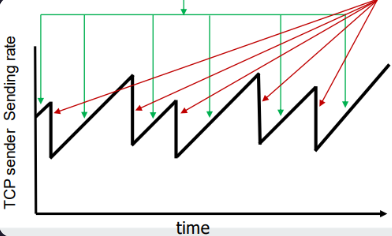
Multiplicative decrease detail: sending rate is
Cut in half on loss detected by triple duplicate ACK (TCP Reno)
Cut to 1 MSS (maximum segment size) when loss detected by timeout (TCP Tahoe)
Why AIMD?
AIMD – a distributed, asynchronous algorithm – has been shown to
Optimise congested flow rates network wide
Have desirable stability properties
TCP Slow Start
AI - cwnd +=MSS every RTT
Need to wait several RTT to reach link capacity if high RTT or a fast link
When connection begins, increase rate exponentially until first loss event:
Initiall cwnd = 1 MSS
Double cwnd every RTT
Done by incrementing cwnd for every ACK received
Summary - initial rate is slow, but ramps up exponentially fast
From Slow Start to Congestion Avoidance
When should the exponential increase switch to linear?
When cwnd gets to 1/2 of its value before timeout
Implementation:Variable ssthresh
On loss event, ssthresh is set to 1/2 of cwnd just before the loss event
TCP CUBIC
Is there a better way than AIMD to “probe” for usable bandwidth?
Insight/intuition
Wmax: sending rate at which congestion loss was detected
Congestion state of bottleneck link probably (?) hasn’t changed much
After cutting rate/window in half on loss, initially ramp to to Wmax faster, but then approach Wmax more slowly
K - point in time when TCP window size will reach Wmax
K itself is tuneable
Increase W as a function of the cube of the distance between the current time and K
Larger increases when further away from K
Smaller increases (cautious) when nearer K
The Congested 'Bottleneck Link'
TCP (classic, CUBIC) increase TCP’s sending rate until packet loss occurs at some router’s output - the bottleneck link
Understanding congestion - useful to focus on congested bottleneck link
Insight - increasing TCP sending rate will not increase end-end throughout at congested bottleneck, which is already transmitting at full rate, R
Multiple flows collectively congest the bottleneck link
Each executes its own TCP congestion control
Each of N flows should ideally receive a throughput of R/N
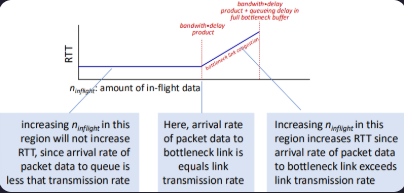
Keeping the Pipe just Full Enough
Keep bottleneck link busy transmitting, but avoid high delays/buffering
Measured throughput = # bytes sent (inflight) in RTT interval / RTT
Ideal amount of inflight data for a connection = connections share of bottleneck bandwidth * min RTT