Photosynthesis
Photosynthesis reaction
carbon dioxide + water light = glucose + oxygen
Endothermic reaction as light energy is taken from surroundings
*Photosynthesis takes place in the the leaves of the plant.
Leaves contain the green chemical chlorophyll which absorbs light energy.
Rate of photosynthesis
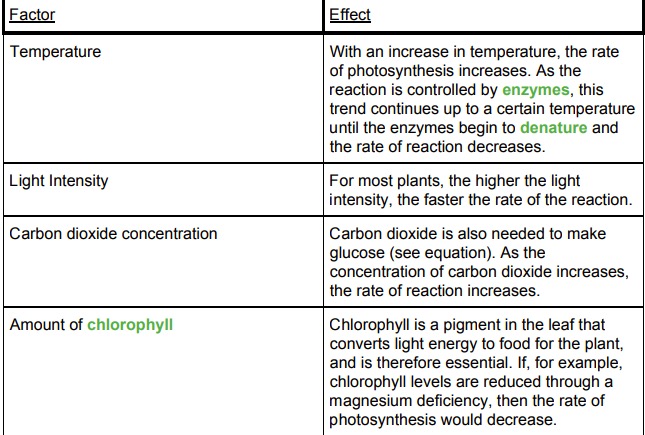
These factors interact and any one of them may be the factor that limits (Something that stops a process from happening any faster) photosynthesis.
Farmers can use the knowledge of limiting factors to enhance the conditions in the greenhouse for a greater rate of photosynthesis. This will increase growth leading to increased profits.
REQUIRED PRACTICAL 6
Inverse square law- Relationship between two factors which involves one increasing whilst one decreases
light intensity=1/distance 2
Example- At 0.25 m:
0.25² = 0.0625
1 ÷ 0.0625 = 16At 0.50 m:
0.50² = 0.25
1 ÷ 0.25 = 4When the distance doubles (0.25 m to 0.50 m), the light intensity decreases to one quarter (16 to 4) due to the inverse square law.
As light intensity decreases, light becomes the limiting factor. Less energy is available for photosynthesis, so the rate decreases.
Uses of glucose from photosynthesis
Glucose used for respiration which is done in the mitochondria.
Produce the insoluble storage molecule starch which can be converted into glucose for the plants to use at night where there is no light.
Produce fat or oil for storage.
Used to produce cellulose which is used to strengthen the cell wall.
Combined with nitrate ions from the soil to form amino acids which produces proteins.