Social Health and Social Networking
Social Health

Articulate Content Library
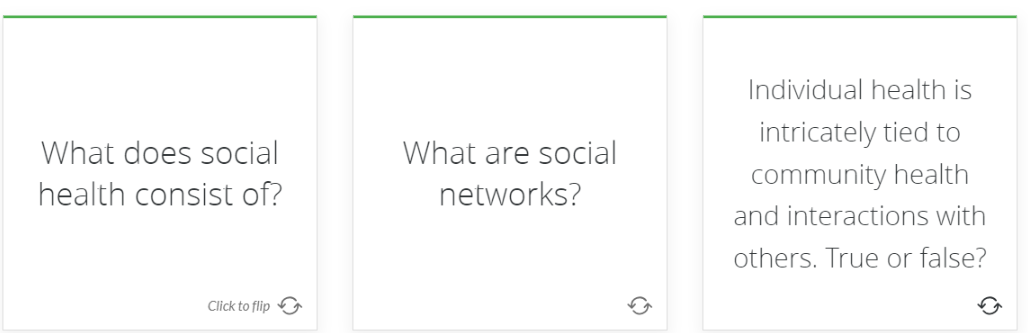
One of the dimensions of wellness is known as social wellness (or social health). Social health relates directly to whether or not you can make and keep friends and friendships. Social health also relates to your behavior and whether you feel comfortable in social situations as well as how you behave in different social settings. Another aspect of social health includes having satisfying interpersonal relationships with others. To have healthy social relationships, you need to be able to communicate effectively and care about how others feel (empathy); a person with good social health takes personal responsibility for what happens when he or she interacts with other people.
Defining social health: "A person with good social health takes personal responsibility for what happens when he or she interacts with other people."
On the other hand, if you are selfish, negative, bitter, or do not like to be around others, you could be hurting your social health. In addition, your social health could be diminished if you find that you are stressed out when you are in social situations. Stress can be one of the most significant threats to a healthy relationship. It is important that you find a balance and not let stress negatively influence your health by finding ways to eliminate or overcome the stress. You will soon learn more about stress and anxiety and how to better deal with them.
Social Networks
Individual (personal) health and well-being are intricately tied to the health of our communities and our interactions with others (social health). Many norms and habits are established by the community and people with whom you regularly interact. For example, if almost everyone around you smokes cigarettes, then it likely seems okay to do so even though smoking results in countless health problems. When a lot of people quit smoking, others will tend to imitate them and also stop smoking.
Social networks are groups of friends and other individuals with whom you interact and communicate. Do not confuse social networks with social media. Although social networks and networking can include social media, social networks do not need to include social media.

People are more likely to have friends who have similar eating habits, physical activity levels, etc. Because of this, people will generally associate with others who have similar body composition; if you interact mostly with people who eat foods with lots of calories and prefer to play games on the computer, you are more likely to have those same habits and behaviors. On the other hand, if most of your friends are active in sports that require them to select healthier food choices, you will probably do some of those same things.
Thus, norms and habits spread through our social networks. Your interactions and dealings with others in your community and your friends and friendships will have an influence on the choices you make, but you can have a great influence on those same people in your life as well. The people in your social network (at home, church, school, in the community, etc.) can have either a positive or negative influence on you, so it is important for you to make sure that the majority of those interactions are positive.
 Life Application
For this lesson, you will do some outside research and write a list that includes five ways social networks can positively impact health and five ways social networks can negatively impact health. Your answer must be well-written, with complete sentences and proper spelling and grammar. You will enter your answers as part of your graded assignment for this lesson.