Module 6: Profit Maximization in Perfectly Competitive Markets
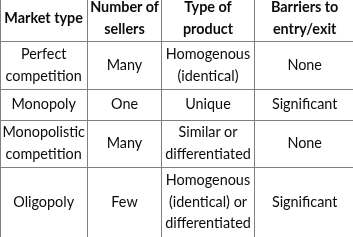
Four Market Structure
Perfect Competition
Monopoly
Monopolistic Competition
Oligopoly
Perfect Competition
Many sellers or producers in market/industry
Actions of one firm does not have any significant impact on other firms in the market
Firms in the market produce identical or homogenous products
Consumers who determine whether the goods are identical or not
No significant barriers to entry or exit
Firms have mobility and can easily come into the market or leave the market
A perfectly competitive firm is so small relative to the market that its actions does not affect the market price of the good produced in that market
Individual Firm’s Demand Curve
The demand curve for an individual firm in a perfectly competitive market is a horizontal line at the market equilibrium price, Pe.
Perfectly elastic
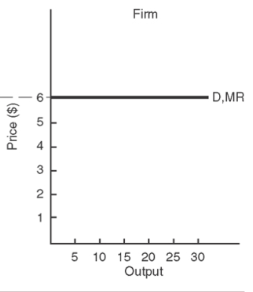
Competitive market has no control over the price, which is set by the market demand and supply of the good
Firm is the price taker and takes the price as “given”
Total and Marginal Revenue
Total revenue (total sales) → the price of the good times the quantity sold
TR = ($ of good)(# of good sold at MC =MR)
Marginal Revenue → Additional revenue earned by the firm for each additional unit of output sold
Marginal Revenue = Equilibrium price (Pe)
Profit Maximization Rule
As long as Marginal cost is less than marginal revenue, it make sense for the firm to produce the additional unit
Marginal cost = (change in total cost) / (change in quantity)
To maximize profit, produce that quantity, Q, where MR = MC
Short-Run Decision Making of Perfectly Competitive Firm
Firm is making positive economic profits
the profit maximization rule pridce that quantity where MR=MC
Leads to a quantity where MR = MC is greater than the dollar amount on the average total cost (ATC) curve for the same quantity
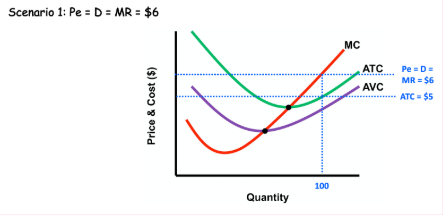
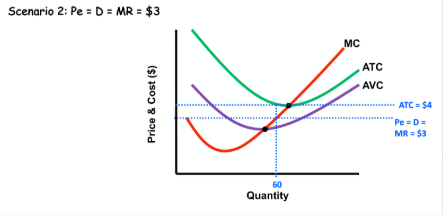
Firm is making a lost, but continues to produce (operate)
MR =MC at a quantity of 60 units, and for the 60 units, the average total cost (ATC) of producing each unit is $5 which is greater than Pe and MR
Firm is making loss but will continue to run its operations and produce because the loss is less than the fixed costs the firm would have to pay if it produced zero output
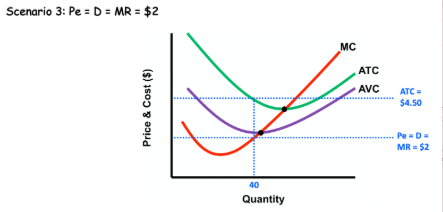
Firm is making a loss, and decides not to produce at all
MR =MC at 40 units, and at this quantity, the fixed costs are greater than the losses that the firm would incur if it produced the 40 units
Garlic Market
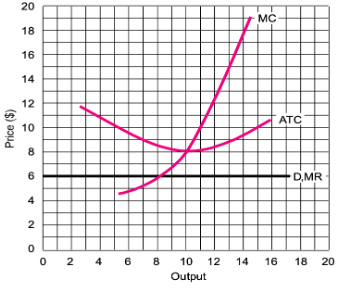
Market equilibrium price ,Pe = $6
MC curve starts at about 5 units, MC about $4.50 while MR = $6
MR > MC and the garlic producer is making $1.50
($6 - $4.50)
At *th bushel, MR = MC and ECONOMIC PROFIT IS 0
TR = $6 × 8 bushel = $48
TC → using ATC curve
8 bushels, ATC = $8.50
TC = $8.50 × 8 bushels = $68
Profit = TR - TC
$48 = $68 = -$20 ($20 loss)
Long-run Outcomes of Perfectly Competitive
Transition to long run for firms making profits int he short run
Firm making profit but no barriers to entry/exit in perfect competition,
These positive economic profits will attract other firms into the industry.
More firms enter the market → the market supply curve will rise and shift right
Leads to a decrease in the market equilibrium price, Pe.
Firm already in the industry, their profit will fall as Pe falls
Firm contitue enter the industry until market supply curve shifts far enough to the right,
Pe falls to a dollar amount equal to the bottom of the ATC curve
Firms in the industry are breaking even and make ZERO ECONOMIC PROFIT
Transition to long run for firms making losses in the short run
Firm has the option to leave the industry
As firm leave the industry, market supply curve will fall and shift to the left
lead to an increase in market equilibrium price, Pe.
Firms remaining in the industry, their losses will be reduced as Pe rises
Firms remaining in the industry, their losses will be reduced as Pe rises
Firm will continue exit the industry until the market supply curve shifts far enough to the left
Pe falls to a dollar amount equal to the bottom of the ATC curve
Breakeven and Shutdown Points
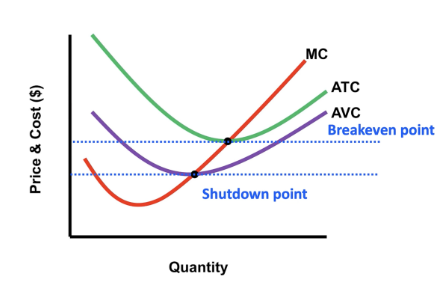
Breakeven point → where MR=MC at bottom of ATC curve
FIrm is breaking even, making ZERO ECONOMIC PROFIT (but making a positive normal accounting profit)
Firms will be producing the goods at the lowest per unit cost possible
Shutdown point → where MR=MC at bottom of AVC curve
Firm’s losses when it is producing that level of output will be equal tot he fixed cost if the firm were to shutdown operations and produce zero output
Pe falls below the price at the shutdown point
Firm will shutdown its operations in SHORT RUN
In LONG RUN, firm can leave the market if it making losses in the short run
A firm that has shutdown its operations would definitely choose not to stay
If a firms is operating where MR=MC below the breakeven point and is making losses that are less than its fixed costs,firmsm will also leave the business
Perfect Competition as the “Ideal” Market Structure
Producing at lowest-cost
Firms in perfect competition will be operating at the bottom or minimum of the ATC curve in the long run
Breakeven point for the firm, represents the lowest per unit cost of producing that good
The point of greatest productive efficiency
In long run, perfect competition will lead to firms producing at the lowest cost possible for society as a whole
Marginal cost pricing
Perfect ocmpetition ensures that the price paid by the consumer reflects the “true” cost of producing the last unit of that good
“true” cost —> referring to the opportunity costs of producing the good
A perfectly competitive firm takes Pe as given and produces where Pe = MR =MC
Then Pe= MC which is marginal cost pricing where the price reflects society’s marginal cost of producing the good
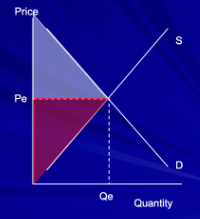
Maximization of social surplus
Consumer surplus → the difference between the price consumers are willing and able to pay for a good and the price they actually pay, Pe.
Purple triangle above Pe and to the left of Qe
Producer surplus → the difference between the price the producer was willing to accept
Red triangle below Pe and to the left of Pe
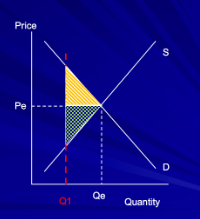
Deadweight loss → the market instead produced at a quantity less than Qe
Consumers would have lost a potential gain in consumer purplus equivalent to the small yellow triangle above Pe and between Q1 and Qe
Producers would lose a potential gain in producer surplus equivalent to the small green triangle below Pe and between Q1 and Qe