Labor and Human Capital
The Value of Labor
In March 2019, Mike Trout signed a 12-year, $430 million contract to continue playing baseball for the Los Angeles Angels. That works out to over $36 million per year to play a game, the highest salary any baseball player had ever been awarded. To many people (especially those who aren't sports fans), this is a ridiculous amount of money to pay an athlete regardless of how talented he is. There are more important jobs in society, such as police officers and firefighters, who don't get paid nearly as much. So why should Trout, a mere baseball player, get paid such an exorbitant sum?
In previous lessons, we've discussed various concepts related to the value of labor. In the circular flow model, we saw that households can earn income by selling their labor to businesses in return for a wage. But what determines this wage? Why does a baseball player get paid tens of millions to hit a ball with a stick, while a firefighter who literally saves lives only gets paid tens of thousands?
Market Value of Labor


Just like goods and services, there is a market value for labor. In a market economy, supply and demand determines the value—the market price—of goods and services. It works the same way for labor. A person's wage or salary is the market price being paid for their labor. This price is determined by the supply and demand of each worker's skills and knowledge. Just like the market price of gold is higher than the market price of silver, the market price for some workers is higher than it is for others.
Baseball players get paid a high wage because that's what the market price is for their work. Top baseball players make even more than regular baseball players because their market price is even higher. This high market price is a result of two major factors:
1
1
There is a very low supply of top baseball players. The supply for top baseball players is also very inelastic. There are only a certain number of individuals who have the talent to play the game at such a high level. The potential for a higher salary might convince a few athletes to play baseball instead of a different sport or to dedicate extra time to perfecting their game, but the supply will not increase that drastically.
2
2
Demand for top baseball players is very high. There are millions of fans who purchase expensive tickets to go see games and buy team merchandise. Many more watch games on television, allowing teams to sell advertisements that are seen along with the game. Fans are much more likely to tune in if there is a great player that they can watch, and they're more likely to cheer for a team (and thus buy that team's tickets and merchandise) if the team has great players and wins more games. The more baseball fans there are, the higher the demand for great players.
This combination of low supply and high demand results in high prices. Let's take a look at what a supply-and-demand graph might look like for top baseball players.
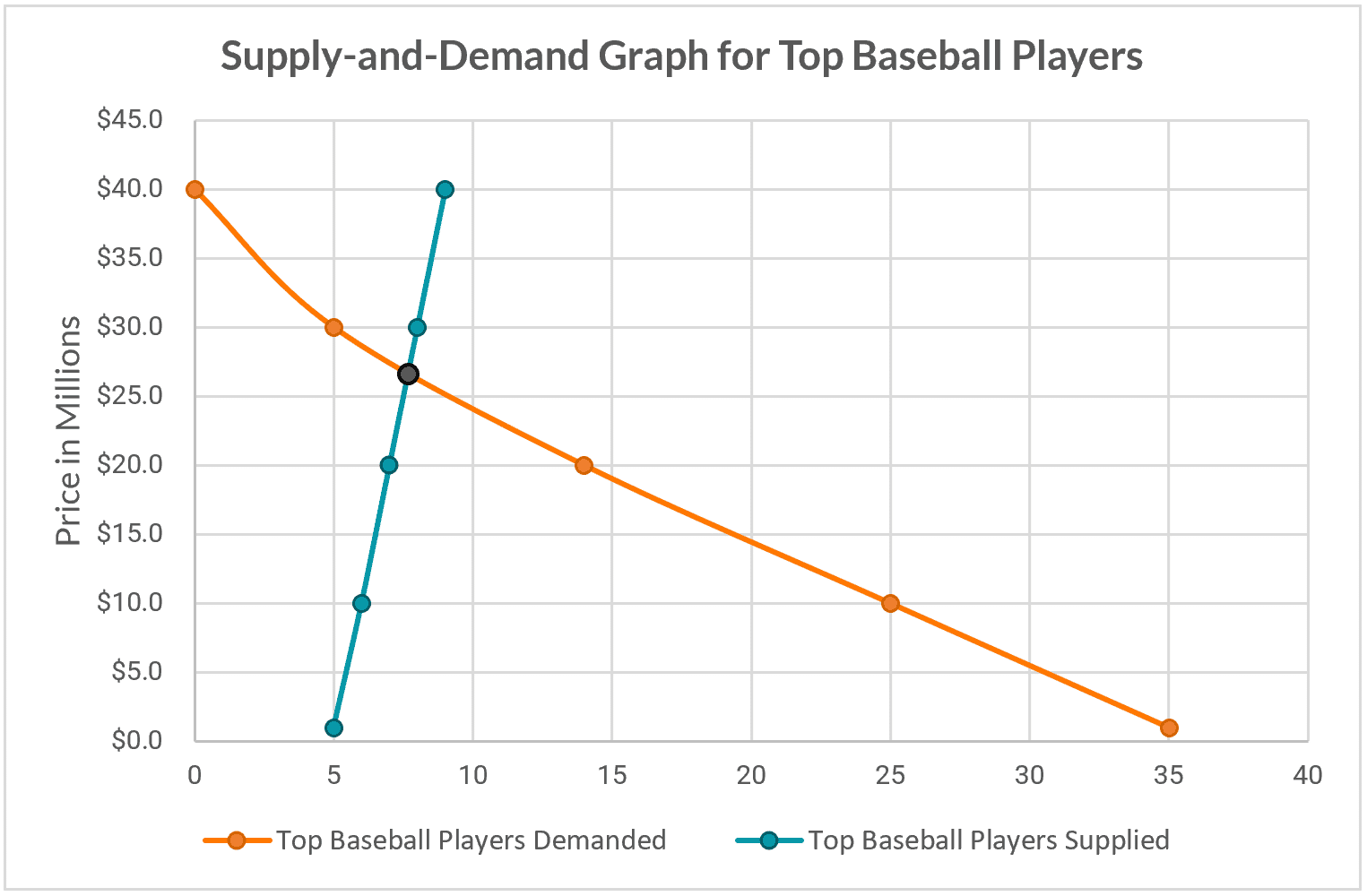
Note: This graph is an illustration and not based on any real data.
As you can see, the curves on our graph intersect at about $27 million. (Remember that this is called the equilibrium price.) The market price, or market value, for these players will thus be in the neighborhood of $27 million. Some players might make a little more or a little less, but the market price will be very close to the equilibrium price.
The demand for top players hasn't changed at all, but the positive change in supply has made a huge difference in the value of their services, cutting the equilibrium price from $27 million to $14 million. Thus, the higher the supply of a particular worker, the lower their market value will be.
Firefighters


So we've established why baseball players are so well paid: there are millions of fans who demand professional baseball players, and there is a very low supply of such players.
But what about firefighters? There is certainly great demand for their services—people don't want their homes to burn down. This should result in a high market value for those workers, right?
The problem is that there is a very high supply of firefighters. Although firefighting is certainly not an easy career and is physically demanding, the skills and training needed to be a firefighter are much easier to obtain than the skills and training needed to be a professional baseball player. Only a select few athletes have the talent required to be a great baseball player, and it takes years and years of training to hone those skills. Because firefighting takes fewer skills and less training, there is a much higher supply of firefighters.
In fact, according to the National Fire Protection Association, there were over a million firefighters in the United States in 2017, two-thirds of whom were volunteer firefighters. It's also likely that even more people could become firefighters if they wanted to (or, in other words, if they were encouraged to become firefighters by being offered a higher wage). This high supply means that the income for firefighters is much lower. In 2017, the 373,600 career firefighters (those who earned a wage for their services) earned an average income of $53,240.
Income by Occupation
Look at the gallery below to see the average annual income for a variety of occupations in 2021. For reference, the average income for all occupations was $58,260. As you view the numbers, think about why the market value for each profession is higher or lower than average. Ask yourself questions such as:
bullet
Does the job require special education or training, or can anyone do it?
bullet
Is the job desirable or undesirable?
bullet
Are workers of that profession in demand?
bullet
Is the job becoming obsolete due to societal or technological changes?










1
2
3
4
5
6
7
8
9
10
Photographer: $48,210
Lawyer: $148,030
Elementary School Teacher: $67,080
Surgeon: $294,520
Dentist: $177,770
Cashier: $26,780
Astronomer: $139,410
Engineer: $104,000
Fast-Food Cook: $25,490
Bus Driver: $38,750
Human Capital
As we've seen, the incomes of various occupations can vary greatly. The educational and career choices that workers make heavily impact the income they earn throughout their lives. Investing in their own human capital can dramatically improve workers' economic prospects.
On average, surgeons earn more than ten times the annual income of a cashier ($255,110 compared to $23,270). But you can't become a surgeon overnight. It takes a huge investment in money and time—hundreds of thousands of dollars in tuition for eight or more years of education—to be able to practice surgery. Such an extensive investment is not possible for many people, but investments in human capital (the skills, knowledge, and experience that an individual brings to the workplace) are the best way for workers of all kinds to increase their incomes. Businesses will reward those workers who become more efficient because they reduce the business's production costs.
The Effect of Human Capital on Production Costs


We've learned so far that the income workers earn is determined by the forces of supply and demand. Occupations that have low supply and high demand earn much higher wages than occupations that have high supply and low demand. But workers within the same occupation can also earn different wages. We can return to baseball for an extreme example of this. While Mike Trout makes $36 million per year, some Major League Baseball players make as little as $700,000 per year. There is such an extreme difference because Trout is a much more productive player than his peers. He gets more hits, scores more runs, and catches more fly balls. This increased productivity makes him much more valuable to his team, so the team is willing to pay him a lot more money.
The same concept applies to almost all jobs. Cashiers at a drug store could have the same starting wage, but good cashiers might get a 5% raise each year, while bad cashiers don't get any raise at all. The company rewards the good cashiers because they're more valuable to the company.
Workers with more human capital—more skills, more knowledge, more experience—become more productive by producing more in the same period of time than lower-skilled workers. An experienced cashier checks out more customers per hour. A skilled baseball player gets more hits per plate appearance. A knowledgeable engineer designs better machines in less time.
This increased productivity lowers production costs. If one employee can do the work of two employees, then the company will save money by only having to pay the wages of that one employee. The company will be willing to pay that employee a higher wage because their increased efficiency will save the company money overall. If a smart and experienced engineer can do the work of two inexperienced engineers, then her company will save money by paying her $150,000 instead of paying two separate engineers $100,000 each.
Investments in Human Capital
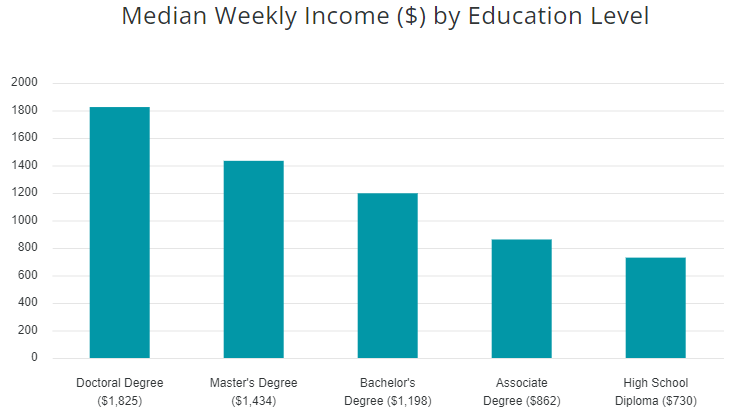
People's incomes partly reflect the choices they've made about their education and careers. Those with fewer marketable skills will earn a lower income than those who have more skills. Unskilled workers have low wages because many people are qualified to do that work. The supply of workers for those jobs is very high, which means businesses don't have to pay more to attract skilled employees.
When individuals improve their skills through education or experience, it's known as an investment in human capital. As people increase their human capital in a certain field, they become more productive and efficient, which makes them more attractive to employers. As we've discussed, the wage or salary that a worker earns is based on the market value of that worker's skills and knowledge. More productive workers earn higher wages. Thus, a worker's income depends mostly on the market value of the goods or services he or she produces. Workers are compensated based on the value they add to the production process. For instance, surgeons earn more money than their assistants because surgeons add the most value to the production of that service.
Becoming a surgeon requires an enormous investment, however. In the United States, it can cost anywhere from $250,000 to $500,000 to receive the needed education to become a surgeon. For most people, this will require a lot of financial aid and student loans. The government will often provide financial aid to students because it wants to make it easier for citizens to become more productive. This financial aid is an example of an investment in human capital.
Being a surgeon also requires continuing education. Because the field of medicine is always changing, surgeons must continue to learn throughout their lives. If they do not stay up to date with modern medicine, their human capital will decrease. This continuing education is a necessary expense for maintaining and expanding human capital.
So the best way for workers to earn a higher income is by becoming more productive, and they can do that by investing in their human capital. Earlier in the course, we discussed several ways you can do this: pursuing education, writing about a field of interest, volunteering, and investing in your overall health. Those investments in human capital will make you more productive, and businesses will compensate you for that increased productivity.

Labor Unions
In the United States, workers have often turned to labor unions—organized associations of workers created to protect their members' interests—to raise their wages. Labor unions became prevalent in the US in the late 1800s and fought against low wages and poor working conditions. Though they've had a mixed history, often being accused of corruption and inciting violence, they achieved many successes. Their actions influenced the passing of a minimum wage and overtime pay, as well as restrictions on child labor. Labor unions were also instrumental in creating safer working conditions for many jobs. In addition to lobbying the government to pass legislation that protects workers, unions implement three main tactics to get employers to accept their demands:
1
1
Strikes: Workers refuse to go back to work until their demands are met.
2
2
Picketing: Workers form picket lines outside their place of work both to inform people why they're on strike and to disrupt their company's activities.
3
3
Boycotts: Unions are often organized into large federations, and they can leverage this size by asking members from all the unions to stop buying products from a particular company.
In some ways, the success of labor unions has decreased their importance. Their lobbying has led to the passage of many federal laws that protect workers, which means those workers no longer have to rely on unions for that protection. At one point, over 40% of workers belonged to a labor union, but that number has fallen all the way to 11%.
Labor unions continue to fight for better pay and benefits, but do their efforts really increase their members' wages? That is the subject of Chapter 19 in Economics in One Lesson, a book that was written when unions still held immense power.
READ: Hazlitt, Economics in One Lesson, Chapter 19: "Do Unions Really Raise Wages?" [This may be Chapter 20 in some newer editions.] When you've finished, click below to continue with the rest of the lesson.
human capital: the skills, knowledge, and experience that an individual brings to the workplace
investment in human capital: an improvement in skill gained through education or experience
labor union: an organized association of workers created to protect their members' interests
The only way to truly increase workers' wages in the long term is to increase their productivity, whether it be through improvements in human capital, physical capital, or technology. Artificially boosting wages might help a very specific set of workers in the short run, but it will harm the economy as a whole over the long term.