Experimental research Design
Definition (#f7aeae)
Important (#edcae9)
Extra (#fffe9d)
Basic Experiment Design:
It includes 2 variables: Independent variable and Dependent variable.
Independent has minimum 2 levels; control and experimental group.
The only difference between the groups is the independent variable.
There are 2 simple experiment designs: posttest only design or pretest-posttest design.
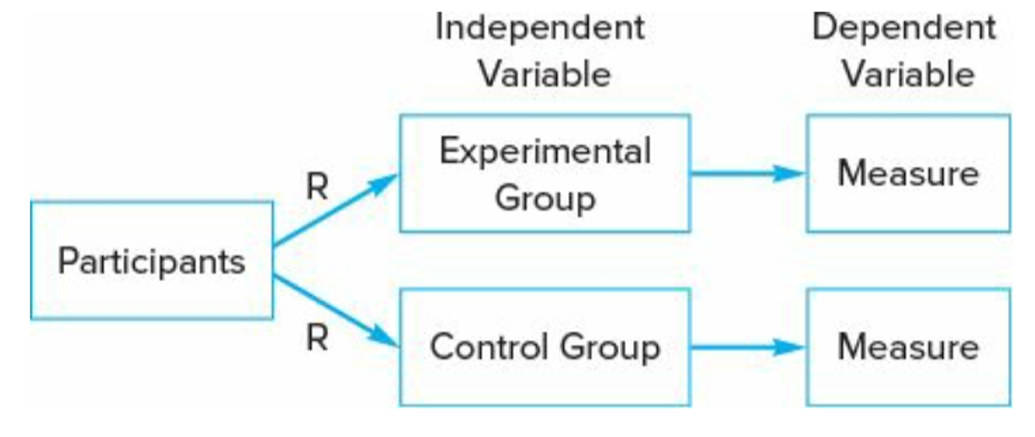
Posttest Only Design:
Has 2 equivalent groups of participants:
Recruits participants and assign them to the two groups; eliminating any potential selection differences.
Participants cannot differ in any systematic way.
Manipulate the IV:
To choose 2 levels of the IV; control and experimental group.
Examines effect of the IV on the DV:
Measurement procedure used for both groups are the same, where comparison between them is made possible.
Since groups are equivalent, effects of confounding variables would be cancelled out.
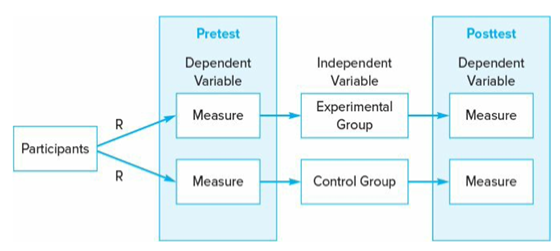
Pretest-Posttest Design:
Pretests are useful if the likelihood of dropouts is high.
A pretest is given before the experimental manipulation.
Not necessary if participants have been randomly assigned, or a large sample is recruited. Random assignments will produce groups that are virtually identical in all respects.
The larger the sample, the less likely the groups will differ in any systematic way prior to the manipulation.
Pretests are time-consuming and may sensitise participants to what one is studying, causing reactivity.
Randomization is necessary with a small sample size.
Assigning Participants:
There are 2 methods: Independent group measures or repeated group measures.
Independent group design: Known as ‘Between-Subjects’ design because comparisons are made between different groups of participants.
Repeated measures design: Called a ‘Within subjects’ design as each participant receives each level of the IV.
Order effects: The order of presenting the treatments affects the dependent variable.
Practice Effect: Effects of practising.
Fatigue Effect: Deterioration in performance due to tiredness, boredom.
Carryover Effect: Effect of the first treatment to influence the response to the second treatment.
Counterbalancing: All possible orders of presentation are included in the experiment.
Time interval: A rest period may counter fatigue effect.
Independent Groups Design:
Different participants are assigned to each of the condition using random assignment.
Use random number generator.
Randomisation prevents any biases & groups are considered equivalent in their characteristics.
Repeated Measures Design:
The same individuals participate in both conditions.
Participants are repeatedly measured on the dependent variable after being in each condition of the experiment.
Fewer participants are needed and this design is more sensitive in finding the effects of IV on DV.
Advantages:
Less number of participants required to complete the experiment.
Greater control over participant differences & ability to detect an effect of the independent variable.
The individual differences can be seen/explained; scores are consistently higher in meaning meaning than low meaning.
Matched Pairs:
Participants are first matched to a subject variable such as age or personality trait.
The matching variable is either the DV or related to the DV.
Matching variable: A factor that strongly affects the DV.
Match Participants into Pairs (M): The matching variable is measured for all participants. Then 2 people who have almost identical scores are paired up.
Randomly Assign Within the Pair (R): Randomly assign one person to the first condition (New Method) and the other person to the second condition (Old Method).