Building a Human
Lecture Overview
Title: Building a Human
Module Code: 4BBA1010
Module Title: Fundamentals of Anatomy
Faculty: Life Sciences & Medicine
Department: Anatomy
Professor: Anthony Graham
Date: 09/2025
Key Steps in Early Development
Learning Objectives
Know the steps of pre- and post-implantation development.
Understand the process of gastrulation and its importance.
Understand the significance of the germ layers.
Understand neurulation and its importance.
Appreciate the significance of the neural crest.
Understand what somites are and their importance.
Understand what endoderm is and know its main derivatives.
Appreciate that the development of the head is different.
Understand the growth of the embryo/foetus and the basic anatomy.
Carnegie Stages of Human Development
Presented by Dr. Mark Hill, Cell Biology Lab, School of Medical Sciences (Anatomy), UNSW.
Key events in human development occur during the earliest stages of embryogenesis.
Stages of Development**
Stage 1: Zygote (1 day, not to scale)
Stage 2: Cleavage stage (4 days)
Stage 3: Early morula (3-4 days)
Stage 4: Compacted morula (day 4)
Stage 5: Early blastocyst (day 5)
Stages 6-8: Late-stage blastocyst and implantation (days 6-9)
Stage 9: Gastrulation begins (week 3)
Stage 12-23: Further development through embryonic and fetal stages
Human Development Timeline
Human Pregnancy Duration: 9 months
First Trimester: Embryonic period (weeks 1-4)
Second Trimester: Fetal period (weeks 5-8)
Third Trimester: Growth and maturation
Important Events During Weeks
Week 1-4: Fertilization, zygote formation, cleavage stages.
Week 5-8: Development of blastocyst, implantation, early organogenesis.
Week 3: Formation of trilaminar embryo, beginning of gastrulation.
Week 4: Somite formation (somitogenesis), cardiac development, neurogenesis.
Development Overview
Cleavage: Rapid cell divisions post-fertilization forming a blastocyst.
Formation of the Blastocyst:
The trophoblast interacts with the uterus leading to implantation.
The embryo derives from the inner cell mass, creating support for early development.
Layer Formation within Blastodisc
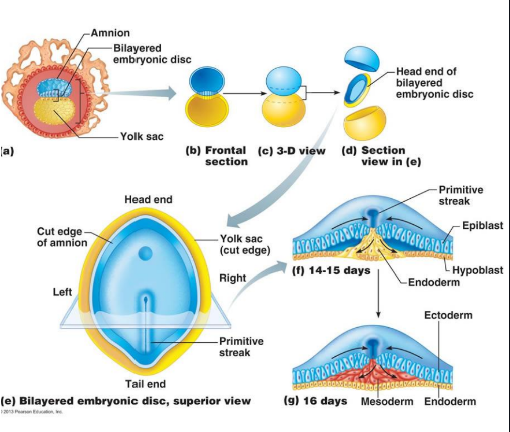
Blastodisc: Composed of two layers:
Epiblast: Forms the embryo and amnion.
Hypoblast: Contributes to the yolk sac.
Gastrulation
Definition: The process of cell sorting and movement that defines the body plan of the embryo.
Key Concepts:
Beginning with the inward movement of epiblast cells.
Establishment of three germ layers:
Ectoderm: Forms the nervous system and skin.
Mesoderm: Forms muscles, blood, and bones.
Endoderm: Forms internal organs.
Germ Layer Derivatives
Examples of derivatives:
Ectoderm: Skin and neural tissues.
Mesoderm: Muscle cells, kidney tubules, and blood components.
Endoderm: Lung cells, thyroid cells, and digestive tract components.
Neurulation
Definition: The formation of the neural tube, originating from the neural plate, crucial for central nervous system development.
Key Features Of Neurulation:
Starts anteriorly and progresses posteriorly.
Neural crest cells contribute to peripheral nervous system, pigment cells, and structures in the head.
Defects in Neurulation
Conditions arising from abnormal neurulation include:
Anencephaly: Failure in closure of anterior neuropore.
Spina bifida: Failure of posterior neuropore closure, may lead to lumbosacral defects.

Somite Formation and Development
Somitogenesis: Formation of somites from paraxial mesoderm, appearing as blocks of tissue contributing to vertebrate structures.
Key Components of Somites:
Sclerotome (bone), myotome (muscle), dermatome (skin).
Somitogenesis Process
Mesodermal cells ingress during gastrulation.
Somites bud from the anterior pre-somitic mesoderm as the embryo extends.
Develops a segmented body plan affecting limb and skeletal development.
Endoderm Development
Formation and Patterning:
Gives rise to numerous visceral organs and structures (e.g., lungs, digestive tract).
Endoderm Derivatives Include:
Esophagus
Stomach
Pancreas
Liver
Small intestine
Special Considerations in Head Development
Head Development Characteristics:
Lack of a coelom, role of the neural crest is more prominent compared to somite contributions.
Importance of ectodermal placodes in facial feature formation.
Fusion of Primordia in Head Development
The frontonasal region transitions from several embryonic structures, with distinct fusion patterns forming nasal cavities and oral structures.
Final Stages of Fetal Development
Key Features by the Sixth to Twenty-Sixth Week:
Development of facial features (eyes, nose, ears).
Limb development progresses from undifferentiated buds to recognizable forms.
Conclusion
The early stages of development show rapid and critical changes that lay the groundwork for the entire organism, highlighting the importance of proper progression through embryogenesis in forming a healthy human.