Fundamentals of Finance M1T2: Present Value
I. Time Value of Money: Foundations and Formulas
A. Simple vs. Compound Interest
Simple Interest:
Gains are linear over time:
FV=P(1+rt)
Compound Interest:
Returns are exponential due to reinvestment:
FV= P(1 + r)^t
Insight: The reinvestment effect becomes dramatic over long horizons (e.g., 100 years: $100 grows to $800 under simple interest, but $86,771 under compounding at 7%).
Conclusion: Compound interest dominates in real-world finance, as it reflects reinvestment and compounding frequency.
B. Present Value (PV)
To reverse compound growth and determine today’s equivalent of a future cash flow:
Where:
Ct: cash flow at time t
r: discount rate
: Discount factor
II. Annuities and Perpetuities
A. Ordinary Annuities (Finite Streams)
Definition: A series of fixed, periodic payments.
PV Formula:
Application: Mortgage payments, retirement savings, coupon bonds.
Annuity Factor Notation:
Case Example:
$0.5M loan over 15 years at 4% ⇒ Annual payment ≈ $45,000.
Annual payment = Cashflow x Annuity Factor
B. Future Value of Annuity
C. Perpetuities
Definition: A stream of fixed payments forever.
If r doubles, PV halves — explains high interest rate sensitivity in valuation (e.g., preferred stock, utilities).
III. Growing Annuities and Perpetuities
A. Growing Annuity (Finite Horizon with Growth)
IF r = g:
Use Case: Salaries, dividends, education costs with consistent growth.
B. Growing Perpetuity
, only valid if r > g
Application: Dividend discount model for equities (Gordon Growth Model).
C. Delayed Annuities and Perpetuities
PV of a perpetuity starting in s years:
PV of t-year annuity starting in s years:
Insight: Break complex cash flows into present-valued components to simplify valuation.
IV. Compounding Frequency and Interest Rate Comparisons
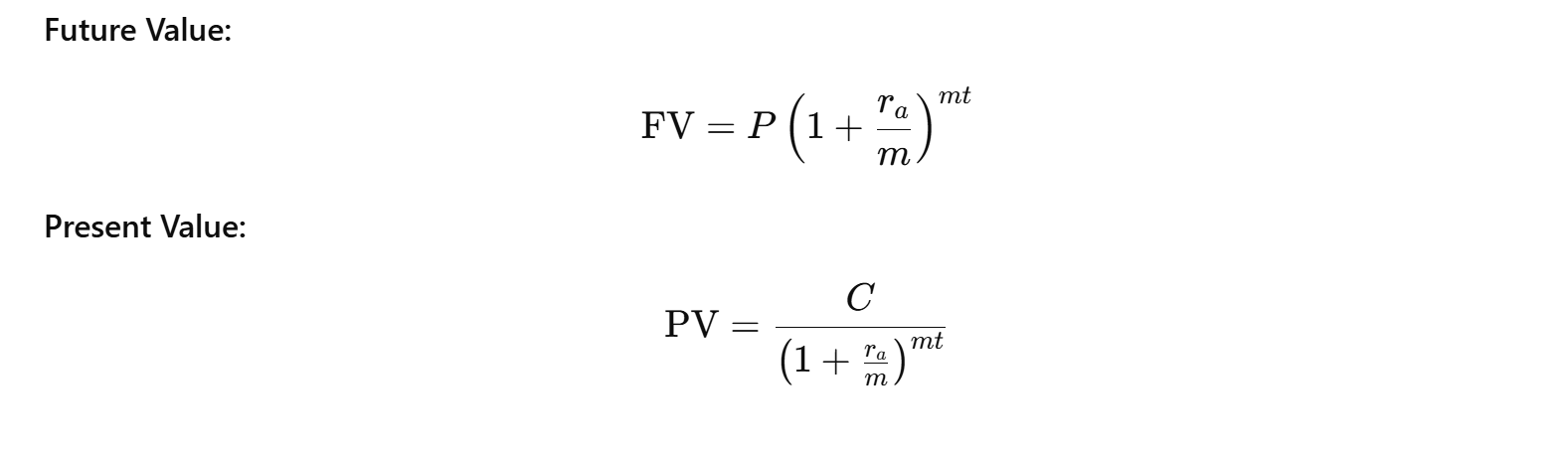
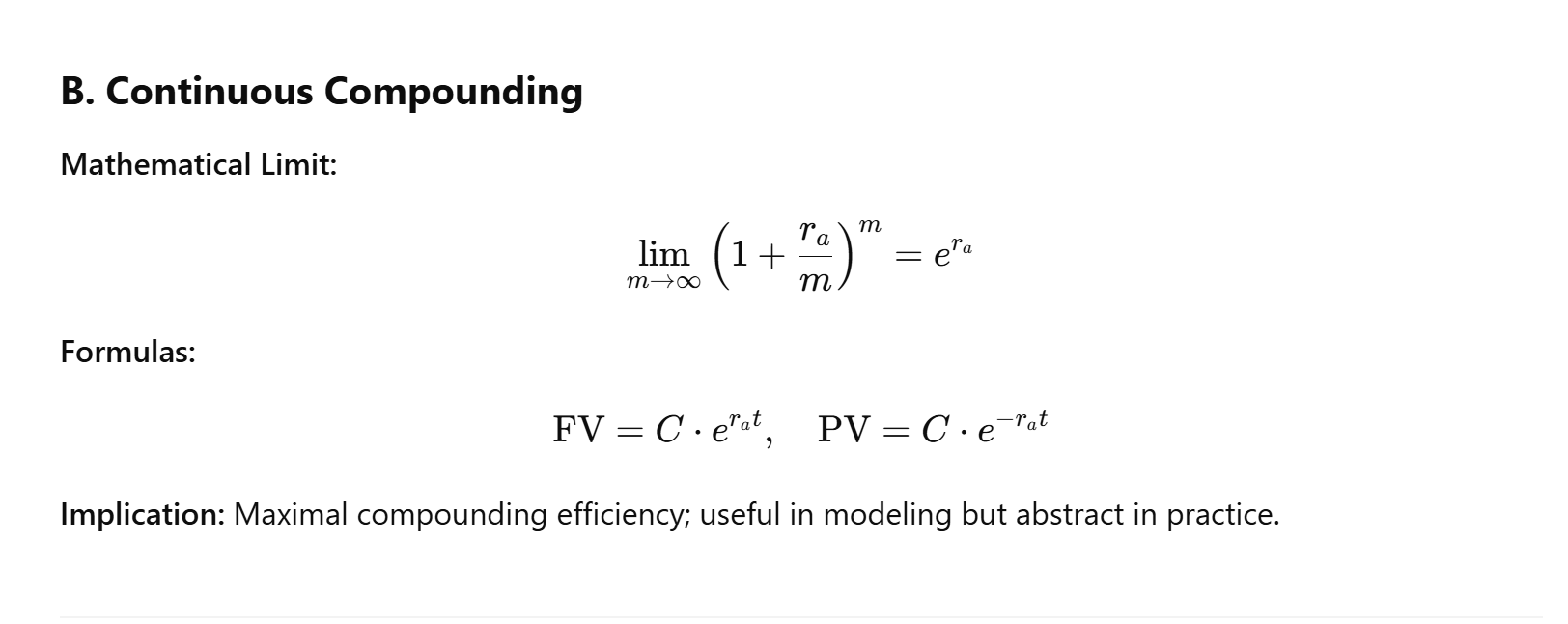
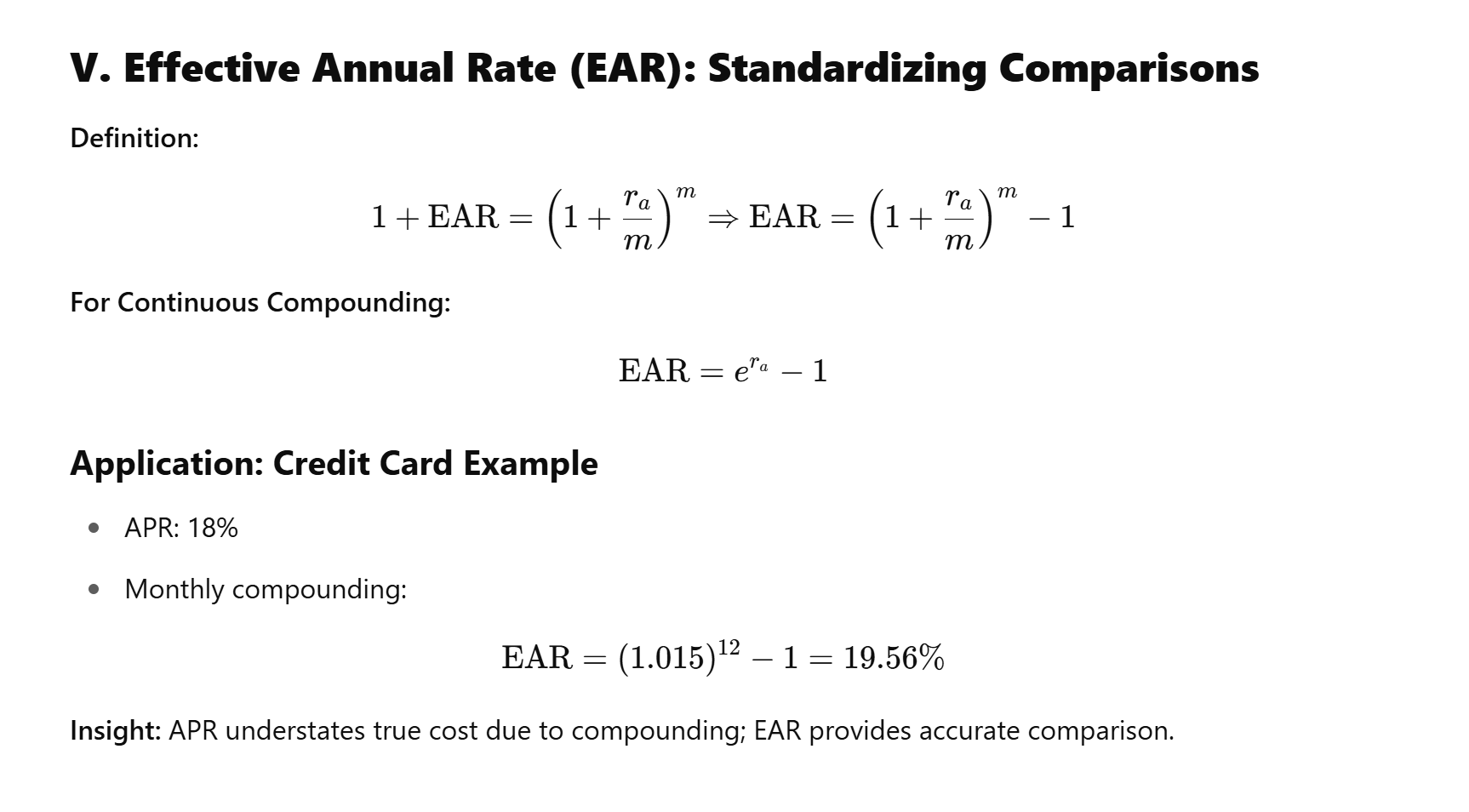
A. Compounding within the Year
Let:
ra : Stated Annual Interest Rate (SAIR)
m: Number of compounding periods per year
Period Rate: ra/m
Key Variables in Present Value and Annuity Formulas
Symbol | Meaning |
|---|---|
C | Cash Flow – The amount of money received or paid at each time period (usually annually). |
r | Discount Rate / Interest Rate – The rate used to discount future cash flows to the present. Also called the required rate of return or opportunity cost of capital. |
t | Time Periods – The total number of periods (usually years) over which the cash flows occur. |
s | Start Delay – The number of periods before the first cash flow begins (used in delayed annuities/perpetuities). |
g | Growth Rate – The rate at which cash flows grow over time in a growing annuity or growing perpetuity. |