GEN ANA
GENERAL ANATOMY
DEFINITION OF TERMS
ANATOMY
from the Greek word "ana" (up) and
"tome" (cutting)
HUMAN ANATOMY
study of parts of the human body and their relationship to one another
PHYSIOLOGY
study of the way these parts accomplish their functions
System Physiology
study of body system's function
Comparative Physiology -
study of various characteristics of living organisms
Medical Physiology
study of physiological dysfunction and diseases
MORPHOLOGY
deals w/ the structures and spatial relationships, the kind of materials used, and the architecture of the entire human body
Cell
fundamental unit structure of all living things
Basic living units; have common characteristics, differ in structure and function
Tissue
collection of similar cells having the same functions
A group of cells with similar structure and function: epithelial, connective, muscle, nervous
Organ
a group of fundamental tissues bound together in the performance of a given function
Two or more tissues work together to perform one or more common function: eye, skin, stomach, heart.
System
a group of organs similar in origin and structure, united together in the performance of a given function
A group of organs of a common funcilon: Skeletal, Muscular, Nervous, Endocrine,Cardiovascular, lymphatic, respiratory, digestive.
STRUCTURAL LEVEL OF A BODY
Chemical- Combination of atoms to form molecules
Cell
Tissue
Organ
Organ System
DIVISIONS OF HUMAN ANATOMY
Gross (Macroscopic) Anatomy
refers to the study of the parts of the body as seen by the naked senses like the eye or natural vision.
Microscopic Anatomy
Very small structures that cannot be seen with naked eyes.
study of the minute structures that can be seen only w/ the aid of lenses.
Histology- Study of body tissues
Cytology- Study of body cells
Developmental Anatomy (Embryology)
study of the origin, growth and development of an organism from conception until birth, or from one-cell stage to the complex human being.
Structural changes to the body throughout lifespan.
Embryology- Development which occur before birth
Neuroanatomy
study of the nervous system.
Methods of studying Human Anatomy
Regional or Topographical
study of the relationships of all structures -bones, joints, muscles, fasciae, tendons, blood vessels, nerves and lymphatics of the body -found in a particular area or region of the body
Systemic anatomy
study in w/c all parts of the body made up of the same structure and of related functions are taken up individually and as a group
system by system
Surface anatomy
delineating on the external surface of the body, the relative position of the organs and structures found inside the body. This is achieved by making use of constantly seen or felt bony projections or depressions for our surface landmarks.
Radiographic anatomy
includes the use of plain x-rays, as well as rays taken after the introduction of various opaque dyes into the blood stream (angiography) or ingested (Barium swallow).
Applied Anatomy
application of the knowledge gained to the actual practice.
ex. Clinical and Surgical Anatomy gives the student the reason for the patient's signs and symptoms, and use them as bases for the diagnosis and treatment from the anatomical standpoint.
Materials used in the study of Human
Anatomy:
Drawings, charts, books, atlases, and illustrations w/ corresponding labels and the descriptions of the parts.
Human models -either ceramics or plastic or rubber -w/c are exact replicas of the human body and its parts.
Human cadavers -dead human bodies
Living anatomy -self or others
ANATOMIC POSITION
Standing position with the body erect facing forward, feet slightly apart, arms hanging and palms also facing forward.
A standard position to w/c description of any part of the body is referred. There are five characteristics.
Body is standing, erect facing the observer.
The arms are hanging at the sides.
The palms are facing forward or anteriorly.
The thumbs are pointing to the sides or laterally.
The feet are together and flat on the ground.
Descriptive Terms in Relation to Position
Superior or Cranial -nearer the head, higher, above
Inferior or Caudal -farther from the head, lower, belowAnterior or Ventral -nearer the front or belly side of the body
Posterior or Dorsal -nearer the backMedial-nearer the midline of the body
Lateral -farther from the midline of the bodyProximal -nearer the point of origin of a part
Distal -farther from the point of origin of a partInternal-closer to the central axis of the body
External -farther from the central axis of the bodySuperficial -nearer the surface of the body
Deep -farther away from the surface of the body
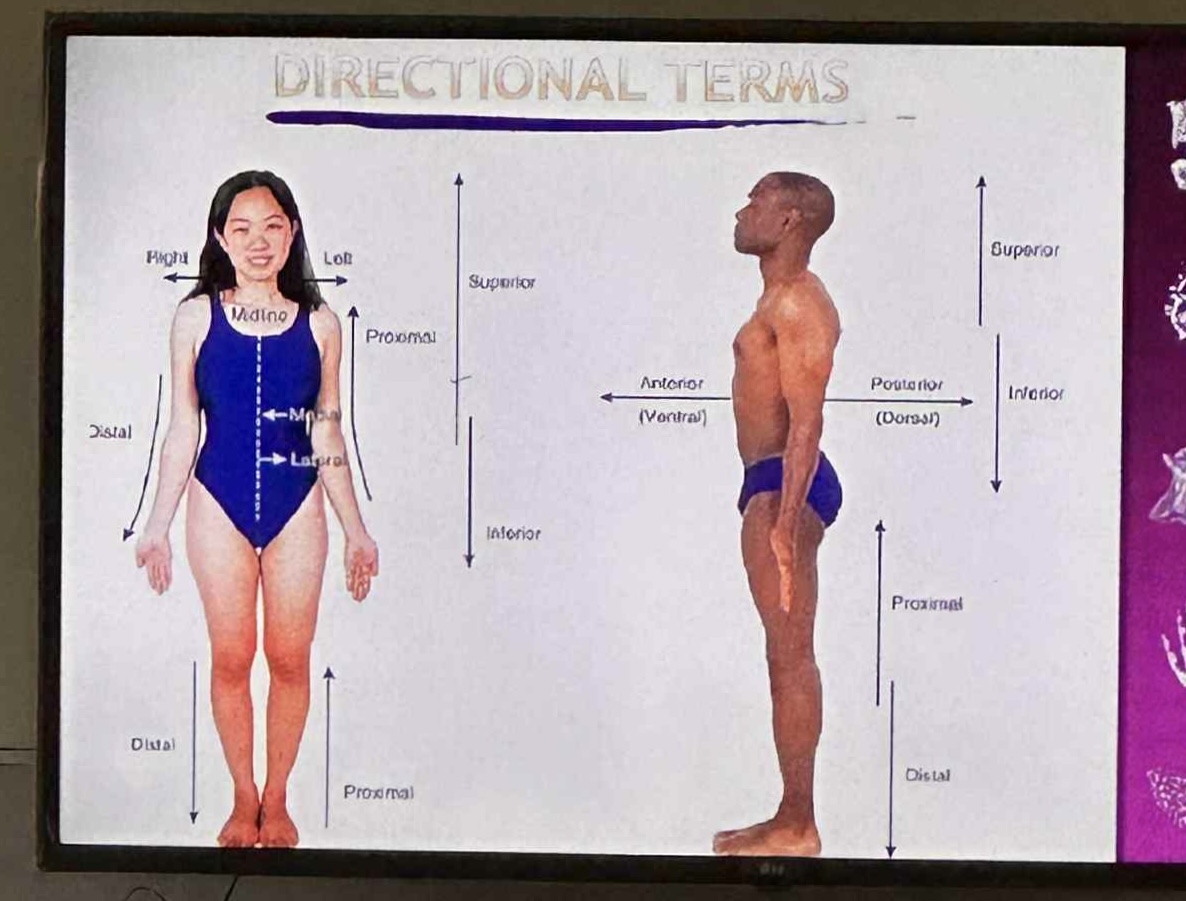
REGIONAL TERMS
Axial Region
axis of our body
comprise of three parts: head, neck and trunk
Perpendicular Region
limbs, or appendages
body parts that attached to the axis.
Body planes and sections
Frontal Plane
- vertical line that divide the body to anterior and posterior parts.
Sagittal plane
Vertical plane divide body into right and left
Sagittal plane that exactly cut in the middle called midsagittal or median plane.
Sagittal plane that offset from median line called parasagittal plane.
Transverse Plane
Horizontal plane which divides into superior and inferior
SYSTEM OF THE BODY
Urinary System
regulation of water, electrolytes and acid-base balance in the body.
Reproductive System
production of babies
Respiratory System
supply blood with oxygen and removing carbon dioxide.
Digestive System
break down the food for absorption
indigestible food will be removed as feces
Muscular System
muscles
produce body movement
Nervous System
consist of brain, sensory receptor, nerves, spinal cord
control homeostasis by stimulating particular muscles contraction and glands secretion
Integumentary System
External cover of the body (skin)
Protects deeper tissues from injury
Site of cutaneous, receptors, sweat and oil glands.
Skeletal System
Bones
Protects and supports body organs
Endocrine System
Hormones secretion to regulate body processes.
Cardiovascular System
Transport blood to the body
Lymphatic/Immune System
Protect the body by attacking foreign substances entering body system