Idioms
Idioms are common everyday expressions whose meaning cannot be determined from individual words. The idiom usually takes the form:
(verb) + (preposition)
Each idiom in English uses a specific preposition, just as each preposition has a different meaning, and using a different preposition to complete the idiom is wrong. So when a preposition is underlined in an English test, ask yourself if it's the correct preposition. how do you know? The correct one makes sense and sounds smooth. Anything wrong sounds funny and shrill. This is a great place to practice trusting your ears. If it's high-pitched, you're probably wrong
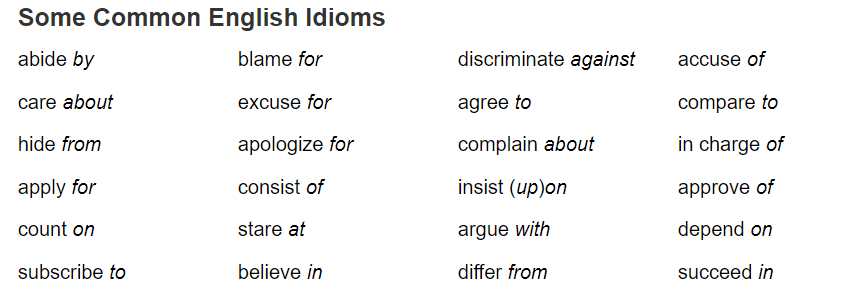
Some Idiom Examples
| Correct | Incorrect |
|---|---|
| Zann went to the movies. | Zann went onto the movies. |
| Giancarlo sat on the couch. | Giancarlo sat in the couch. |
| Malaria is a threat to travelers. | Malaria is a threat of travelers. |
| Focusing on your studies will bring you success. | Focusing with your studies will bring you success. |
More Examples:
- Mary thought that the test was a piece of cake.
The phrase piece of cake typically signifies the relative ease of a task.
- During our winter break, my friends and I hit the slopes.
The phrase hit the slopes is generally used to indicate snow-skiing.
- My father insisted that I put my nose to the grindstone next semester.
The phrase nose to the grindstone is used to suggest that one is working hard.
- Throughout the summer I lived a stone’s throw from a popular beach.
The phrase stone’s throw generally indicates a short distance.
- Hector is often too bogged down with his studies to spend time with his friends.
The phrase bogged down is most often used to mean overwhelmed.
- I often sit across from my sister on the bus.
Not: with, by, to
- Darla’s professor casually glanced at her.
Not: to, upon