Inheritance, Variation and Evolution
sexual and asexual reproduction
asexual reproduction involves 1 parent. the child is a clone of the parent produced by mitosis (eukaryotic cells) or binary fission (prokaryotic cells like bacteria).
advantages | disadvantages |
faster - mates don’t need to be found + engaged with | no variety means no selective survival advantages - at risk if environment changes |
requires less energy | organisms can only evolve via random mutations, which are uncommon. no guarantee those mutations are positive either |
produces much more offspring |
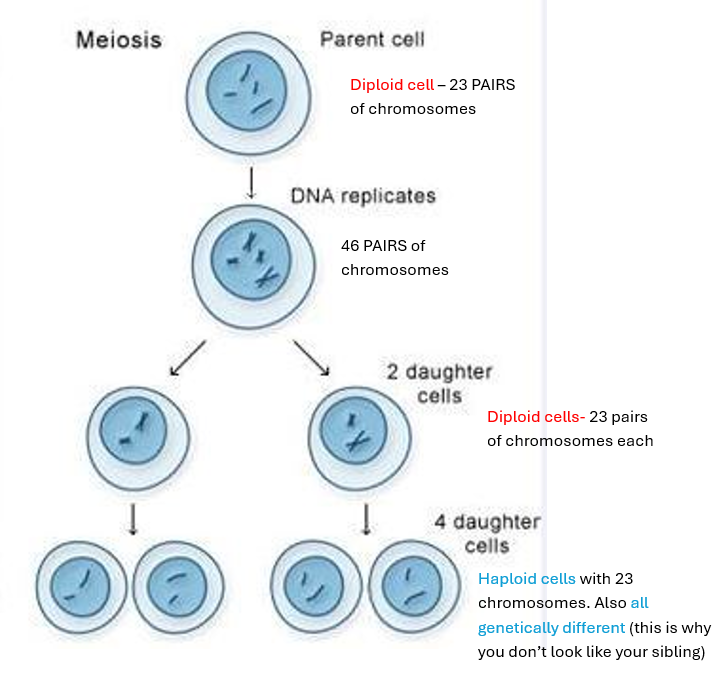
sexual reproduction involves 2 parents. the child is a mix of their genetic information, causing variety in offspring. this is done by fusing the gametes of the parents (fertilisation). the gametes are produced by meiosis.
gametes join to produce a zygote, which then divides by mitosis. at a certain size, this is considered an embryo, which then starts to differentiate.
advantages | disadvantages |
variety enables survival advantages, natural selection and evolution | slower - mate needs to be found |
requires more energy to occur + to find mate | |
produces fewer offspring |
mitosis produces 2 diploid cells that’re clones of the original cell.
meiosis produces 4 haploid cells that have genetic variability.
organisms can use both sexual and asexual reproduction methods. e.g.
strawberries produce seeds sexually but also ‘runners’ asexually that shoot off from main plant to create roots elsewhere.
malarial parasites reproduce sexually in the mosquito then asexually in the human host
many fungi reproduce asexually by spores but also reproduce sexually to give variation
DNA structure
the nucleus of a cell contains 46 chromosomes that include DNA which is comprised of genes
nucleus → chromosome → DNA → gene
genes code for proteins that do something (e.g. determine eye colour, act as enzymes) but DNA itself IS NOT A PROTEIN
DNA is a polymer made of billions of nucleotides that’ve reacted together
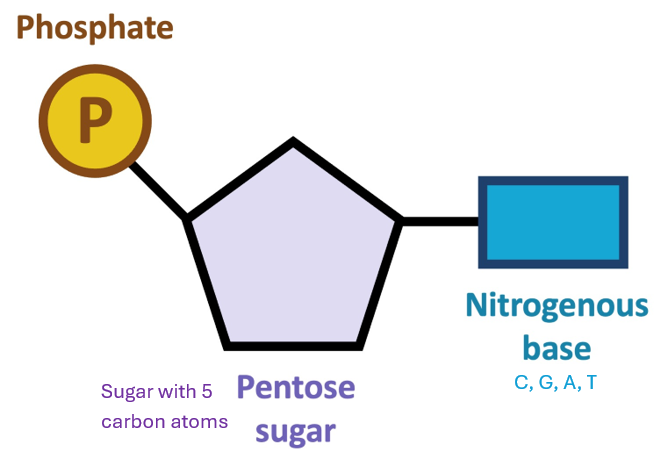
the pentose sugar and phosphate make up a backbone of DNA - one of the helixes in DNA’s double helix structure.
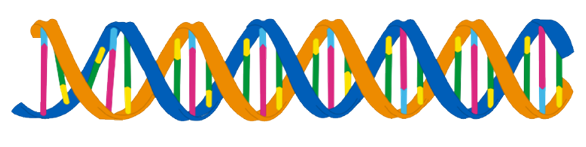
here, the orange is one helix and the blue the other. bases are specific and complementary to each other and held together by intermolecular forces. A complements T, C complements G
Genomes
the genome of an organism is its entire genetic material - all of its DNA
almost every cell (bar examples like gametes, red blood cells) in the body has the same DNA.
basically every human has the same genes but those genes will code for different proteins in different people because the base pairs are different.
sequencing the human genome allows us to do a lot of things:
search for the genes that’re linked to different disease/how genes are affected by diseases such as cancers to personalise treatment
understanding how inherited disorders work so we can then create medicines and treatments to repair or change these genes (gene therapy)
to trace human migration and understand human evolution
Protein Synthesis
the gene coding for the protein that needs to be synthesised is switched on
an enzyme reads one strand/helix of the gene and figures out the complementary base parings. this complementary strand is known as mRNA
mRNA uses U as the compliment to A rather than T
the mRNA moves out of the nucleus and into the cytoplasm, where it binds onto a ribosome
the ribosome reads the genetic code of the mRNA in groups of 3 bases at a time (the triplet code). 3 bases = 1 amino acid
a tRNA molecule with an amino acid attached to it that has the complementary base pairs to the 3 read by the ribosome comes and binds to the mRNA. it brings its amino acid along with it
the tRNA gives its amino acid up to the ribosome
the process continues and the tRNA amino acids bond, forming a chain.
when the ribosome reaches the end of the gene, marked be a specific combination of bases, the ribosome releases the polypeptide chain
the polypeptide chain gets compressed into a protein outside of the ribosome and goes on to do its job
Mutations
mutations are changes in the base code of DNA. they occur randomly and continuously. they may be the deletion, addition or substitution of a certain base, which will affect how the DNA is read.
every time a cell divides, it copies billions of base pairs. errors are thus not unlikely over a whole human life time.
most mutations don’t have an impact because
it often doesn’t change the amino acid formed, as for all combinations of 3 bases there’s only 20 amino acids
not every part of the gene codes for an amino acid anyway. some of these parts will be used to turn the gene on or off, so it will/won’t be expressed.
mutations that do have impacts may be good or (more commonly) bad. e.g. an enzyme may no longer be able to fit its substrate, but it also may change to fit a completely new one.
Inheritance
some characteristics like fur colour in mice are decided by just one gene, however most are decided by 2 or more.
gametes - sex cells (egg and sperm in humans)
chromosome - long strands of DNA that get compressed in the nucleus of a cell
gene - a section of DNA on a chromosome, coding for a protein.
allele - different forms of the same gene. humans always have 2 alleles of each gene, one from each parent - one on each chromosome in a pair.
dominant alleles are expressed if there’s at least one of them present
recessive alleles are expressed only if there’s 2 of them present
diseases or traits that are recessive can skip generations, and can have carriers, who doesn’t have the trait but may pass it onto their offspring if they mate with another carrier
phenotype - the physical expression of a certain trait
genotype - the alleles deciding the phenotype
heterozygous genotype - one allele is recessive and one is dominant
homozygous genotype - both alleles are the same
further splits into homozygous recessive and homozygous dominant
below is a punnett square. you need to be able to construct and use these to extract the:
% chance of a trait
the genotypic and phenotypic ratios
so say the trait for grey fur in a mice is dominant and white fur is recessive. If the two mice below mate:
there’s a 75% chance the mice has grey fur and a 25% chance it’s got white fur
the genotypic ratio is 1:2:1, AA:Aa:aa
the phenotypic ratio is 3:1, grey:white
A | a | |
A | AA | Aa |
a | Aa | aa |
pedigree analysis charts (family trees) can also be used to work out the chance of someone inheriting a certain condition.
Sex determination
sex is decided by the 23rd pair of chromosomes.
women have XX chromosomes
men have XY chromosomes
a punnett square shows that this creates a 50/50 chance of having a girl or a boy.
the Y chromosome is shorter than the X, so for men, whatever is on their X chromosome determines some sex based characteristics (e.g. hemophilia, a blood disorder). women have two Xs, so have a ‘backup allele’ that makes it less likely for them to get certain disorders like hemophilia.
Development of understanding of inheritance
mid 19th century → gregor mendel breeds pea plants, discovers inheritance of certain characteristics determined by ‘units’ that got passed onto offspring
however wasn’t always visible in humans at the time so wasn’t widely believed
late 19th century → microscopes that could observe chromosomes and cell division are invented.
early 20th century → observed that chromosomes and mendel’s ‘units’ behaved in similar ways. this led to the idea that the ‘units’, now called genes, were located on chromosomes
mid 20th century → the structure of DNA was determined and the mechanism of gene function worked out
Inherited disorders
polydactyly - having extra fingers or toes - is caused by a dominant allele
cystic fibrosis - affects cell membranes, meaning there’s a thick mucus in the airways + digestive system. caused by a recessive allele → at least one parent must have CF and the other must be a carrier, or they can both be carriers
DNA can be extracted from embryos in a womb or cells can be taken from a lab grown embryo and tested to decide if it will have a disease or not.
pros of embryo screening | cons of embryo screening | |
economic | treating disorders can be expensive, so by finding out if the child has it, adjustments can be made | expensive to carry out |
ethical | reduces the amount of people suffering from a disease | may encourage people to pick characteristics - designer babies |
social | there’s regulations in place to prevent it being used to create designer babies | could be promoting prejudice by suggesting those with genetic disorders cannot live a full life/are unwanted |
may lead to a miscarriage | ||
decisions must be made about whether to terminate the pregnancy | ||
not completely reliable for every disorder - false negatives and positives are possible |
a question about embryo screening will often ask you to make a judgement, so make sure you weigh up both sides but come to a conclusion!
Variation
variation - the differences in characteristics of individuals in a species. caused by:
genetic differences between individuals - what genes they’ve inherited
environmental differences between individuals - where they’ve developed
a mix of genetic + environmental causes
species - a group of organisms capable of breeding to produce FERTILE offspring
adaptation - a behaviour/feature that helps an organism to compete and survive
only genetic variation is passed onto offspring.
there is usually a lot of genetic variation within a population of a species. all of the genetic variation is caused by mutations. mutations will rarely affect, influence or determine the phenotype, and even more rarely will the new phenotype be suited to a change in the environment. however when this occurs, rapid change is seen in the species - evolution.
Evolution
evolution - a change in the inherited characteristics of a population over time through a process of natural selection which may result in the formation of a new species
our best theory for evolution is that species of living things have evolved from simple life forms that first developed more than three billion years ago
the process of natural selection
a mutation occurs, potentially giving an organism a selective survival advantage - they have a higher chance of survival in their environment
the organisms which are more likely to survive more likely live long enough to breed and pass on their ALLELES (not their genes)
the next generation now as the advantageous mutation
over several generations, the advantageous allele(s) are naturally selected and the frequency of the mutation increases within the population
Speciation
when two populations of one species become so different in phenotype due to natural selection that they can no longer interbreed to produce fertile offspring, forming 2 new species.
new species arise due to:
genetic variation
natural selection
speciation
alfred russel wallace was a contemporary of darwin. the two shared evidence and he used darwin’s theory of natural selection (survival of the fittest) to develop a model of speciation:
variation exists within a population
a species may be isolated by geographical features like a mountain or a river, reducing the gene pool and preventing interbreeding
in the new environment, a certain mutation may provide a selective survival advantage, which will spread to the rest of the population via natural selection
eventually, the genetic variation between the two species will increase as various alleles are selected to the point where they can’t interbreed to produce fertile offspring anymore. 2 species have thus been created.
evolutionary trees can be used to decide when speciation occured:
changes in the understanding of evolution over time
before darwin, jean-baptiste lamarck argued that:
the characteristics an animal used more got stronger and larger, and those that weren’t used disappeared over time
that these changes were passed onto offspring
his theory is disregarded, as it suggests simple organisms (bacteria) would eventually cease to exist, but we know they haven’t.
charles darwin went on a worldwide tour observing the differences in species and mixed this with emerging knowledge about fossils. for example in the galapagos, he observed that different finches had different sizes, beaks and claws depending on what they were eating, despite their close proximity on the islands. he used this evidence to write ‘on the origin of species’ in 1859. here, he presented the theory of evolution by natural selection. the 3 main points he made were:
individual organisms within a particular species show a wide range of variation for a characteristic
individuals with characteristics most suited to the environment are more likely to survive to breed successfully
the characteristics that enabled those individuals to survive are then passed on to the next generation
however it took time for his theory to become accepted because:
the theory challenged the idea that God made all the animals and plants that live on Earth
there was insufficient evidence at the time the theory was published
the mechanism of inheritance and variation was not yet known
selective breeding
the process by which humans breed plants and animals for particular genetic characteristics that are beneficial to us, e.g:
disease resistance in crops
increased milk or meat yield from animals
aesthetic value - cuter animals, larger flowers
temperament in animals
farmers pick two parents with the desired characteristic(s) (the breeding stock) and breed them together
some of their offspring will have the characteristic, so become the breeding stock and are bred
this continues over many generations until all the offspring has the desired characteristric
selective breeding involves inbreeding (breeding siblings/closely related individuals) which means:
there’s little variation
the whole breed slowly becomes prone to a certain disease or an inherited defect
genetic engineering
a process which involves modifying the genome of an organism by introducing a gene from another organism to give a desired characteristic, e.g
larger fruit
disease resistance in plants
to produce insulin that diabetics who can’t do it naturally can use
the process
the plasmid (ring of DNA acting as the vector) is removed from the bacteria/virus it’s in and is cut by a restriction enzyme
the chromosome containing a certain gene coding for a certain characteristic is removed from the nucleus. the gene is cut from the chromosome with a restriction enzyme
the gene gets inserted into the plasmid/vector with DNA ligase enzymes
the vector and the gene attached to it get inserted back into a suitable bacterium/virus
the vector multiplies within the bacteria, as does the bacteria itself
the gene and its vector, or sometimes the whole bacterium/virus, gets put into an organism during its early development so it can develop with the desired characteristics, is switched on, and begins to produce the protein.
pros of genetic engineering | cons of genetic engineering |
can be useful in medicine to mass produce certain hormones | GM crops might have an effect on wild flowers and therefore insects |
can be used to improve crop yields by improving growth rate, making it so the crop can grow well in different conditions, enables plants to make their own herbicide/pesitcide | GM crops are infertile. these genes could spread into wild plants → infertility in other species, which affects the entire environment |
crops with extra vitamins can be produced in areas where they are difficult to obtain, improving human health | growing with herbicides and pesticides can kill insects and other plants, which reduces biodiversity |
greater yields can help solve world hunger, which is becoming an increasingly bigger issue due to population growth | worries we don’t completely understand the effects of GM crops on human health |
genetic engineering in agriculture could lead to genetic engineering in humans |
cloning
clones are genetically identical individuals
natural cloning occurs during asexual reproduction.
all cloning suffers from the issues of a reduced gene pool. artificial clones (especially animal ones) have low survival rates, shortened life spans, and are more likely to have genetic problems
cloning in plants
cuttings: cutting a piece of the plant and replanting it so it can grow into a new plant. this works because there’s meristem at the bottom of a stem.
+ simple, quick to carry out the cutting, cheap
- takes a long time to grow → inefficient on a large scale
tissue culture: taking a sample of plant cells and growing them into plantlets, which can be harvested and planted in compost
+ creates lots of plantlets, can be used to preserve endangered species
- expensive and requires more equipment than cuttings
cloning in animals
embryo splitting: embryos (a cluster of cells) get split into individual cells that will divide into their own embryos. that embryo then gets implanted into a host mother. the babies will all be identical to each other, but not to the host.
+ useful for getting lots of offspring with a desired characteristic
- takes a lot of time, costly as equipment is needed
adult cell cloning:
a body cell is taken from a donor animal and has its nucleus removed
the egg cell from another donor has its nucleus removed
the nucleus from the body cell gets put into the empty egg cell
the cell is delivered an electric shock to encourage it to start dividing into an embryo
the embryo is placed into a surrogate mother
the offspring is a clone of the animal who’s body cell was used
with humans adult cell cloning, steps 5 and 6 don’t occur. instead, the embryo is used to produce embryonic stem cells for stem cell therapy.
evidence for evolution
fossils are the traces of organisms from millions of years ago, found in rocks. there are 3 types:
fossils formed when an organism dies but doesn’t decay because 1 or more of the conditions for decay (moisture, oxygen, heat) aren’t met. these organisms thus become almost fully preserved in ice, amber or other materials
mineralisation, where rock slowly replaces the hard parts of an organism like bone as the organism decays
traces of an organism, e.g. footprints, burrows, roots
as you dig further down, the fossils get older and they also get less complex. this supports Darwin’s theory of evolution, that says we came from simple creatures.
we’re uncertain about the origins of life as most of these organisms were soft-bodied, so not fossilised, or because their fossils were destroyed by geological activity.
the fossil record is incomplete, for a few reasons:
lots of early life didn’t have bones, so couldn’t be fossilised via mineralisation, the most common type
we haven’t found all fossils
the further you go beneath the surface, the hotter it becomes, so the harder it is to extract those fossils. the heat also eventually destroys them.
antibiotic resistant bacteria
bacteria can evolve rapidly because they reproduce at a fast rate.
mutations of bacterial pathogens produce new strains.
the process by which bacteria become antibiotic resistant:
a strain may be resistant so is not killed
the strain survives and reproduces while non-resistant strains don’t, so the population of the resistant strain rises
the resistant strain spreads as people aren’t immune to it and there’s no effective treatment
MRSA is a bacteria group that’s resistant to antibiotics.
the development of new antibiotics is costly and slow. It is unlikely to keep up with the emergence of new resistant strains. thus, it’s important we do all we can to reduce the rate of development of antibiotic resistant strains as much as we can, e.g:
doctors should not prescribe antibiotics inappropriately, such as to treat non-serious or viral infections
patients should complete their course of antibiotics so all bacteria are killed and none survive to mutate and form resistant strains
the agricultural use of antibiotics should be restricted.
extinction
extinction is when a species permanently loses all of its members. it can occur due to:
new diseases
new predators
new, more successful competitors
changes to the environment over time, such as climate change, making it unsuitable
a single catastrophic event, such as a massive volcanic eruption or a collision between an asteroid and the Earth
a lack of food
classification of organisms
we classify things via the linnaen system of classification, that goes
kingdom → phylum → class → order → family → genus → species
from least to most specific.
the binomial naming system is used to identify different animals. it’s the genus then the species. e.g:
humans → homo sapiens; homo is the genus, sapien is the species.
as mciroscopes have developed we’ve been able to observe smaller plants and animals and classify them. theyv’e also furthered our understanding of internal structures like DNA, and the understanding of biochemical processes has progressed, which has led to new models of classification being proposed. e.g: the ‘three-domain system’ developed by Carl Woese. In this system organisms are divided into:
Archaea (primitive bacteria usually living in extreme environments)
Bacteria (true bacteria)
Eukaryota (which includes protists, fungi, plants and animals).