Unit 4 Overview: Functional Harmony and Musical Structure
Understanding Harmonic Function
In tonal music, chords are not random events; they follow a specific grammar or syntax known as Functional Harmony. This system dictates how chords progress from stability to tension and back to stability. Understanding this flow is essential for part-writing (FRQs 5 and 6) and harmonic dictation.
The Three Main Functions
Broadly speaking, every chord in a key can be categorized into one of three functional families. The standard progression of functional harmony is:
Tonic Predominant Dominant Tonic
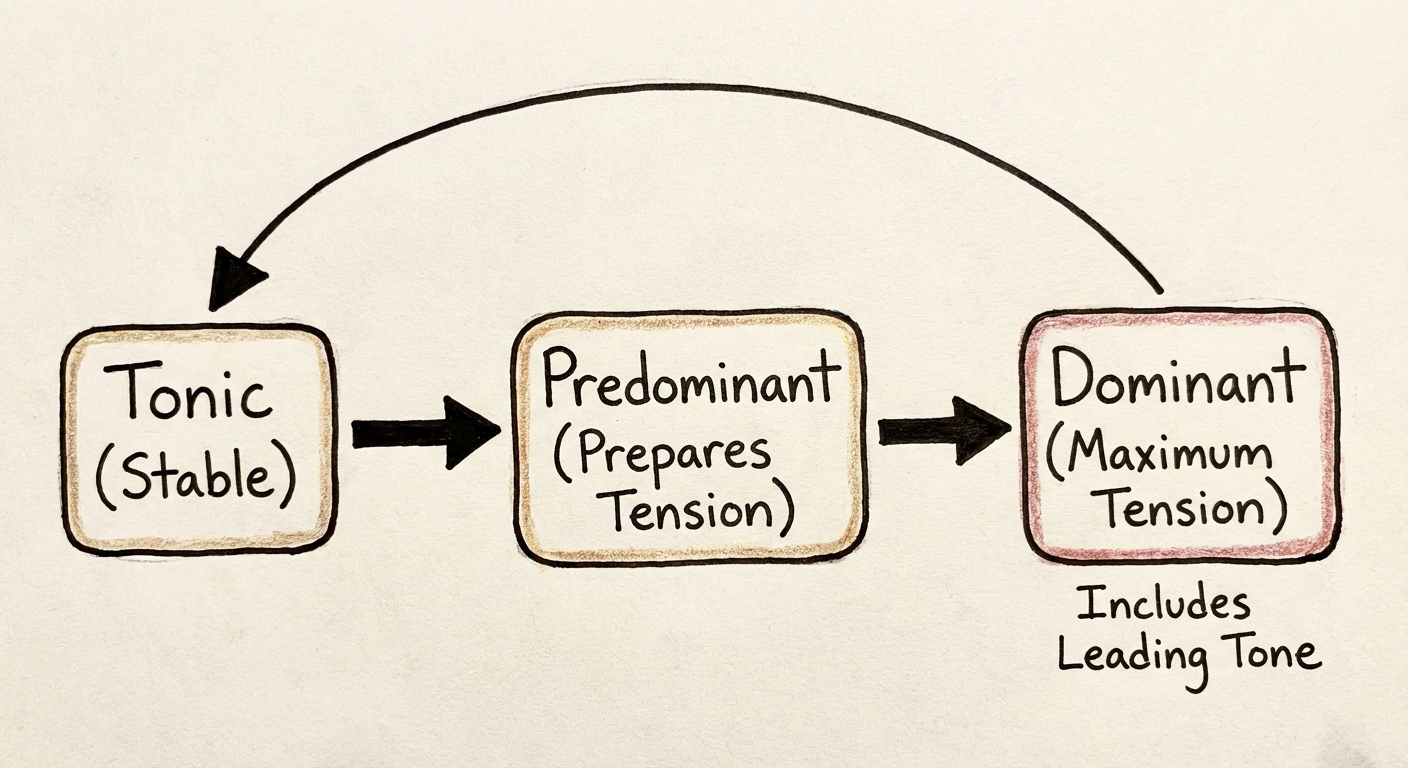
1. Part I: The Tonic Function (Stability)
- Role: The home base. It represents rest, stability, and resolution.
- Primary Chord: I (Major) or i (minor).
- Substitute: vi or VI (often used in Deceptive Cadences to prolong the phrase).
2. Part II: The Dominant Function (Tension)
- Role: The conflict or tension that demands resolution. The defining characteristic is the presence of the Leading Tone (scale degree 7), which pulls strongly upward to the Tonic (scale degree 1).
- Primary Chord: V and V$^7$ (the strongest dominant chords).
- Substitute: vii$^o$ or vii$^{o7}$ (leading-tone chords).
3. Part III: The Predominant (Subdominant) Function (Preparation)
- Role: Bridges the gap between Tonic and Dominant. It sets up the tension.
- Primary Chords: IV (iv) and ii (ii$^o$).
- Note: In AP Music Theory, the supertonic (ii) is considered a stronger predominant than the subdominant (IV) because its root movement to V is a descending 5th (strong root movement).
| Function | Major Key Chords | Minor Key Chords |
|---|---|---|
| Tonic | I, vi | i, VI |
| Predominant | IV, ii | iv, ii$^o$ |
| Dominant | V, vii$^o$ | V (must raise leading tone!), vii$^o$ |
Key Concept: You generally do not move backward from Dominant to Predominant (D S). This is called a "retrogression" and is usually avoided in Common Practice style.
Cadences: The Punctuation of Music
A Cadence is a harmonic goal—a resting point at the end of a phrase. Think of cadences as punctuation marks (periods, commas, question marks). Identifying cadences requires looking at the last two chords of a musical phrase.
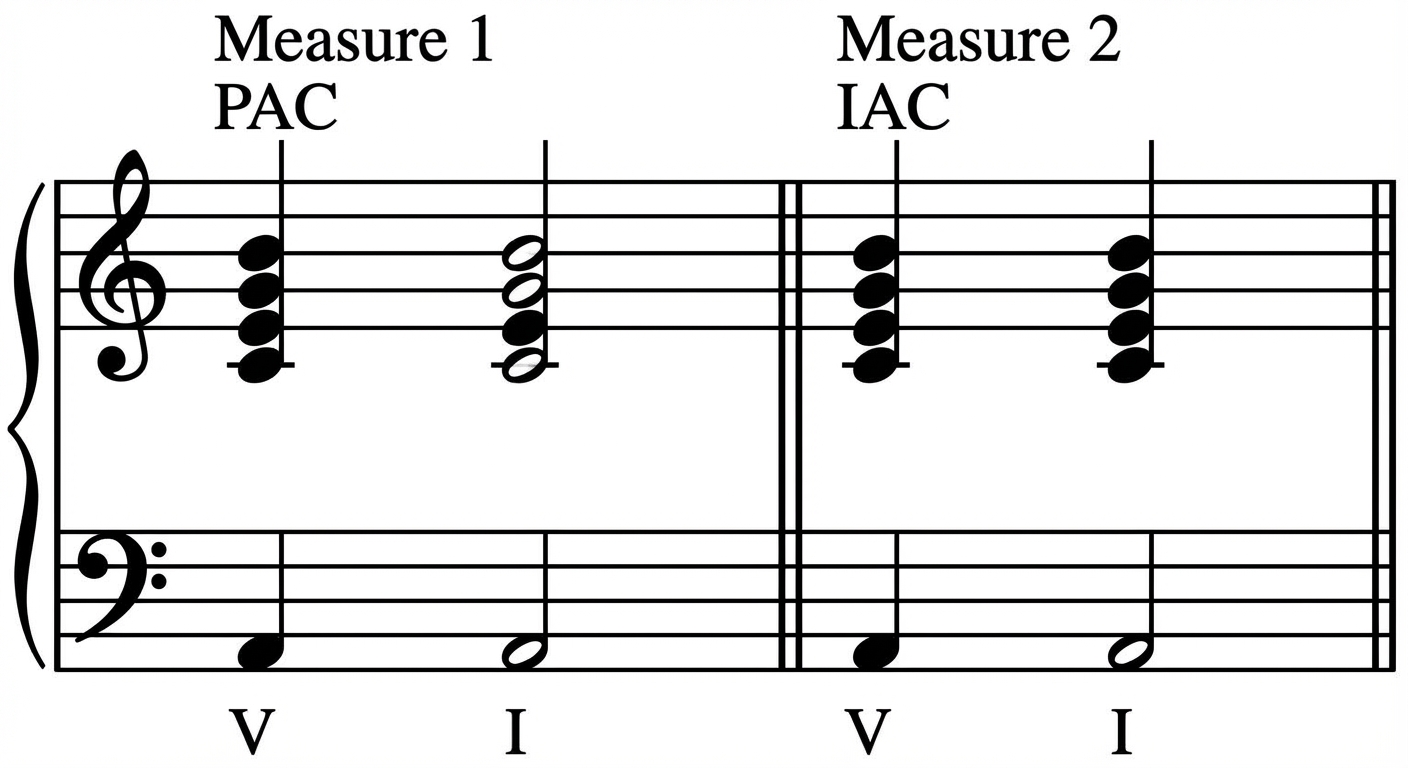
1. Authentic Cadences (V I)
The most conclusive cadence type. It represents a full stop.
Perfect Authentic Cadence (PAC)
Ideally, this is the strongest finish in music.
- Progression: V I (or V$^7$ I).
- Condition A: Both chords must be in Root Position.
- Condition B: The Soprano must end on Scale Degree 1 (Do) in the final chord.
Imperfect Authentic Cadence (IAC)
Still V I, but "weaker" because it fails one of the PAC tests.
- One or both chords are inverted.
- The Soprano ends on Scale Degree 3 (Mi) or 5 (Sol).
2. The Half Cadence (Ends on V)
This sounds like a question mark or a comma. It feels unfinished and demands a continuation.
- Progression: Anything V.
- The most common approach is I V or IV V.
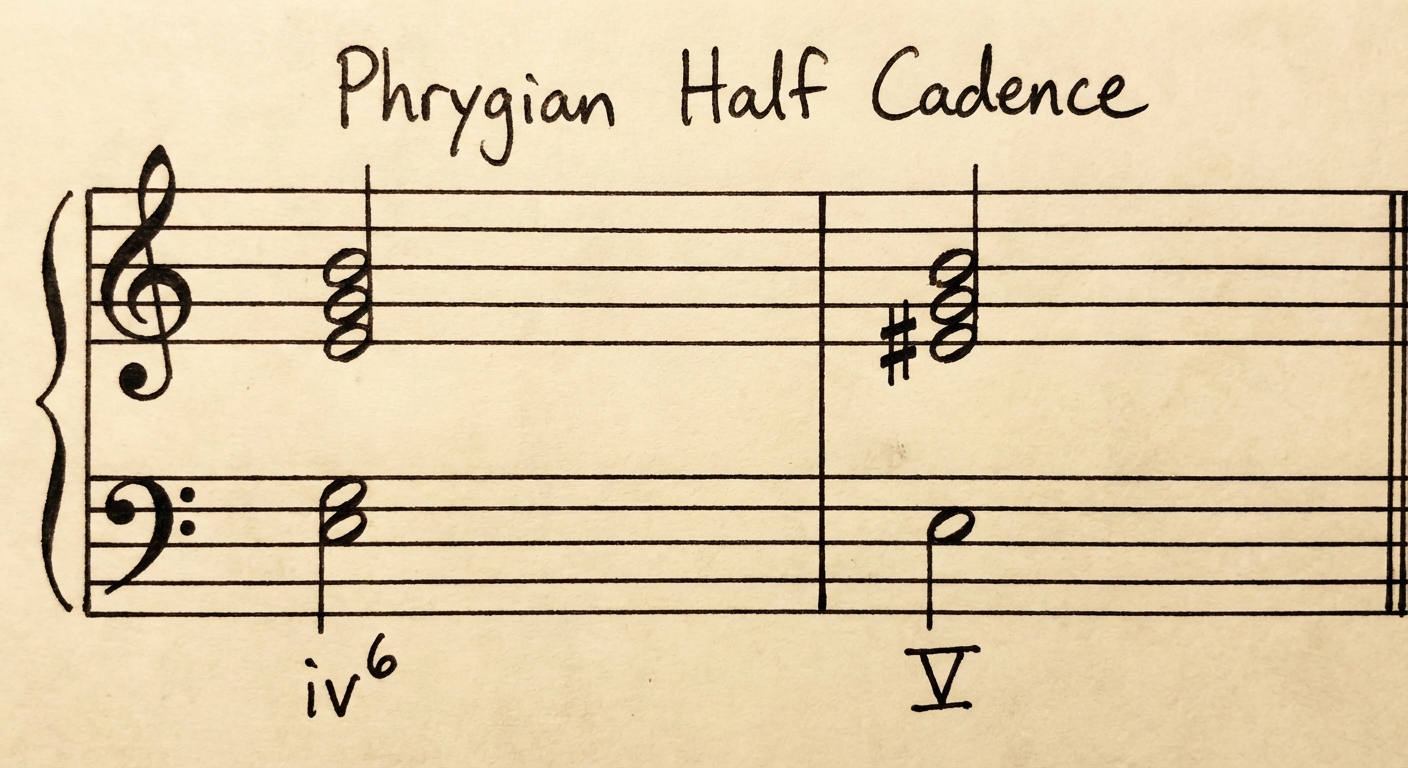
The Phrygian Half Cadence
A specific type of half cadence found only in minor keys.
- Progression: iv$^6$ V.
- Voice Leading: The bass moves down by half-step () while the soprano usually moves up by whole step (). This contrary motion is highly characteristic.
3. The Plagal Cadence (IV I)
Often called the "Amen" cadence. It creates a sense of "post-resolution" rather than active resolution, as it lacks the leading tone.
- Progression: IV I (or iv i).
4. The Deceptive Cadence (V vi)
The "Psych Out." The ear expects the V to resolve to I, but it goes to the submediant (vi/VI) instead.
- Progression: V vi (Major) or V VI (minor).
- Voice Leading Rule: In a V vi progression, the leading tone in the soprano MUST resolve up to tonic to avoid augmented intervals.
Phrase Structure and Period Form
A Phrase is a substantial musical thought that ends with a cadence. Generally, phrases are 4 measures long, though they can vary.
The Period
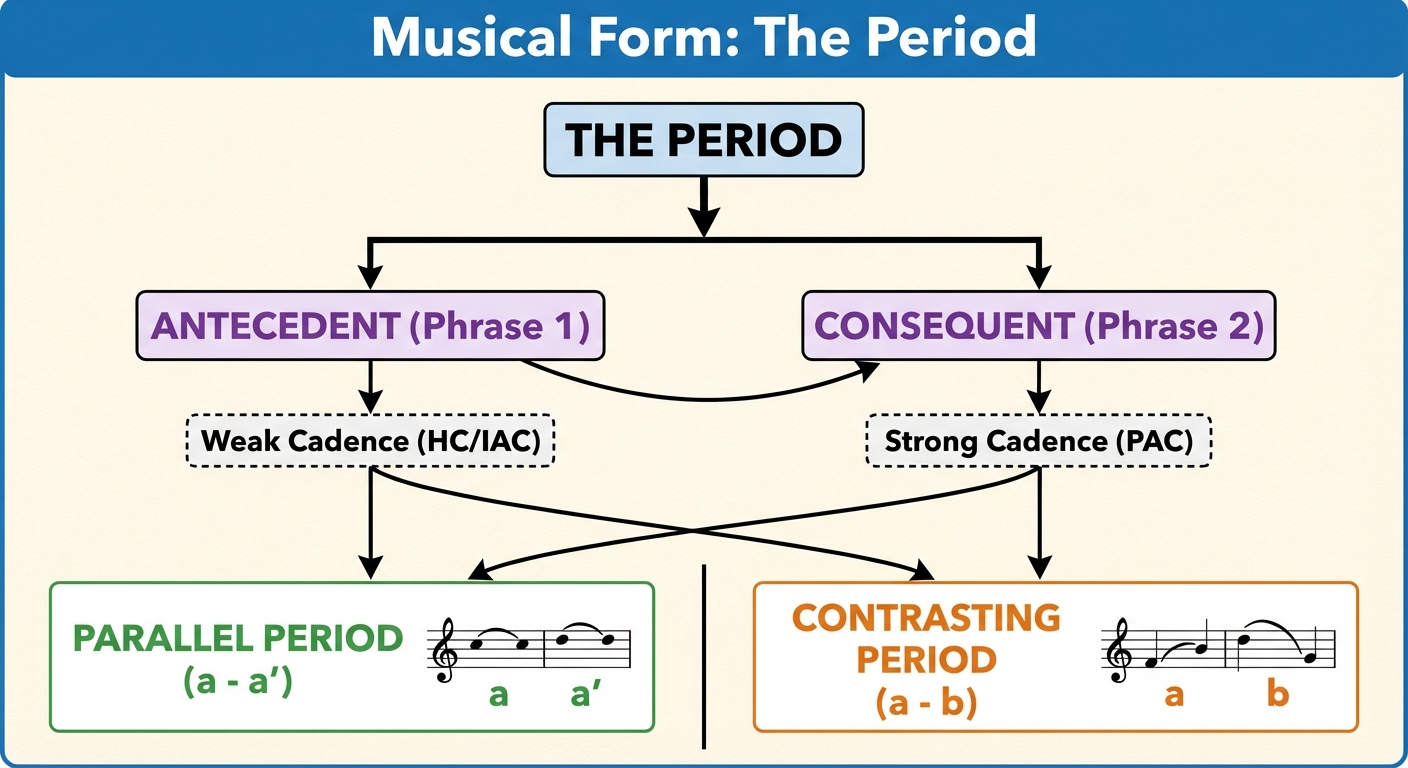
A Period is a pair of phrases that work together in an "Antecedent-Consequent" (Question-Answer) relationship.
- Phrase 1 (Antecedent): Ends with a weak cadence (usually a Half Cadence or IAC).
- Phrase 2 (Consequent): Ends with a strong cadence (usually a PAC) that feels more final than the first.
Types of Periods
To identify the type of period, compare the melodic material at the beginning of both phrases.
1. Parallel Period ($a$ … $a'$)
- The second phrase begins with the same melody as the first phrase (or very similar).
- Example: Phrase 1 starts with a specific motif; Phrase 2 starts with that same motif but alters the ending to achieve a stronger cadence.
2. Contrasting Period ($a$ … $b$)
- The second phrase begins with different melodic material than the first.
- Despite the difference in melody, they still function as a pair because of the weak-strong cadence relationship.
Memory Aid: The Cadence Checklist
When analyzing a cadence, ask these questions in order:
- Does it end on V? Half Cadence (Check Bass: is it $iv^6$ to $V$ in minor? Then Phrygian).
- Does it end on vi? Check previous chord. If V vi, it's Deceptive.
- Does it end on I? Check previous chord.
- If IV I: Plagal.
- If V I: Authentic.
- Drill Down: Is the soprano on Do? Roots in bass? Yes = PAC. No = IAC.
Common Mistakes & Pitfalls
Confusing the Phrygian Half Cadence:
- Mistake: Calling any minor key cadence ending on V "Phrygian."
- Correction: It implies a specific bass motion: iv$^6$ to V. If the bass doesn't move scale degree , it is just a standard Half Cadence.
Misidentifying PACs:
- Mistake: Seeing a V going to I and automatically labeling it a PAC.
- Correction: Always check the Soprano voice. If the soprano ends on the 3rd or 5th of the chord, it is an IAC, even if it sounds strong.
The "vii°" Trap:
- Mistake: Thinking a cadence must use V.
- Correction: vii$^o$ I is also considered an Authentic cadence (usually IAC) because it has Dominant function resolving to Tonic, though V I is standard.
Period Identification:
- Mistake: Identifying a "Period" just because there are two phrases.
- Correction: A Period strictly requires the weak-to-strong cadence relationship. If Phrase 1 ends in a PAC and Phrase 2 ends in a PAC, that is a "Phrase Group," not a Period, because there is no sense of unresolved tension leading to resolution.