Exam 1
Ego Defense Mechanisms
| Name | Definition | Adaptive Use | Maladaptive Use |
|---|---|---|---|
| altruism | dealing with anxiety by reaching out to others | mother who lost child to drunk driver starts Mothers Against Drunk Driving | N/A |
| sublimation | dealing with unacceptable feelings or impulses by unconsciously substituting acceptable and constructive forms of expression | a person who just had an argument with gf goes on five mile run | N/A |
| suppression | voluntarily blocking unpleasant thoughts and feelings from consciousness | you fail MH exam but ignore it by starting to study for different subject | “tomorrow is another day” maladaptive bc you dont explore why you failed MH |
| splitting | demonstrating an inability to reconcile negative and positive attributes of self or others into cohesive image (hard time seeing something for what it is) | N/A | bf who was really nice at first starts to treat you badly but you still think hes a great guy |
| projection | attributing one’s unacceptable thoughts and feelings onto another person who does not have them | N/A | husband angrily says “youre so stubborn” when he is the one who is actually stubborn |
| reaction | unacceptable feelings or behaviors are controlled or kept out of awareness by overcompensating or demonstrating the opposite behavior | employee who despises boss goes to his annual holiday party and act like he really likes his boss | man having affair greets his wife saying “honey im home” |
| undoing | performing an act to make up for prior unacceptable thoughts or behavior | child cleans room after mouthing off | abusive husband says “im sorry. i love you. i promise ill never do it again” after giving wife black eye when angry |
| rationalization | creating reasonable and acceptable explanations for unacceptable feelings or behavior | someone tells themself “someone must have told a good joke” when they walk past a group that starts laughing as they walk by | woman who feels guilty after eating a whole box of cookies says “i had to eat them bc no one else would” |
| dissociation | disruption in consciousness, memory, identity, or perception of environment that results in compartmentalizing uncomfortable or unpleasant thoughts, feelings, or experiences (mentally removing yourself) | student who is studying blocks out construction noise outside | … |
| repression | unconsciously putting unacceptable ideas, thoughts and emotions out of conscious awareness | person who was molested as a child has no recollection of it | guy who has been wanting to break up with gf for awhile forgets he told her they would go out on Saturday |
| displacement | shifting feelings related to an object, person, or situation to another less threatening object, person, or situation | student who is angry about his grade on paper goes to batting cage and swings angrily at the balls | woman who just got in an argument with her bf yells at her mother over phone |
| denial | pretending the truth is not reality to manage unpleasant, anxiety-causing thoughts or feelings | patient whose breast cancer cause an open wound on her chest says, “its just a few cells” | person who just got third DUI says they do not have a drinking problem |
- Transference - patient views provider as being similar to someone they know
- how to address:
- Countertransference - provider view patient as being similar to someone they know
- how to address:
- self stigma - person w/ mental illness has negative stereotypes about themself
- how to respond:
- public stigma - negative stereotypes that cause people to fear, reject, and avoid people with mental illness
- how to respond:
- label avoidance - avoiding treatment to avoid being labeled as mentally ill
- how to respond:
Erikson’s Stages of Psychosocial Development
| Years | Developmental Task | Virtue | Successful Completion |
|---|---|---|---|
| 0-1 | Trust vs. Mistrust | Hope | Viewing world as safe and reliable; relationships as nurturing, stable, and dependable |
| 1-3 | Autonomy vs. Shame/Doubt | Will | achieving a sense of control and free will |
| 3-6 | Initiative vs. Guilt | Purpose | beginning development of a conscience; learning to manage conflict and anxiety |
| 6-12 | Industry vs. Inferiority | Competence | emerging confidence in own abilities; taking pleasure in accomplishments |
| 12-18 | Identity vs. Role Confusion | Fidelity | formulating sense of self and belonging |
| 18-35 | Intimacy vs. Isolation | Love | forming adult, loving relationships, and meaningful attachment to others |
| 35-65 | Generativity vs. Stagnation | Care | being creative and productive; establishing the next generation |
| 65-death | Integrity vs. Despair | Wisdom | Accepting responsibility for oneself and life |
Piaget’s Cognitive Stages of Development
| Age | Stage | Major Cognitive Developmental Task |
|---|---|---|
| birth - 2 | sensorimotor | |
| 2 - 7 | preoperational | |
| 7 - 11 | concrete operations | |
| 11 through adolescence | formal operations |
Interpersonal theories
- Sullivan (significance of interpersonal relationships)
- therapeutic milieu - sense of community through group therapy and recreational activities
- Peplau - therapeutic nurse client relationship
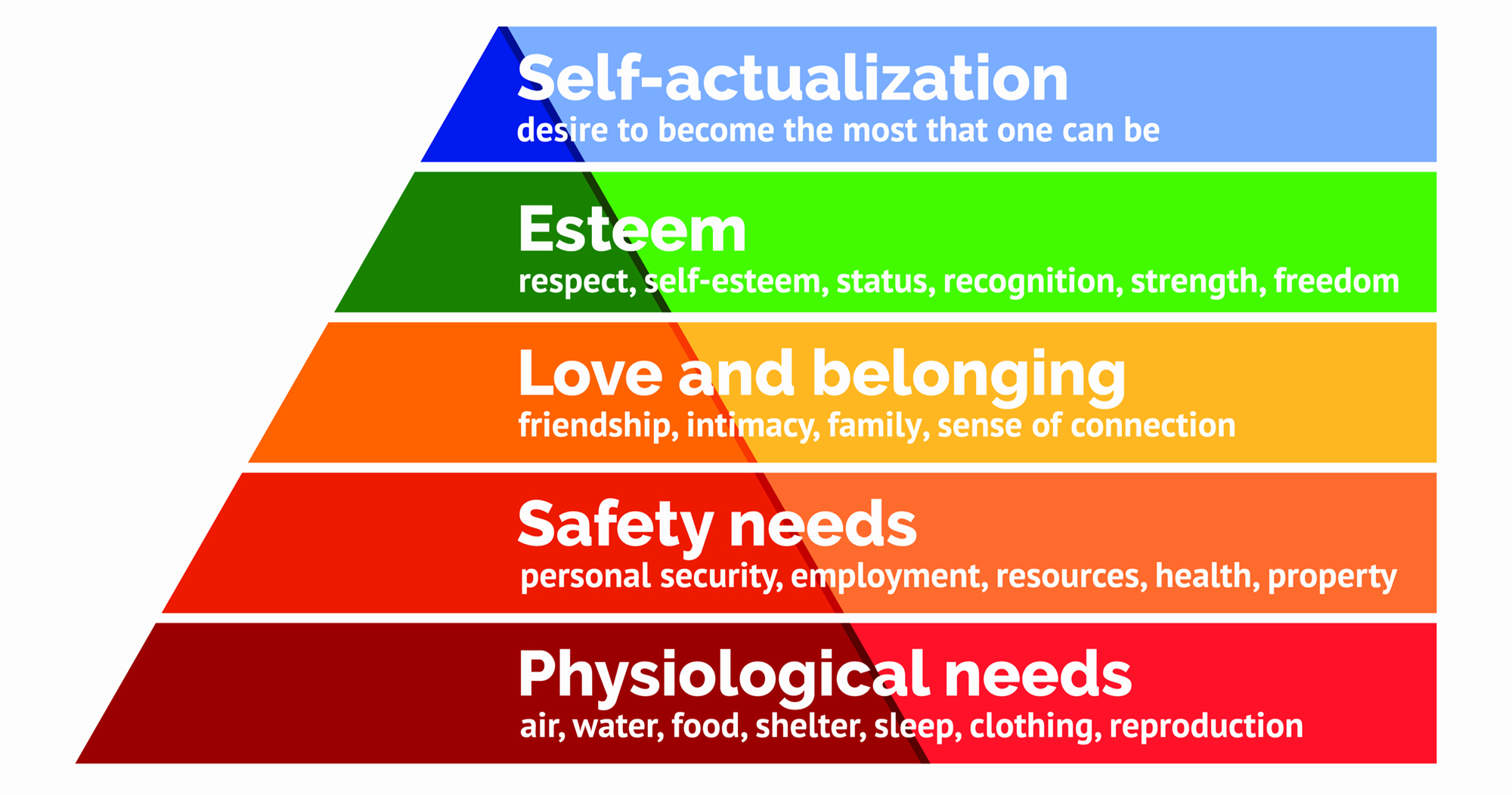
Maslow’s Hierarchy of Needs
Yalom’s Therapeutic Factors of Groups
- instillation of hope - generating and fostering sense of hope
- universality - involving all members of the group
- imparting of information - communicating and sharing information to members of the group
- altruism - selfless concern for others
- existential factors - learning how to exist as part of something larger than oneself
- catharsis - releasing and subsequently obtaining relief from strong repressed emotions
- development of socialization techniques -
- collective reputation of the primary family group - summarizing main points together
- imitative behavior - copying actions performed by another person; important in socialization
- interpersonal learning - provides self-insight and the development of social interaction skills
- group cohesiveness - the extent to which group members feel a sense of connection and unity to each other and the group’s goals
Types of Non-pharmacologic Therapies
- individual therapy
- group therapy
- family therapy
- cognitive behavioral
- modeling
- aversion
- systemic desensitization
- relaxation
- community meetings
- electroconvulsive
- psychiatric rehabilitation
Areas of Functioning within Families
| Healthy | Dysfunctional | |
|---|---|---|
| Communication | clear, understandable messages between family members; each member is encouraged to express thoughts and feelings | blaming - members blame other to shift focus away from their own inadequacies; manipulating - members use dishonesty to support their own agendas; placating - one member takes responsibility for problems to keep peace at all costs; distracting - member inserts irrelevant information during attempt at problem solving |
| Management | adults of family agree on important issues such as rule making, finances, and plans for future | management may be chaotic with child making management decisions |
| Boundaries | boundaries are distinguishable between family roles; clear boundaries define roles of each member and are understood by all; each member functions appropriately | enmeshed boundaries - thoughts, roles, and feelings blend so much that individual roles are unclear; rigid boundaries - these families tend to have members that isolate themselves |
| Socialization | all members interact, plan, and adopt healthy ways of coping; children learn to function as family members as well as members of society; members are able to change as the family grows and matures | children do not learn healthy socialization skills within the family and have difficulty adapting to socialization roles of society |
| Emotions and Support | emotional needs of family are me most of the time and memnbers have concerns about each other; conflict and anger do not dominate | negative emotions predominate most of the time; members are isolated and afraid and do not show concern for each other |
Challenging Group Behaviors and How to Respond
Monopolizer
- decide if, how, when to intervene
- politely interrupt by acknowledging contribution then redirect discussion
- may choose to limit discussion time per member
“Yes, but…”
- avoid problem solving
- encourage person to develop own solution
Disliked member
- show respect
- acknowledge contribution
- stay neutral
- avoid displaying negative verbal and nonverbal behaviors
Silent member
- respect person’s silent nature
- understand meaning of person’s silence before encouraging interaction
Group Conflict
- determine if conflict is natural part of group process or whether group needs to address issues
- with leader to member conflict, be sensitive to power differential
- handle conflict through conflict resolution if needed
Issues and Appropriate Responses
Veterans
- Issues
- reluctant to seek treatment; stigma
- treatment may not be readily available
- high rates of suicide, homicide, injury
- more PTSD
- sleep disorders, substance abuse, and family dysfunction
Homeless
- Issues
- spend more time in jail
- homeless longer
- spend more time in shelters
- less family contact
- greater barriers to employment
- Responses
- Projects for Assistance in Transition from Homelessness (PATH) program
- Funds: community-based outreach, mental health, substance abuse, case management, limited housing
- ACCESS Demonstration Project
Incarceration
- Issues
- deinstitutionalization
- more rigid criteria for civil commitment
- lack of adequate community support
- economizing treatment for mental illness
- attitudes of police and society