Customer Service
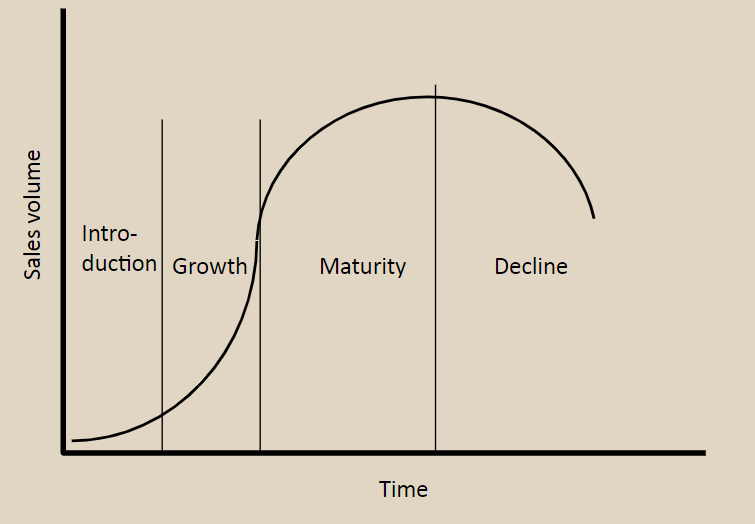
Product Life-Cycle Curve
 Nature of the Product
Product Characteristics
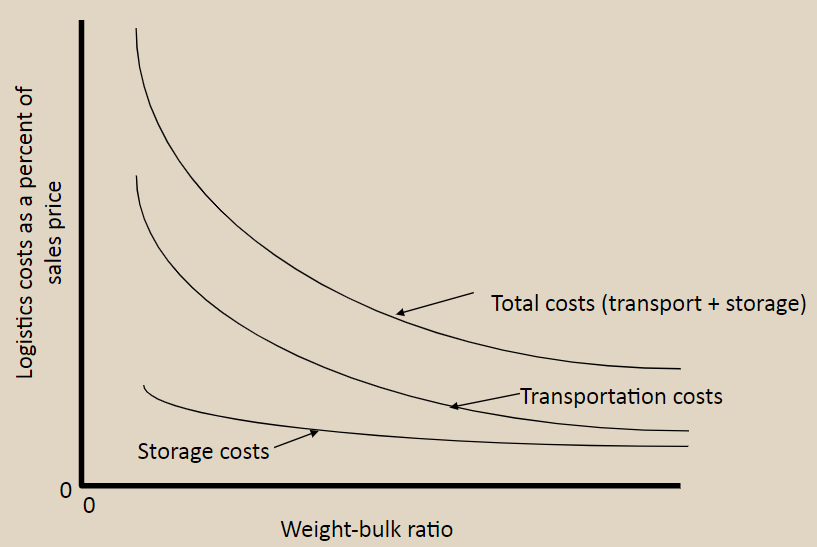
Weight-buld ratio.
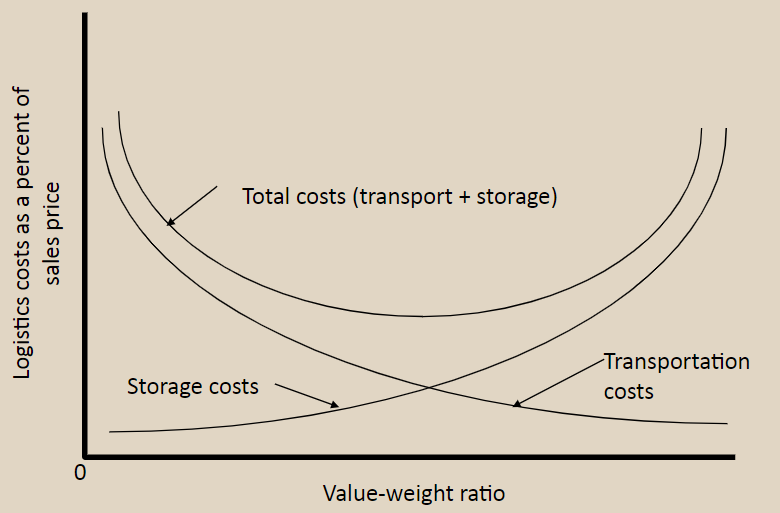
Value-weight ratio.
Substitutability.
Risk.
Effect of Weight-Bulk Rati on Logistics Costs
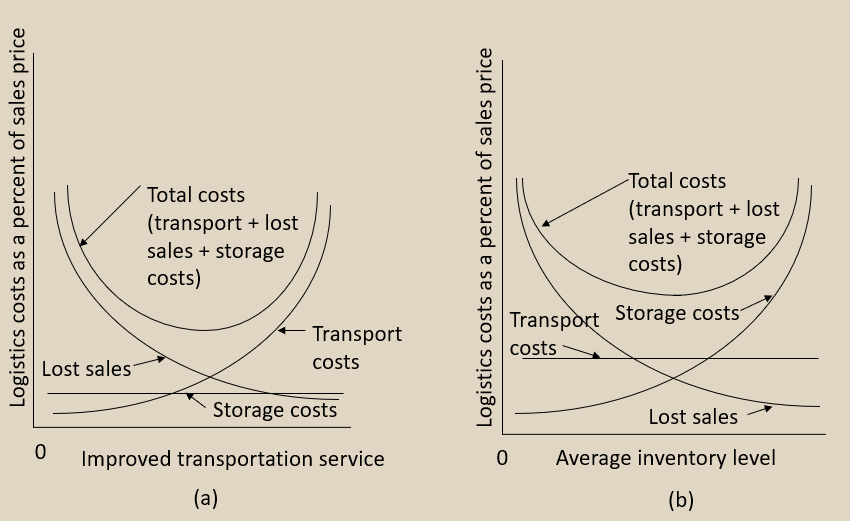
 Effect of Transport Service and Inventory Level on Logistics Costs
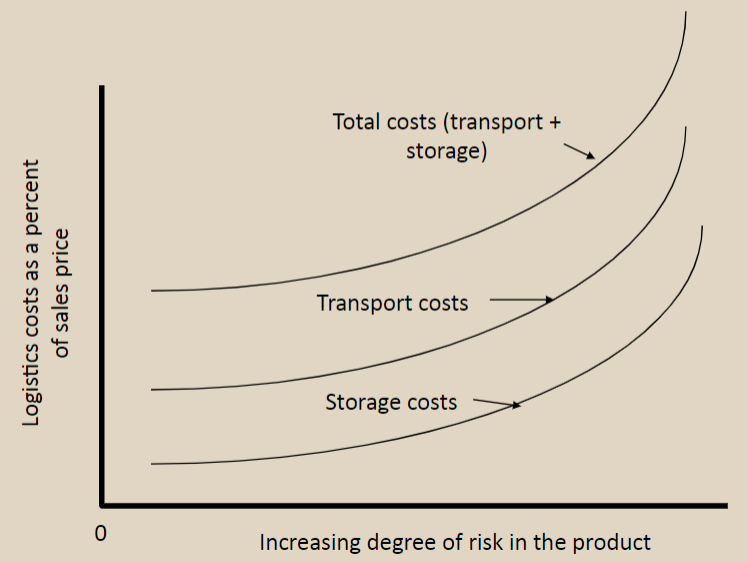 Nature of the Product Continued
Product Packaging
Facilitate storage and handling.
Promote better utilization of transport equipment.
Provide product protection.
Promote the sale of the product.
Change the product density.
Facilitate product use.
Provide reuse value for the customer.
Product Pricing
Geographic Pricing Methods
Incoterms (e.g., F.O.B. pricing).
Zone pricing.
Single or uniform pricing.
Freight equalization.
Basing point pricing.
Customer Service Defined
Customer service is generally presumed to be a means by which companies attempt to differentiate their product, keep customers loyal, increase sales, and improve profits.
It’s elements are:
Price.
Product quality.
Service.
It is an integral part of the marketing mix of:
Price.
Product.
Promotion.
Place (Physical Distribution).
Most Important Customer Service Elements
On-time delivery.
Order fill rate.
Product condition.
Accurate documentation.
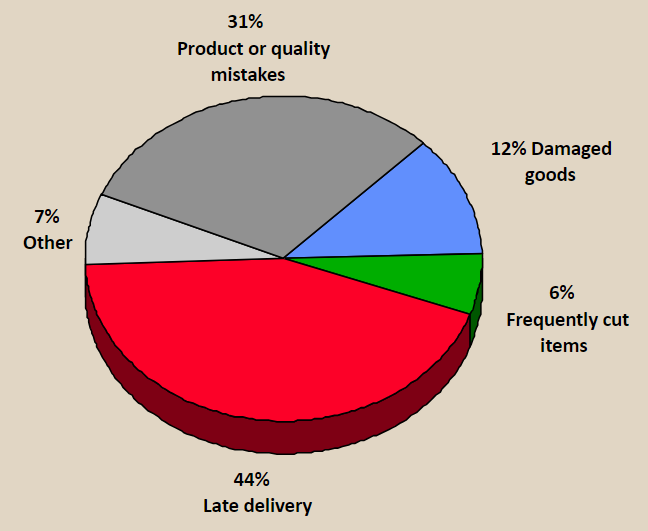
Common Customer Service Complaints
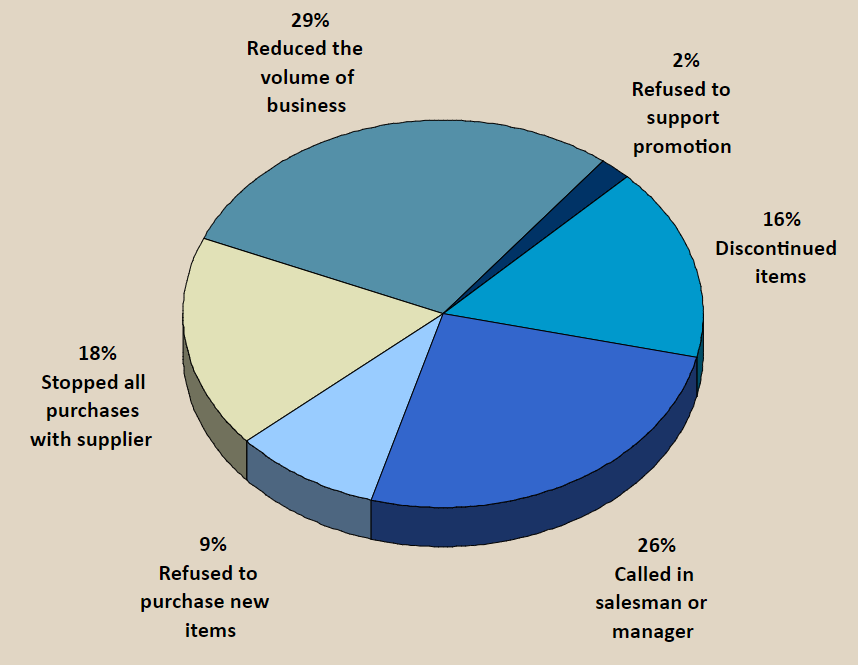
 Penalties for Customer Service Failures
 Order Cycle Time
Order cycle time contains the basic elements of customer service where logistics customer service is defined as:
The time elapsed between when a customer order, purchase order, or service request is placed by a customer and when it is received by that customer.
Order cycle elements
Transport time.
Order transmittal time.
Order processing and assembly time.
Production time.
Stock availability.
Order cycle time is expressed as a bimodal frequency distribution.
Constraints on order cycle time.
Order processing priorities.
Order condition standards (e.g., damage and filling accuracy).
Order constraints (e.g., size minimum and placement schedule).
Service Observations
The dominant customer service elements are logistical in nature.
Late delivery is the most common service complaint and speed of delivery is the most important service element.
The penalty for service failure is primarily reduced patronage, i.e., lost sales.
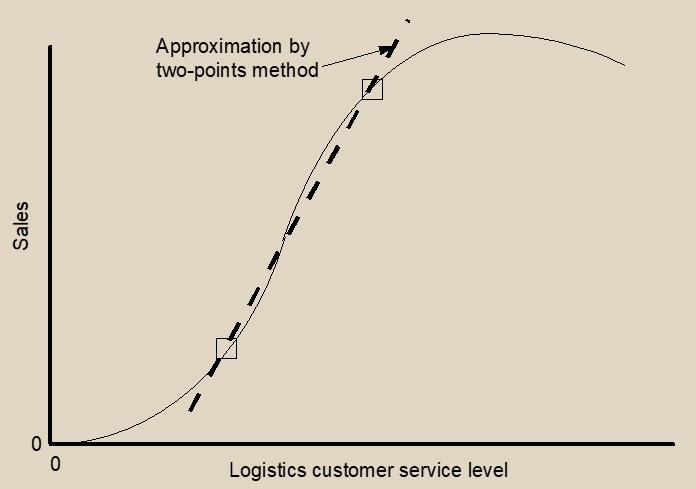
The logistics customer service effect on sales is difficult to determine.
Modeling a Sales-Service Relationship
A mathematical expression of the level of service provided and the revenue generated.
It is needed to find the optimal service level.
A theoretical basis for the relationship.
Sales-Service Relationship by the Two-Points Method
 Cost-Revenue Tradeoffs
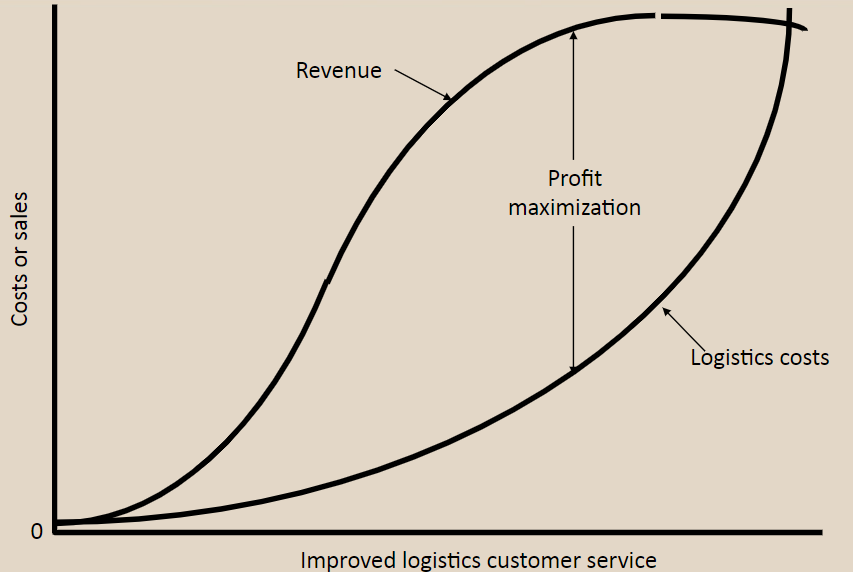 Determining Optimum Service Levels
Cost vs. service.
Theory
Optimum profit is the point where profit contribution equals marginal cost.
Practice
For a constant rate:
 Example
Given the following data for a particular product
Sales response rate = 0.15% change in revenue for a 1% change in the service level (fill rate)
Trading margin = $0.75 per case
Carrying cost = 25% per year
Annual sales through the warehouse = 80,000 cases
Standard product cost = $10.00
Demand standard deviation = 500 cases per week
Lead time = 1 week
Setting Service Levels
Service is treated as a constraint on design.
Planning for service contingencies.
Measuring Service Performance
Percent of sales on backorder.
Number of stockouts.
Percent of on-time deliveries.
The number of inaccurate orders.
Order cycle time.
Fill rate--% of demand met, % of orders filled complete, etc.
Service Contingencies
System Breakdown Actions
Insure the risk.
Plan for alternate supply sources.
Arrange alternate transportation.
Shift demand.
Build quick responses to demand shifts.
Set inventories for disruptions.
Product Recall Actions
Establish a task force committee.
Trace the product.
Design a reverse logistics channel.