Week 7 - Wind Energy
Energy basics
Energy basics
First law of thermodynamics:
You can neither create or destroy energy
But it can change forms
Energy conversion processes

Energy units
Energy is measured in Joules (J)
A joule is the energy exerted when applying 1 Newton over one meter
A watt is a joule per second (W = Js-1)
Watts are also amps*volts
A kilowatt hour (kWh) is a measure of energy

Why does the wind blow?
Why does the wind blow?
More solar radiation received at the equator
Nature “dislikes” gradients
will try to smooth it out
Moves warm air aloft and towards the poles
Moves cool air away from the poles
Results in a three cell set up in each hemisphere
Hadley circulation
Rotation of the Earth results in circular movements of air masses
Cyclones and anti-cyclones
Prevailing Winds - large scale

Wind profile and surface roughness

The rougher the surface the more friction there is and the slower the wind speeds.
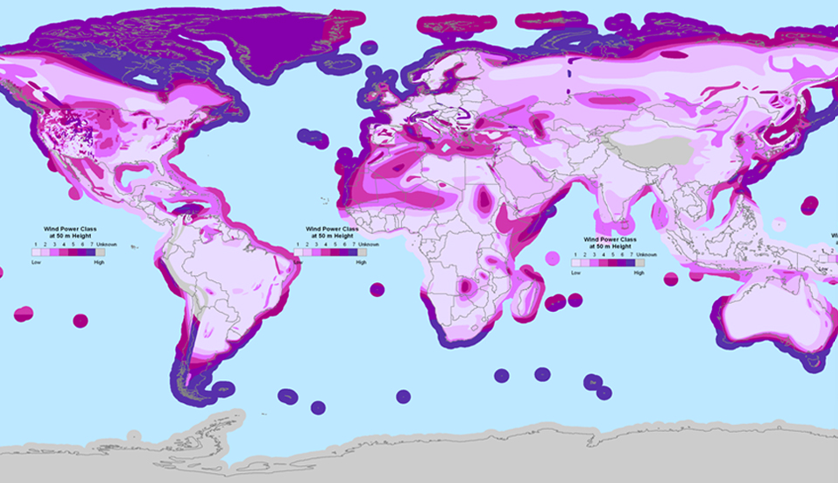
Global wind resources
Best resources
Mid and high latitudes
Coastal or elevated areas
Drops rapidly inland
Australia has excellent resources
Tropics not so good
Continental interiors generally not much good either
Parts of a turbine

Rotor
Most important part
Blades and the hub
At the connection points there are drives which allow the turbine to change the pitch of the blades
Main shaft
Takes rotational energy from the rotor converting it from the revolutions from the gear box
If wind direction changes the whole nacelle will turn using the yaw drive to ensure that the rotor is facing into the wind to maximise the energy efficiency.
Global wind deployment


Current state of the art
The largest offshore wind farm opened
Uses the world’s biggest turbines
Doggerbank, UK - 3.6GW
Golden Plains Wind Farm
Located in Western Victoria
Will be the largest wind farm in Australia when complete
1.3GW
Maths of wind energy
Wind energy maths
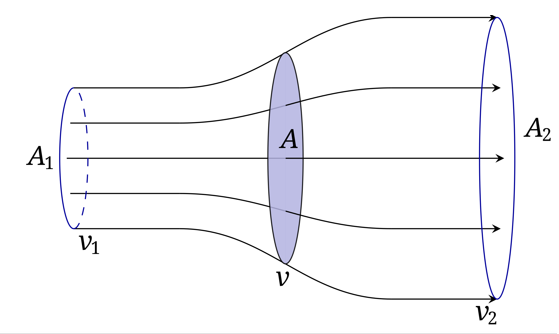
Flow through the disk turns the rotor
Lift and drag slows down the wind
Kinetic energy is transferred to rotor

How much power in the wind?
The mass of air passing through the swept area of a turbine is the velocity times the Area times the density
m = vAD
Area is the radius time pi squared. Radius of a large turbine can exceed 50m
A = πr2
So the energy that a turbine “sees” is
K = ½ πr2Dv3
BUT:
We can’t extract all the energy from the wind or it would stop, preventing more wind to flow through
The limit can be calculated by calculating by calculating the derivative of the power equation (Betz’ law)
This shows that the maximum extractable energy is 16/27 (59%) of the total available
How much power?
K = ½ πr2Dv3
Assume 50m radius turbine, air density of 1.23kg/m3 and a wind speed of 12m/s
What’s the total power avaliable?
8.35MW
What’s the maximum available once you take into account the Betz limit?
4.95MW
Power Curve, Weibull and Environment
Power curve
Wind turbines output is limited by turbine size
Cut-in speed about 3m/s
Cut-out speed at 25 m/s

No matter how high the wind speed is if the turbine isn’t big enough it won’t be able to collect that energy.
Above 25m/s wind speed will cause the turbine to automatically cut-out, the brakes will be applied and the blades with feather which is designed to protect the wind turbine from damage.
Weibull Curve for Wind Speed
A common way to describe variable wind speeds is to use histogram data and fit a Weibull distribution to it.


Things to consider when planning to build a wind farm
Wind resource
Is there enough wind?
Transmission capacity
If a line is there, is it already congested?
Road access
Heritage overlay/native claim
Flora and fauna (esp.birds) at risk in the area
Neighbours
Noise
Flicker effect
Visual amenity
Geology
Will the ground support the turbine towers