Calorimetry
Calorimetry: An experimental method for finding enthalpy change by measuring temperature change over time. When observed and plotted on a graph, data can be extrapolated to give an accurate value for the change in temperature.
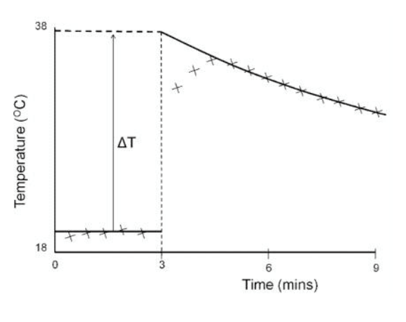
38 is the Tmax: the temperature before the reaction.
Calculating enthalpy change from experiments:
You will need to measure the following:
The temperature of the water/solution before and after the experiment has concluded
The mass of water/solution being heated
This will be the same as volume as water/dilute solutions have a density of 1gcm-3
The moles of reactant (limiting) that reacts this may be calculated from:
The mass of a fuel burnt
The concentration/volume of a reactant
Enthalpy change calculation:
Calculate the change in temperature
Calculate the heat transferred using q=mc△T
q = heat transferred in J
m = mass of the water/solution being heated
c = specific heat capacity 4.2Jg-1K-1
△T = change in temperature
When you know the heat transferred you need to calculate the moles that reacted
Divide the value of q by the moles
If the reaction was exothermic then make the value negative
Remember to convert Jmol-1 to kJmol-1