Unit 8
Unit 8: Marketing Mix - Pricing Concepts and Management
12-1 Price and Nonprice Competition
Price Competition:
- Emphasizes price as a key issue, focusing on matching or beating competitors' prices.Nonprice Competition:
- Involves emphasizing other factors besides price to distinguish a product from competing brands.Strategic Decision:
- The choice between price and nonprice competition depends on the preferences of the target market.
- If the target market prioritizes price, marketers will focus on pricing strategies. Conversely, if the market values factors like luxury or innovation, the marketing strategy will hinge on these non-price elements.
12-2 Development of Pricing Objectives
Pricing Objectives:
- Goals that outline what a firm wants to achieve through pricing strategies. Pricing objectives should align with the firm’s overall marketing and business objectives.
- Different approaches are:
1. Survival: Temporarily lowering prices to boost sales, even below costs (not sustainable long-term).
2. Profit: Seeking to maximize profit, although rarely implemented directly as it is difficult to achieve.
3. Return on Investment (ROI): Aiming for a specific return on investment.
4. Market Share: Targeting a particular share of the market. Setting a low price to grab as many customers as possible and become the "leader" in the market.
5. Cash Flow: Rapidly recovering cash, often crucial for products with short life cycles.
6. Status Quo: Maintaining existing market share, competing prices, or achieving price stability to sustain customer perception/output.
7. Product Quality: Setting prices based on production costs associated with a certain quality level.
12-3 Assessment of the Target Market's Evaluation of Price
The significance of price can differ based on:
- Type of Product: Is it discretionary? Conspicuous consumption?
- Target Market: Evaluates factors such as demographics, geographic location, behavior, and psychographics.
- Purchase Situation: Context of the purchase, such as impulse buys or urgent needs (e.g., broken car).Value Proposition:
- Value merges a product's price with quality attributes that clients use to differentiate products. Higher prices may be justified if products carry desirable features or promise great convenience.Consumer Behavior:
- Generally, consumers are inclined to pay more for products that save them time and offer convenience.
12-4 Analysis of Demand
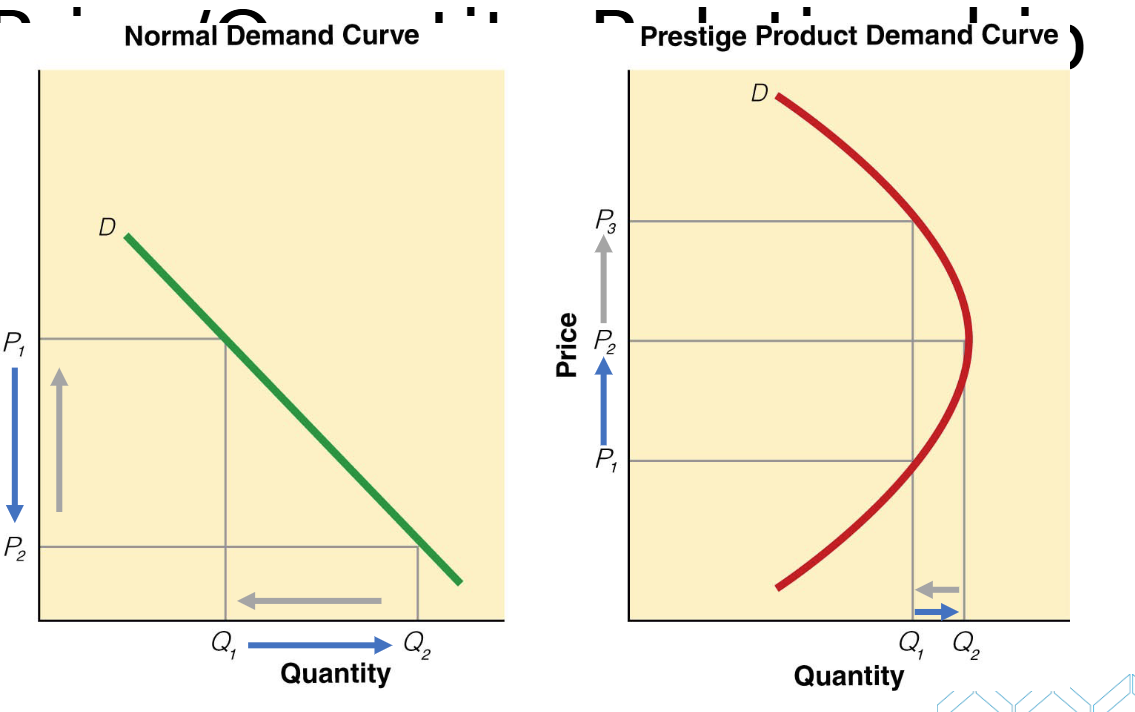
Demand Curve: A graphical representation showing the quantity of a product a firm anticipates selling at various prices under constant conditions.
- General rule: as prices drop, quantity demanded increases.
- Factors influencing demand include product quality, promotional efforts, and distribution effectiveness.
- Shifts in demand can result from improvements in these marketing mix factors.Luxury Products:
- Demand often paradoxically increases with higher prices, creating a prestige effect.
Demand Changes In Context
Factors influencing demand fluctuations:
- Changes in consumers’ needs
- Variability in marketing mix effectiveness
- Availability of substitute products
- A dynamic competitive environmentSome organizations forecast demand fluctuations, adapting products and pricing accordingly.
Assessing Price Elasticity of Demand
Price Elasticity of Demand:
- Measures how sensitive the quantity demanded is to price changes, calculated as:

- Elastic demand implies a significant change in quantity due to price changes, whereas inelastic demand results in minimal changes.Implications for Marketers:
- Understanding elasticity helps in pricing strategies; higher prices can be beneficial if the demand is inelastic.
- Costs and profit implications must also be analyzed alongside elasticity.
12-5 Demand, Cost, and Profit Relationships
Understanding these relationships is crucial for effective pricing strategies.
Marginal Analysis:
- Examines firm costs and revenues when production or sales volumes change by a single unit.
- Major terms include:
- Fixed Costs: Costs constant despite production levels.
- Average Fixed Cost: Fixed cost per unit produced.
- Variable Costs: Costs changing in direct relation to production levels.
- Average Variable Cost: Variable cost per unit produced.
- Total Cost: Sum of fixed and variable costs multiplied by quantity produced.
- Average Total Cost: Combined average fixed and variable costs.
- Marginal Cost (MC): Additional cost incurred by producing one more unit.
- Marginal Revenue (MR): Change in total revenue from the sale of one additional unit.
Breakeven Analysis
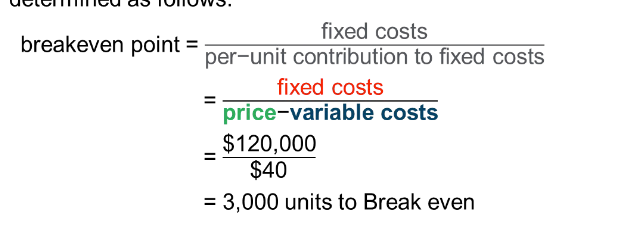
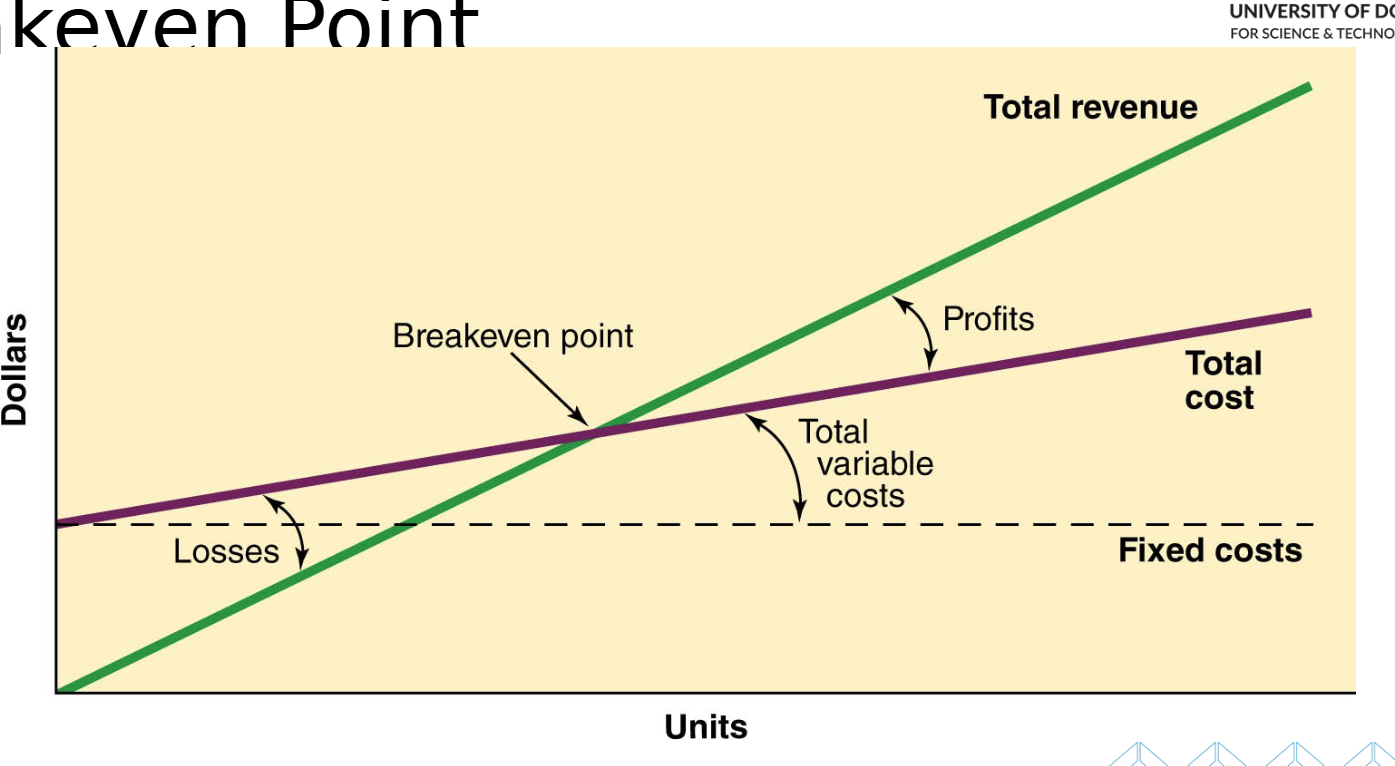
Breakeven Point:
- The juncture where production costs equal revenues from sales.
- Essential for pricing strategy as it determines units needed to cover fixed costs.
- Example Calculation:
- Given a product priced at $100 with an average variable cost of $60:
- Contribution to fixed costs per unit = $100 - $60 = $40
- Total fixed costs = $120,000
-
12-6 Evaluation of Competitors' Prices
Regularly assessing competitors' prices is vital for marketing research.
A firm must avoid:
- Pricing significantly higher than competitors, which can hinder sales due to perceived higher costs.
- Pricing far below competitors, which risks a perception of low quality.Some firms may intentionally price above competitors to convey exclusivity and product quality.
12-7 Selection of a Basis for Pricing
Bases for pricing include:
- Cost, Demand, and Competition:
- Organizations normally evaluate at least two, if not all three, bases promptly.
- Pricing equilibrium represents a delicate balance:
- High prices can diminish demand.
- Low prices can jeopardize profit margins.Other influencing factors include:
- Costs
- Competition
- Consumer buying behavior
- Manufacturing capabilities
- Product life cycles.
Types of Pricing Approaches
Cost-Based Pricing:
- Involves adding a dollar amount or percentage on top of production costs.
- Variants include:
- Cost-Plus Pricing: Adding a specific dollar amount or percentage to seller's costs.
- Markup Pricing: Adding a predetermined percentage to the cost price.Demand-Based Pricing:
- Prices shift based on market demand; higher when demand is strong, and lower when weak.Competition-Based Pricing:
- Predominantly influenced by competitor prices, common in industries with homogeneous goods.
12-8 Selection of a Pricing Strategy
Pricing Strategy: A structured approach aimed at fulfilling pricing objectives.
Influencing factors include:
- Pricing and marketing objectives
- Product market
- Degree of product differentiation
- Life cycle stage of the product.
Types of Pricing Strategies
New-Product Pricing:
- High demand and status can lead consumers to accept initial high pricing (price skimming).
- Penetration Pricing: Low entry pricing to quickly capture market share.Differential Pricing:
- Varies charges based on buyer segments, often used across diverse consumer groups.Psychological Pricing:
- Appeals to emotional rather than rational purchasing decisions (e.g., odd-number pricing, bundle pricing).Product-Line Pricing:
- Adjusts prices within a product line for consistency and competitiveness.Promotional Pricing:
- Special pricing strategies, including price leaders and seasonal discounts.
12-9 Determination of a Specific Price
A pricing strategy results in a target price or range. Refinement may be necessary for market alignment.
Steps to finalize pricing include:
- Establishing pricing objectives.
- Gaining extensive knowledge about the target market.
- Assessing demand, price elasticity, costs, and competition.Marketers must understand the impact of pricing in the marketing mix for optimal pricing decisions.
12-10 Pricing for Business Markets
Pricing strategy differs for business vs. consumer markets due to factors like purchase size and transportation concerns.
Geographic Pricing:
- Addresses cost differences due to distance; includes F.O.B. origin and F.O.B. destination pricing strategies.Transfer Pricing:
- Pricing for goods transferred between different units of an organization, which considers various costs.Discounting Policies:
- Ensures pricing flexibility and attractiveness for bulk purchasing, early payment, and other strategic incentives.