Relationships and families
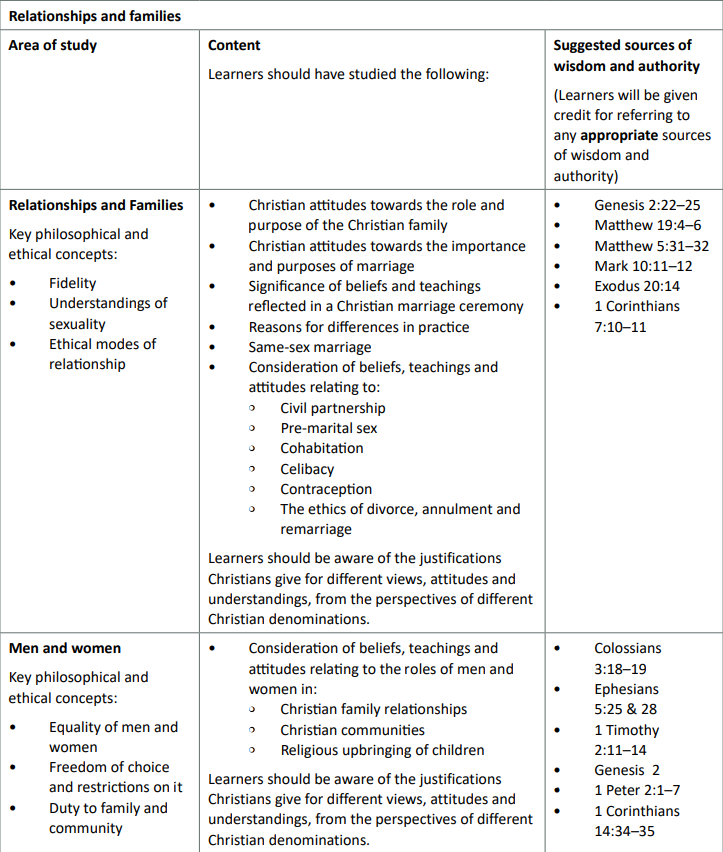
Key Philosophical and Ethical Concepts
Fidelity
Definition: Faithfulness and loyalty, especially in marriage.
Christian view: Mirrors the covenant between Christ and the Church (Ephesians 5:25).
Adultery: Forbidden as it breaks trust in marriage.
Bible Reference: "You shall not commit adultery" (Exodus 20:14).
Explanation: God values exclusive, faithful relationships; adultery is a serious sin.
Understandings of Sexuality
Traditional belief: Sexual activity belongs in heterosexual marriage for unity and procreation.
Conservative Christians: View same-sex relationships as sinful.
Liberal Christians: Accept homosexuality, focusing on love, fidelity, and justice.
Overall: Sexuality is a gift from God to be used responsibly.
Ethical Modes of Relationship
Marriage: A God-ordained, lifelong union.
Cohabitation: Accepted by liberals, rejected by conservatives.
Celibacy: Valued for devotion to God, especially in Catholicism.
Civil Partnerships: Accepted by some for legal rights; others oppose them, seeing them as undermining marriage.
Christian attitudes towards the importance and purposes of marriage
Marriage is seen as a sacred covenant and, for some (Catholics), a sacrament.
Purposes:
Union of husband and wife in love.
Procreation and raising children in the faith.
Reflecting the faithful relationship between Christ and the Church.
Bible reference: Matthew 19:4–6
Quote: "‘Haven’t you read,’ he replied, ‘that at the beginning the Creator made them male and female,’ and said, ‘For this reason a man will leave his father and mother and be united to his wife, and the two will become one flesh’? So they are no longer two, but one flesh. Therefore what God has joined together, let no one separate."
Explanation: Jesus confirms marriage as God’s design, permanent and sacred.
Significance of beliefs and teachings reflected in a Christian marriage ceremony
Vows: Promises made before God, showing seriousness and commitment.
Exchange of rings: Symbolises unending love and fidelity.
Readings and prayers: Emphasise marriage’s religious importance.
Blessings: Ask for God's presence in the couple's life.
Ceremonies reflect Christian teachings about the nature of love, commitment, and the divine role in marriage.
Reasons for differences in practice
Catholics: Marriage is a sacrament and cannot be dissolved (except by death); annulments are rare.
Protestants: Allow divorce and remarriage, often emphasising forgiveness and human weakness.
Liberal churches: May bless same-sex marriages.
Cultural influences: Some communities incorporate traditional customs with Christian ceremonies.
Same-Sex Marriage
Catholic and conservative Protestant views: Marriage should only be between a man and a woman.
Liberal Christian views: Emphasis on love and faithfulness leads some to affirm same-sex marriages.
Debate: Balances traditional biblical interpretation with modern understandings of love and equality.
Consideration of beliefs, teachings and attitudes relating to:
Civil partnership
Accepted by some Christians (for legal rights and protections).
Others oppose it, arguing that it undermines the sanctity of marriage.
Pre-marital sex
Traditional view: Sex is only for marriage, as it is a physical expression of spiritual unity.
Liberal view: Acceptable in a committed, loving relationship.
Seen by conservatives as dishonouring God's gift of sexuality.
Cohabitation
Living together without marriage.
Conservatives: Reject it as sinful.
Liberals: May accept it but encourage marriage eventually.
Celibacy
Choosing not to marry or have sexual relationships, often for religious devotion.
Seen as a calling by God (especially in Catholicism).
Paul praised celibacy as allowing a person to focus entirely on God (1 Corinthians 7).
Contraception
Catholics: Only natural methods are acceptable; artificial contraception is sinful because it separates sex from procreation.
Protestants: Many accept contraception as responsible family planning within marriage.
The ethics of divorce, annulment and remarriage
Divorce:
Catholics: Generally not permitted; only annulments allowed (if marriage was invalid from the start).
Protestants: Divorce accepted as a sad reality in a fallen world; remarriage often permitted.
Bible references:
Matthew 5:31–32
Quote: "It has been said, ‘Anyone who divorces his wife must give her a certificate of divorce.’ But I tell you that anyone who divorces his wife, except for sexual immorality, makes her the victim of adultery, and anyone who marries a divorced woman commits adultery."
Explanation: Jesus restricts divorce, highlighting its serious consequences.
Mark 10:11–12
Quote: "Anyone who divorces his wife and marries another woman commits adultery against her. And if she divorces her husband and marries another man, she commits adultery."
Explanation: Reaffirms marriage’s lifelong commitment.
Bible References (with Quotes and Explanations):
Genesis 2:22–25
Quote: "Then the Lord God made a woman from the rib he had taken out of the man, and he brought her to the man. The man said, 'This is now bone of my bones and flesh of my flesh; she shall be called "woman," for she was taken out of man.' That is why a man leaves his father and mother and is united to his wife, and they become one flesh."
Explanation: Establishes marriage as a God-ordained, lifelong union between man and woman.
Exodus 20:14
Quote: "You shall not commit adultery."
Explanation: Protects the sanctity of marriage and family life.
1 Corinthians 7:10–11
Quote: "To the married I give this command (not I, but the Lord): A wife must not separate from her husband. But if she does, she must remain unmarried or else be reconciled to her husband. And a husband must not divorce his wife."
Explanation: Paul urges married couples to stay together, emphasising reconciliation rather than separation.
Equality of Men and Women
Christian View: Christians believe men and women are equal in worth before God, though roles differ, especially in family and church.
Biblical Teaching:
Men and women are made in the image of God (Genesis 1:27), implying equality in value.
Some interpretations suggest different roles in family and church life, though equal in essence.
Freedom of Choice and Restrictions on It
Christian Perspective on Freedom:
Freedom is a gift from God but must be used responsibly.
Freedom should not lead to sin or harm others.
For example, some denominations restrict women from leadership roles in the church, while others support it.
Biblical Teaching:
Galatians 3:28: “There is neither Jew nor Greek, slave nor free, male nor female, for you are all one in Christ Jesus.”
Explanation: This passage affirms equality in Christ, highlighting equal status before God in spiritual terms.
Duty to Family and Community
Role of Men and Women:
Men are traditionally seen as breadwinners and protectors, while women nurture and care for children.
These roles are evolving, with many women working professionally and men contributing to family care.
Both have a duty to love and serve their families and communities.
Roles of Men and Women in Christian Family Relationships
Traditional View:
The man is the head of the household, and the woman supports him.
Supported by the Bible, teaching that men lead while women care for families.
Bible Reference:
“Wives, submit yourselves to your husbands, as is fitting in the Lord. Husbands, love your wives and do not be harsh with them.” (Colossians 3:18–19)
Explanation: Paul calls women to submit and men to love with sacrificial love, ensuring mutual respect.
Complementarian View:
Men and women have complementary roles, both equally important in God’s design, with men leading in some areas.
Egalitarian View:
Men and women are equal in both family roles and leadership, rejecting dominance by one gender.
Roles of Men and Women in Christian Communities
Traditional View:
Many denominations teach that men should hold leadership roles (pastors, elders), while women often serve in supporting roles like teaching children.
Bible Reference:
“I do not permit a woman to teach or to assume authority over a man; she must be quiet.” (1 Timothy 2:12)
Explanation: Some see this as restricting women’s authority in church, while others argue it's culturally specific and not universally applicable.
Modern View:
Many accept women as preachers and leaders, arguing the gifts of the Spirit are not limited by gender.
Bible Reference:
“In Christ, there is no male and female, for all are one in Christ Jesus.” (Galatians 3:28)
Explanation: Supports women in leadership, as all believers are equal in Christ.
Religious Upbringing of Children
Parental Roles:
Both men and women share responsibility for raising children in faith.
Fathers often seen as spiritual leaders, while mothers nurture and care for children.
Cultural traditions may shape these roles.
Bible References and Their Explanations
Colossians 3:18–19:
“Wives, submit yourselves to your husbands, as is fitting in the Lord. Husbands, love your wives and do not be harsh with them.”
Explanation: Paul stresses a reciprocal relationship: wives submit, but husbands love with gentleness, ensuring mutual respect and care.
Ephesians 5:25 & 28:
“Husbands, love your wives, just as Christ loved the church...” (v. 25)
“Husbands ought to love their wives as their own bodies...” (v. 28)
Explanation: These verses emphasize sacrificial love, likening it to Christ’s love for the Church, indicating leadership should be marked by love.
1 Timothy 2:11–14:
“A woman should learn in quietness and full submission...”
Explanation: Often cited to restrict women’s leadership in church, but some argue it was culturally specific to that time.
Genesis 2:
“It is not good for the man to be alone. I will make a helper suitable for him.” (v. 18)
Explanation: Women were created as helpers and partners, emphasizing complementary roles between genders.
1 Peter 2:1–7:
“Wives, in the same way submit yourselves to your own husbands...” (v. 1)
Explanation: Wives are instructed to exhibit Christ-like character, influencing husbands through respectful and gentle behavior.
1 Corinthians 14:34–35:
“Women should remain silent in the churches...”
Explanation: A debated passage regarding women’s role in church; some see it as cultural, others as a universal ban. Many modern churches interpret it as specific to the Corinthian situation.
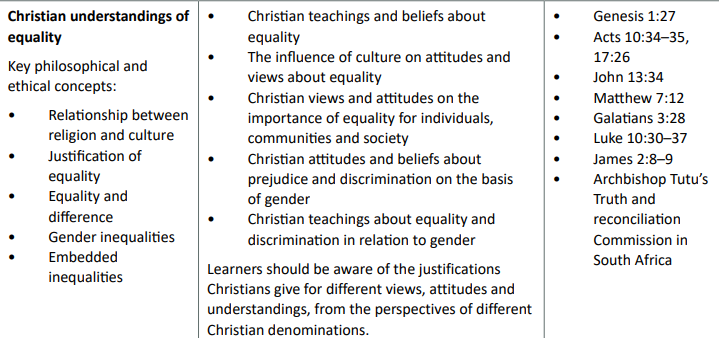
Relationship Between Religion and Culture
Christian Understanding:
Christianity intersects with culture, shaping and being shaped by cultural practices.
Different cultures interpret Christian teachings in various ways, influencing the understanding of equality.
Some cultural practices may clash with religious teachings on equality, such as gender roles or caste systems.
Christian Response:
Christianity emphasizes equality before God, urging believers to challenge cultural norms that cause injustice.
The Bible advocates for love and unity, transcending cultural and social barriers.
Justification of Equality
Christian Perspective:
All people are created in the image of God, providing the foundation for equality.
Equality is supported by Jesus' teachings, modeling compassion, inclusion, and respect for all individuals, regardless of status.
Equality and Difference
Christian View:
Christianity teaches that all people are equal in value but may have different roles, gifts, and responsibilities.
Men and women are equal in dignity, though traditional interpretations may assign different roles in family and church life.
The Bible emphasizes unity in diversity, with different gifts and roles contributing to the community’s good.
Gender Inequalities
Christian Perspective:
Traditional Christian views have been influenced by patriarchal structures, leading to gender inequalities.
Modern interpretations increasingly focus on gender equality, with many denominations ordaining women and emphasizing their equal role in church leadership and family life.
Biblical Basis:
Scriptures like Galatians 3:28 and John 13:34 support equality, arguing that in Christ, all gender distinctions are secondary to the shared value of all believers.
Embedded Inequalities
Understanding of Embedded Inequalities:
These are inequalities ingrained in society, culture, and institutions, such as patriarchy, racial discrimination, and economic disparities.
Christianity calls believers to challenge such systems, using Christ’s teachings to advocate for justice and equality.
The church’s role varies by denomination, but there is a general consensus that Christians should work to overcome injustice.
Christian Teachings and Beliefs about Equality
Christian Teachings about Equality:
Christianity teaches that all people are equal in the eyes of God, regardless of race, gender, or social status.
Genesis emphasizes that all human beings are created in God’s image, affirming inherent equality.
Bible Reference:
“So God created mankind in his own image, in the image of God he created them; male and female he created them.” (Genesis 1:27)
Explanation: This passage emphasizes that both men and women were created in God's image, affirming their equal worth and dignity.
The Influence of Culture on Attitudes and Views About Equality
Christian Perspective:
Christianity influences culture by promoting values of equality, love, and justice.
Cultural attitudes like patriarchy or racial segregation may influence how Christian teachings are applied.
Example:
In some cultures, the church’s stance on equality may clash with cultural practices like gender-based violence or discrimination.
Influence of the Church:
The church has often worked to challenge unjust cultural norms.
For example, the church played a significant role in the Civil Rights Movement in the U.S., advocating for racial equality based on Christian principles of justice and human dignity.
Christian Views and Attitudes on the Importance of Equality for Individuals, Communities, and Society
Christian Understanding:
Equality is vital for individual flourishing and the wellbeing of communities and society.
Jesus’ teachings on loving one’s neighbor (Matthew 7:12) emphasize fairness and respect, which are crucial for building just societies.
Equality fosters social harmony, allowing all individuals to contribute to the common good without fear of discrimination or oppression.
Christian Attitudes and Beliefs About Prejudice and Discrimination on the Basis of Gender
Prejudice and Discrimination:
Christianity condemns discrimination based on gender, race, or social status.
The Bible teaches believers to treat others with respect and love, rejecting all forms of prejudice.
Bible Reference:
“There is neither Jew nor Greek, slave nor free, male nor female, for you are all one in Christ Jesus.” (Galatians 3:28)
Explanation: This passage teaches equality in Christ, urging believers to avoid discrimination.
Christian Teachings About Equality and Discrimination in Relation to Gender
Christian Teachings:
Many denominations are revising their views on gender roles, especially in church.
While traditional views may limit women’s roles, many now embrace their full participation in ministry and leadership.
Bible Reference:
“A new command I give you: Love one another. As I have loved you, so you must love one another.” (John 13:34)
Explanation: This passage emphasizes love and equality, challenging gender discrimination and advocating for mutual love in all relationships.
Bible References and Their Explanations
Genesis 1:27:
“So God created mankind in his own image, in the image of God he created them; male and female he created them.”
Explanation: This verse affirms that both men and women are equally made in the image of God, providing the foundation for Christian beliefs about the inherent dignity and worth of every human.
Acts 10:34–35:
“Then Peter began to speak: ‘I now realize how true it is that God does not show favoritism but accepts from every nation the one who fears him and does what is right.’”
Explanation: Peter’s statement emphasizes that God’s love extends to all people, regardless of nationality, gender, or background.
John 13:34:
“A new command I give you: Love one another. As I have loved you, so you must love one another.”
Explanation: Jesus’ command to love others challenges discrimination and promotes equality in relationships.
Matthew 7:12:
“So in everything, do to others what you would have them do to you, for this sums up the Law and the Prophets.”
Explanation: The Golden Rule emphasizes equality, urging us to treat others with fairness and respect.
Galatians 3:28:
“There is neither Jew nor Greek, slave nor free, male nor female, for you are all one in Christ Jesus.”
Explanation: This verse teaches equality in Christ, transcending all distinctions based on gender, race, and social status.
Luke 10:30–37:
“A man was going down from Jerusalem to Jericho, when he was attacked by robbers...” (Parable of the Good Samaritan)
Explanation: This parable teaches the importance of showing compassion and love for all, regardless of background, and calls for equality and justice.
James 2:8–9:
“If you really keep the royal law found in Scripture, ‘Love your neighbor as yourself,’ you are doing right. But if you show favoritism, you sin.”
Explanation: James condemns favoritism and discrimination, urging Christians to love everyone equally, as commanded in God’s law.
Archbishop Desmond Tutu’s Truth and Reconciliation Commission:
Context: Archbishop Tutu played a key role in South Africa’s Truth and Reconciliation Commission, promoting equality through forgiveness and reconciliation.
Christian Message: Tutu’s work highlights Christian principles of justice, forgiveness, and reconciliation, rooted in the belief that all people are equal in God’s eyes.