Quiz 1 Content (1st 2 weeks)
Neuron
- leaky bags of charged liquid
- some - cell body
- dendrites - input
- axon - output
- myelin sheath
- axon terminals
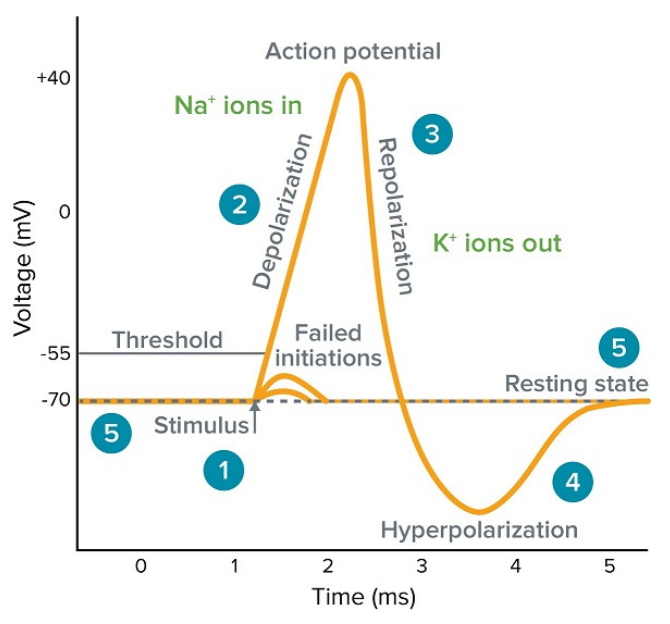
Action Potential
- -70mV across neurons membrane
- neurons depolarize to fire and AP
- depolarization at -55mV
- then refractory period happens
- BCIs record or stimulate action potentials
The Synapse
- axon teminal → synaptic cleft → dendrite
- presynaptic neuron → post synaptic neuron
- between:
- receives neurotransmitters from dendrites
- generates and action potential
- releases neurotransmitters from axon terminal
Nervous System
- PNS
- Somatic
- skeletal muscles, sensory organs
- Autonomic
- pumping heart, breathing
- CNS
- brain
- spinal cord
Brain Anatomy
- composed of many nuclei (clusters of neurons)
- separated into 2 cerebral hemispherse
- has both distributed and localized neural networks
- Frontal Lobes:
- voluntary movement, expressive language, higher level executive functions (future plans, judgment, decision making, inhibition, attention span)
- not developed until late 20s
- Parietal Lobes:
- sensory processing (touch, pressure, hot/cold, pain), navigation + control, judging size shape + distance, symbol interpretation (math, spoken language, writing)
- useful for judgement or size, distane and shapes’
- understand math problems and handwriting
- Temporal Lobes:
- auditory info, emotions, language, visual perception, encoding memory
- Determines L/R dominance
- Dominant left (most people) - understand language, learning, remembering verbal info (right-handed)
- Non-dominant right (most people) - learn and remember non-verbal info (music)
- Wemicke’s and Broca’s area- Speech recognition
- Occipital Lobes:
- Primary visual corex
- color interpretation, visual receiving and association
- Ventral and Dorsal streams
- ventral - “what” of vision
- dorsal - “where/how” of vision
Homunculus
- somatosensory - what you feel
- motor - voluntary motion
- represents either motor or sensory distribution along the cerebral cortex of brain
10-20 system
- EEG - detects cortical neuron activity near electrodes
- EEG standardization:
- allows for result validation in independent trials
- scalable to different skulls, helps pinpoint brain areas
- Even numbers = right
- odd numbers = left
- Terms:
- C - central
- P - parietal
- T - temporal
- F - frontal
- Fp - frontal polar
- O - occipital
- A - mastoids
- Naison - top of nose
- Inion - base of skull
- 10-20 stands for 10% and 20% intervals between naison and inion
10-10 system
- increases accuracy with more nodes
How are EEG’s recorded?
- Take bipolar montages → subtract down he cap → 5 electrodes = 4 signals outputted
- the differential amplifier used → subtracts input 1 and input 2 → subtraction is outputted
The Bands of an EEG
- Delta band → 1-3 Hz
- deep sleep, motivational process
- highest amplitude, slowest wave
- Theta band → 4-7 Hz
- memory and emotional regulation
- encoding of info during exploratory movements and spatial navigation
- salience detection
- Alpha band → 8-12 Hz
- visual input, perceptual awareness
- inverse relation to cortical activation
- plays role in inhibiton
- eyes closed = inc amplitude
- eyes open = dec amplitude
- Beta band → 13-30 Hz
- decrease during voluntary movements
- bursts after the act is complete
- same response when imagining movement
- plays role in attentive behavior
- serves as a carrier for attentional activation
- alertness or arousal → allows perception of stimuli
- Gamma band → 30-100 Hz
- construction of object representation
- increased → complex/demanding tasks
- bind spatially distinct features of visual objects
- reflect associations between words and meanings
- integration of sensory and motor processes during movement