Review
The Cell
Plasma Membrane— semi-permeable membrane
Seperates cell from enviro
Controls passage of substances
Carbs— recognition of neighbots
Phspholipid bi-layer
Simple diffusion—no atp
facilitated diffusion—no atp
exocytosis and endocytosis—atp
active transport—atp
Nucleus— genetic material
ER + Golgi Apparatus
Mitochondria
Smooth out membrane
highly folded inner membrane
What is needed to keep a cell (or organism) alive?
oxygen
nutrients (ex. glucose)
ATP
Water
Homeostasis
Equilibrium of Physiological Systems
Homeostasis— maintenance of a stable internal environment
Monitor internal conditions, make adjustments
Ex: body temp, blood pressure
Set point— physiological value around which normal range fluctuates
Occurs at many organizational levels
Maintenance of Equilibrium
Negative feedback— primarily responsible for maintaining homeostasis
Disruptions to homeostasis→ disease
ATP Production
Glycolysis, Krebs cycle, electron transport chain
Glycolysis— know basics of what happens
What goes in→ glucose
What comes out→ 2 pyruvate
Side products
2 NADH
Where→
Basis→ glucose gets split into two pyruvates and produces 2 ATP and 1 NADH (which goes to etc)
Not a short process
Each reaction is catalyzed by a protein
First half— energy requiring phase
Main takeaway— need to make a lot of stuff to do this. Its happening in cells all the time
Pyruvic Acid→ acetyl CoA
Prior to entering the Krebs Cycle inside the Mitochondria
NAD+ → NADH + H+
Krebs Cycle
End up regenerating first molecule at the end
Completely oxidize glucose
in the mitochondria matrix
have to have proteins present to help catalyze reaction
Electron Transport Chain→ watch video
Cellular Respiration→ watch video
ATP, or adenosine triphosphate, is made up of an adenine base, a ribose sugar, and three phosphate groups.
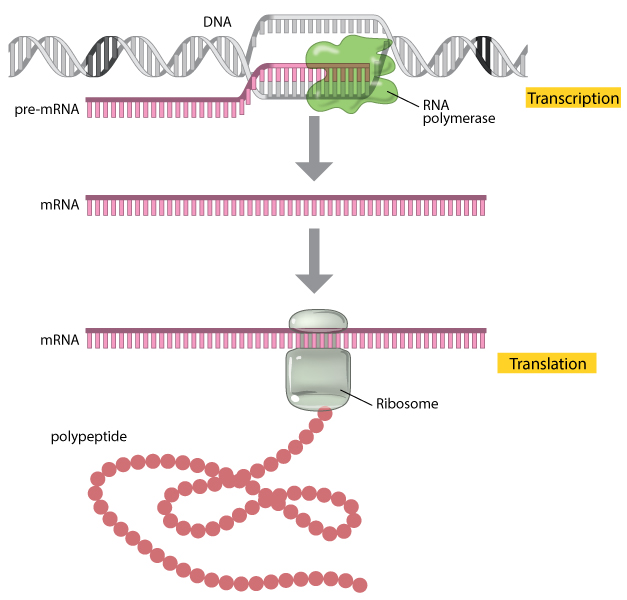
Transcription
DNA→ mRNA
Transcription factors— proteins that regulate transcriptions of genes
Enhancer— bind simulatory factors
Repressor— bind inhibitory factors
Activators can simulate transcription in three ways:
Recruit transcriptional machinery
Chromatin remodeling
Stimulate RNA polymerase
Repressors act by competition, quenching, or active repression
Translation
mRNA→ protein
Post Translational Modifiations
Occur on proteins after translation
Regulates protein compartmentalization/trafficking and activity
Ex: phosphorylation of a transcription factor such as NF-kB
Several different ways to modify after translation
Secretory Pathway
Start:
proteins that will be secreted outside the ER throufh a translocon via the below process:
SRP receptor AKA “docking protein”
translation arrest—until SRP-nascent-peptide-ribosome complex binds SRP receptor
For secretion, entire peptide/protein travel through translocon.

Pathway:

Watch video to further review
Peptide hormone example:
• Nucleus – mRNA (transcription)
• Secretory pathway
• Cytosol – mRNA/ribosome and start of translation
• ER – translation continues with translocon entry and packaging of protein into
vesicle
• Golgi - Movement to and through Golgi network and protein is processed into
peptide hormone
• Vesicle then trafficked to membrane for release from cell into blood