Electron Transfer Reactions R3.2
Defined by oxygen/hydrogen loss/gain
Oxidation
gain of oxygen
loss of hydrogen
ex. iron rusting
LEO
lose electrons = oxidized
atom more positive → oxidation state increases
Reduction
loss of oxygen
gain of hydrogen
ex. photosynthesis
GER
gain electrons = reduced
atom more negative → oxidation state decreases
oxidation/reduction occur when there is a shift in electron density from one atom to another
defined by electron transfer
not all compounds have hydrogen/oxygen
Redox reactions - reactions involving oxidation/reduction
cannot have one without the other
oxidation states - hypothetical charges assigned to an atom based on degree of electron transfer
different from ionic charges
ionic charges - actual number of electrons gained/lost
Oxidation State Rules
pure elements are 0
monatomic ions → charge is the the oxidation states
oxidation states in a neutral compound → add up to 0
oxidation states in polyatomic ion → add up to charge of the ion
compound of polyatomic → use periodic table
group 1 = +1
group 2 = +2
Fluorine = -1
Oxygen = -2 EXCEPT
peroxides (O^-2 2) - each O = -1
OF2 - O = +2
Hydrogen = +1 EXCEPT
metal hydrides (H at end) - H = -1
chlorine = -1 EXCEPT
bonded to O or F
backward calculate, does not have set number
Rule = hierarchy
Higher up supersedes below
meaning… the rule above is followed rather than the rule below it
redox reactions
cannot have oxidation without reduction
conservation of electrons
lost by one species → gained by another
reducing agent - species getting oxidized + causes reduction of other species
oxidizing agent - species getting reduced + causes oxidation of other species
term agent = FULL reacting species
a single atom is oxidized/reduced
agent - reacting compound containing the atom
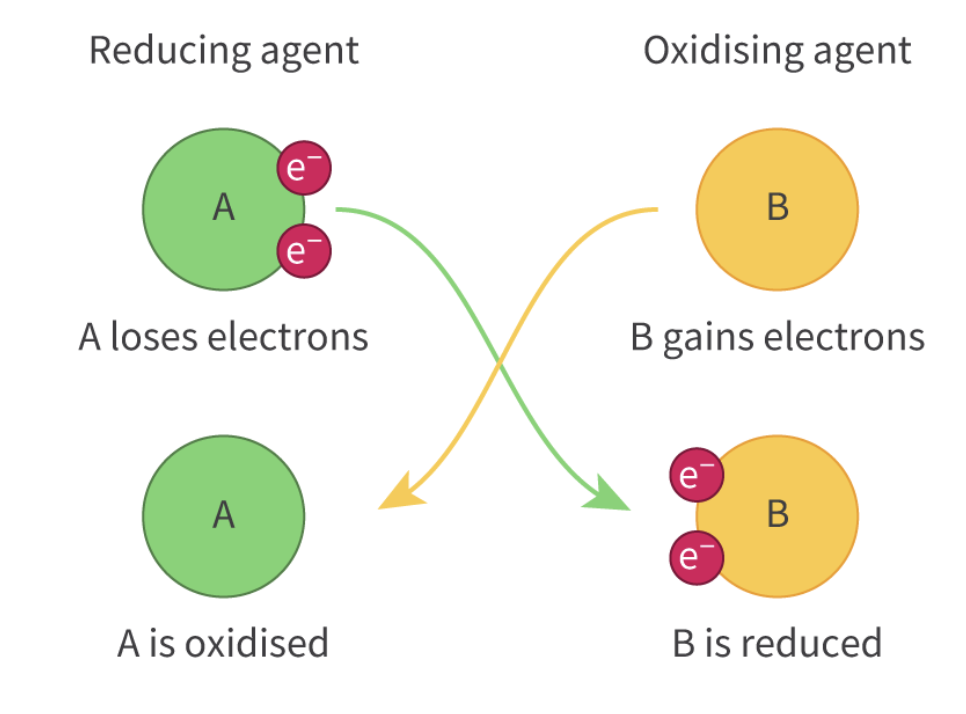
oxidation cannot occur without reduction → write 2 separate equations to show what happens to each species
½ equations - describe the oxidation/reduction occuring
electrons included
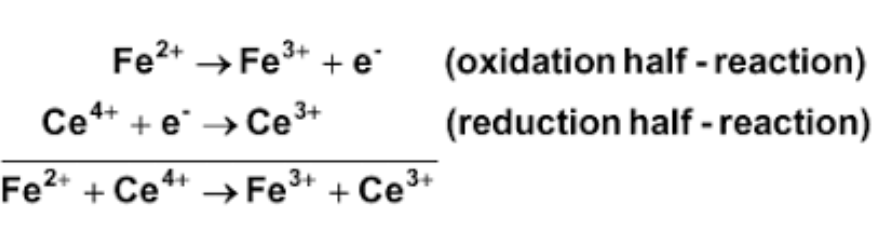
Balancing redox reactions
in neutral conditions → 2 half equations can be added together → obtain overall equation of reaction
must always ensure electrons are equal and cancel out
adding directly does not always work
electrons lost must equal electrons gained
Hess Law → multiply half equations by a factor → equal number of electrons transferred
acidic conditions
write ½ reactions without electrons
balance all elements EXCEPT H AND O
balance O by adding water
acids = aqueous
balance H by adding H+
determine overall charges on both sides
balance charges on each side with electrons
electrons need to be equal → multiply for common multiple
add both ½ equations + cancel anything common on both sides
Redox reactions only proceed in the forward direction
redox never exists in equilibrium
Displacement - a more reactive element replaces an ion in solution (single replacement)
metals - replace metal ions or hydrogen ions
metals react w dilute acids → displace hydrogen
acid + metal → salt + hydrogen gas

halogens - replace halogen ions
elements only replace an ion if the element is more reactive → periodic trend in reactivity
oxidation of metals
all metals have tendency to lose electrons → become cations (oxidation)
down a group → ease of oxidation increases
Ionization Energy decreases → easier to lose electrons
EXCEPTION: LITHIUM
most reactive metal
across a period → ease of oxidation decreases
IE increases → more difficult to lose electrons
more reactive metals lose electrons more easily = stronger reducing agent
reduction of halogens
halogens tend to gain 1 electron → become octet (reduction)
down group 17 → ease of reduction decreases
atomic radius increases → electronegativity decreases
nucleus farther from valence shell → attraction for electrons decreases
more reactive halogens gain electrons more easily = stronger oxidizing agent
Oxidation
adding oxygen
adding bonds to oxygen
removing hydrogen
Compounds with oxygen
alcohols (-OH)
can get oxidized into
aldehydes
ketones
carboxylic acids
primary
carbon w OH → bonded to 1 other carbon
oxidized into aldehydes → carboxylic acids
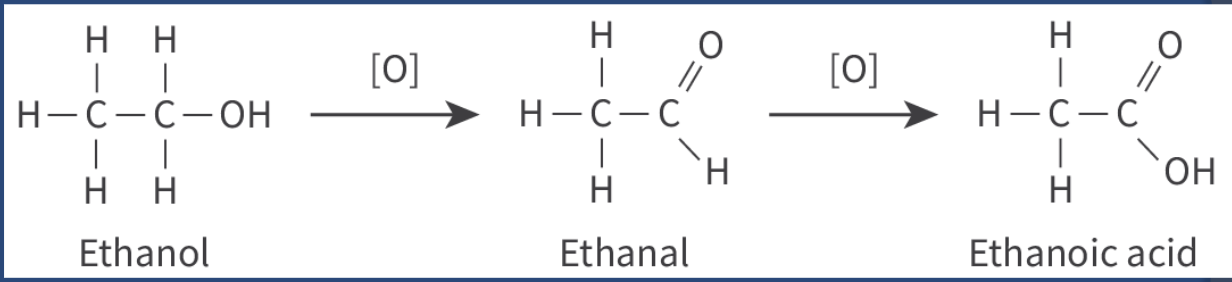
O = oxidizing agent
most commonly used = color change
extent of oxidation → determines whether product will be aldehyde or carboxylic acid
partial = aldehyde
complete = carboxylic acid
if carboxylic acid = desired product → reflux
ensures reaction completes
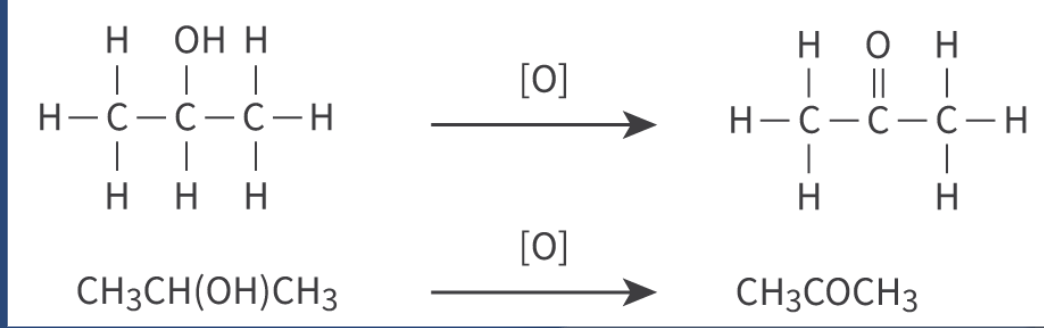
secondary
bonded to 2 carbons
oxidized into ketones
reflux used to ensure completion
tertiary
bonded to 3 carbons
cannot undergo oxidation
carbon bonded to -OH has no hydrogens to be removed for oxidation
aldehydes (C=O at end)
ketones (C=O in middle)
carboxylic acids (-COOH)
most oxidated form
most oxygen
combustion - extreme form of oxidation
rapid process resulting in complete oxidation
reactant is O2
products always CO2 + H2O
Oxidation - controlled process where specific products can be obtained
reactant = oxidation agent
product depends on reaction conditions
Reduction
loss of oxygen
removing bonds from oxygen
addition of hydrogen
the reverse of the previous oxidation reactions
carboxylic acids and aldehydes → primary alcohols
ketones → secondary alcohols
unsaturated compounds - hydrocarbons that contain a carbon-carbon double or triple bond
alkenes/alkynes
test for unsaturation
react compound w Br2 (aq) → see if there is a color change
brown → colorless
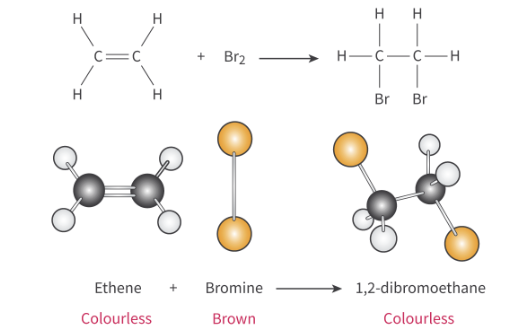
alkenes/alkynes - reduced by adding hydrogen
alkenes → alkanes when reacted w H2
in presence of nickel catalyst + heat
alkynes → alkenes or alkanes when reacted w H2
in presence of metal catalyst (Pt, Pd, Ni) + heat
hydrogenation - reaction involving the addition of hydrogen (H2) to an unsaturated molecules
decreases degree of unsaturation (index of hydrogen deficiency)
ie number of double bonds
Redox reactions can be used in electrochemical cells to convert forms of energy
Electrochemical cell - system where redox reactions occur
electrochemical bc electrons are transferred from chem reactions
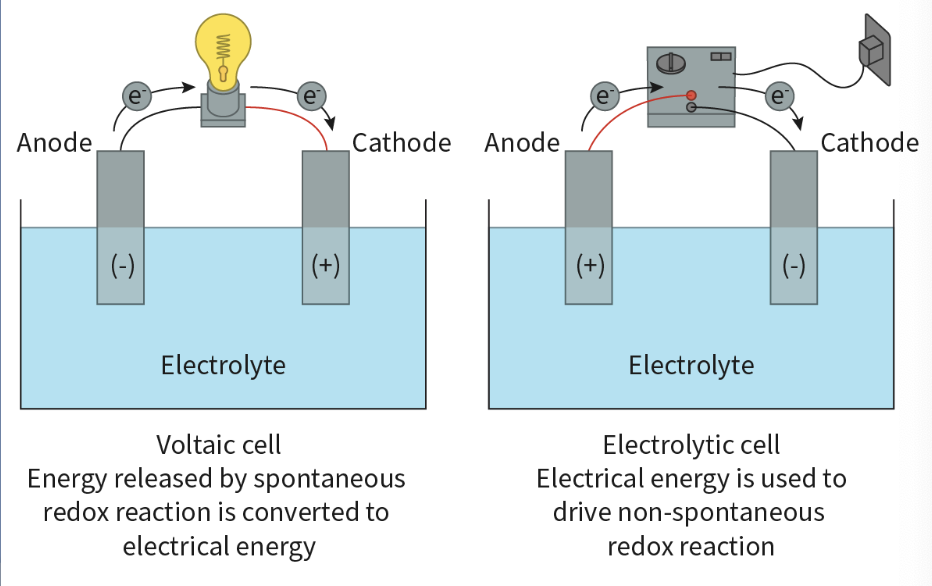
has 2 electrodes: anode and cathode
2 types
voltaic cell (galvanic cell)
convert chem → electrical energy
energy from spontaneous exothermic chem reactions → electrical energy
energy is released
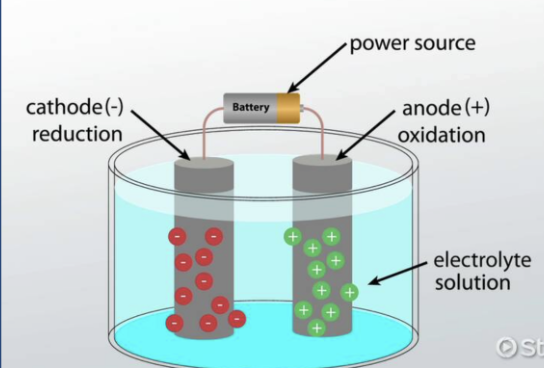
cathode = positive electrode
anode = negative electrode
electrolytic cell
convert electrical → chem energy
energy is provided to generate non spontaneous chem reaction
energy is required
cathode = negative electrode
anode = positive electrode
in both cells
oxidation at anode
reduction at cathode
Voltaic cells (primary batteries)
electrical current produced from a spontaneous redox reaction
composed of
2 half cells
contains half the redox reaction
anode ½ cell = oxidation
cathode ½ cell = reduction
made of metal electrode in a solution w ions of the same metal
wire attached to electrode
electrons flow anode → cathode
salt bridge
liquid juncture allowing movement of cations + anions btwn solutions
completes circuit
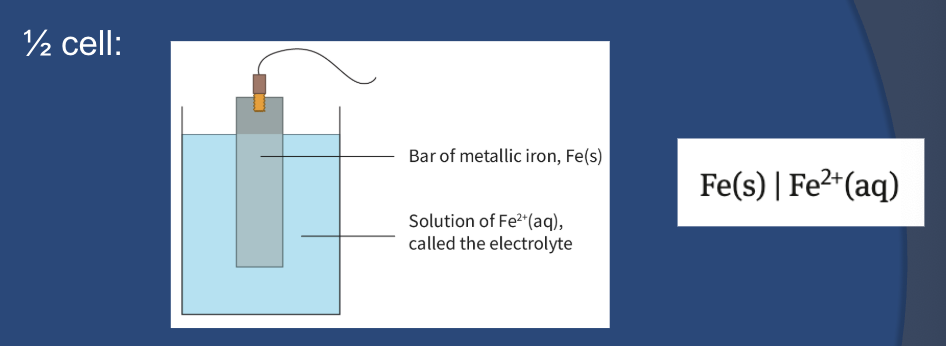
half cells
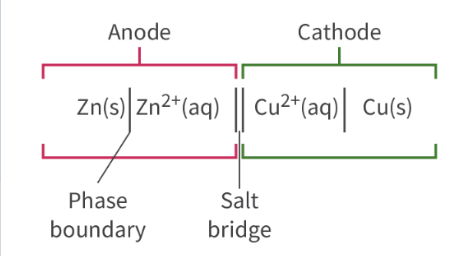
represented as
metal | metal ion (including states of metter)
line btwn the two = phase boundary
atoms of metal form ions by releasing electrons
equilibrium is established
metal surface is negative compared to solution
electrode potential - charge separation btwn metal electrode and solution
can be composed of any metal electrode along w ion in solution
Wire
half cells are created → wire connects the two metal electrodes
oxidation (loss) occurs at anode
reduction (gain) occurs at cathode
electrons always flow anode → cathode
wire allows electrical energy to be quantified and harnessed
voltmeter - reads electrical output
Salt Bridge
essential for battery function
physically separates anode/cathode half cells
provides electrical path for movement of cations/anions in cell
reduces charge build up as electrons and ions flow
ions move to balance out ½ cell change
contains strong inert electrolyte
KCl, KNO3, Na2SO4
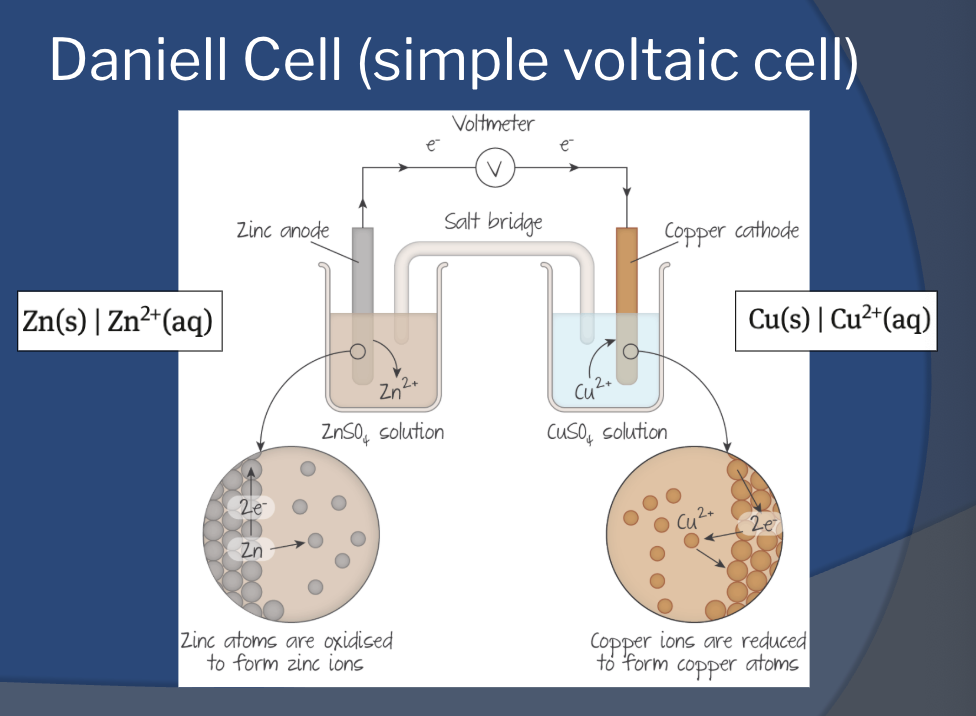
cell diagram - combines representation of 2 half cells into one overall representation of electrochemical cell
2 half cells separated by double vertical line ||
shows phase boundary
anode on left + cathode on right
secondary cells
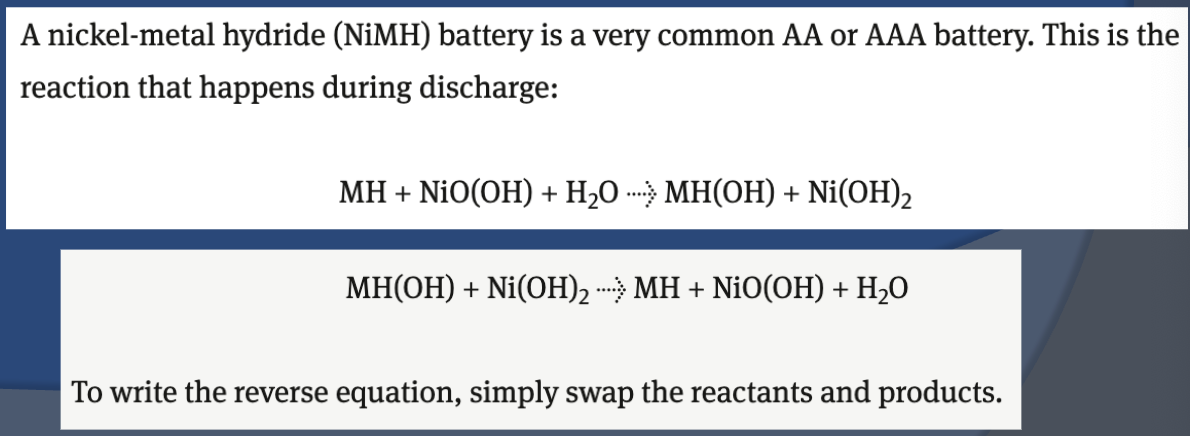
rechargeable batteries - use reversible chem reactions to give energy to power devices
electrical current used to drive reaction in reverse
battery life - measures time the battery will continue providing energy
used for primary + secondary cells
Reactions
discharge - battery is producing electricity
charging - electrical current used to charge battery
reverse of discharge reaction
fuel cells - generate electrical energy from redox reaction
fuel continuously produce electricity IF reactant material is available
common fuel cells use hydrogen or methanol
comparison
primary cell
single use battery
irreversible
long shelf life
low cost
greater reliability
low energy density
waste when discarded
environmental impact (negative)
Uses
medical devices
emergency equipment
remote sensors
secondary cell
rechargeable battery
reversible
high energy density
long lifespan
low environmental impact
types of batteries
lead-acid = heavy + maintenance
used in automobiles
nickel-cadmium = toxic cadmium
bad for environment
used in portable electronics + aircrafts
nickel-metal hydride = less durable + short lifespan
consumer electronics + hybrid electric vehicles
lithium=ion = expensive + careful handling
portable electronics + electric vehicles + renewable energy system
fuel cell
continuous reaction
IF fuel/oxidant are available
high efficiency
lower emissions
reduced noise pollution
high cost
limited fuel ability
efficiency losses
environmental impacts (negative)
not durable
safety concerns
Uses
powering electric vehicles
backup power for buildings
generating electricity from renewable sources
Electrolytic cells - electrical energy used to drive a nonspontaneous reaction
electrolysis - electricity is passed through molten/aqueous solution to make chemical change
used to obtain solid metal from ore
ore - naturally occurring mineral/rock containing high concentrations of a particular metal
metals in ores = ionic compounds → reduce metal cation via electrolysis → obtain the solid metal
single electrolytic cell composition
1 container
2 inert electrodes
usually graphite
a solution (the electrolyte)
molten or aqueous salt
battery/power sources
supplies electrons to cathode
anions attracted to anode (positive)
cations attracted to cathode (negative)
voltaic vs electrolytic
voltaic
oxidation = negative anode
reduction = positive cathode
exothermic + spontaneous
chemical → electrical energy
cathode = potisive
anode = negative
2 separate aqueous solutions connected by salt bridge + external circuit
current conducted by electrons in external circuit + movement of ions in salt bridge
electrolytic
oxidation = positive anode
reduction = negative cathode
endothermic + nonspontaneous
electrical → chemical energy
cathode = negative
anode = positive
electrolyte is molten/aqueous in 1 container
current conducted by electrons in external circuit + movement of ions in electrolyte
voltage generated by voltaic cell depends on reactivity + electrode potential of 2 ½ cells
Standard electrode potential E∅- electrode potential (volts) of a half reaction under SATP
quantifies/determines whether one element more readily undergoes reduction/oxidation compared to other element
SATP conditions = 25C/298K + 1 atm platinum electrode
and acidic solution where [H+] = 1.0 mol dm-3
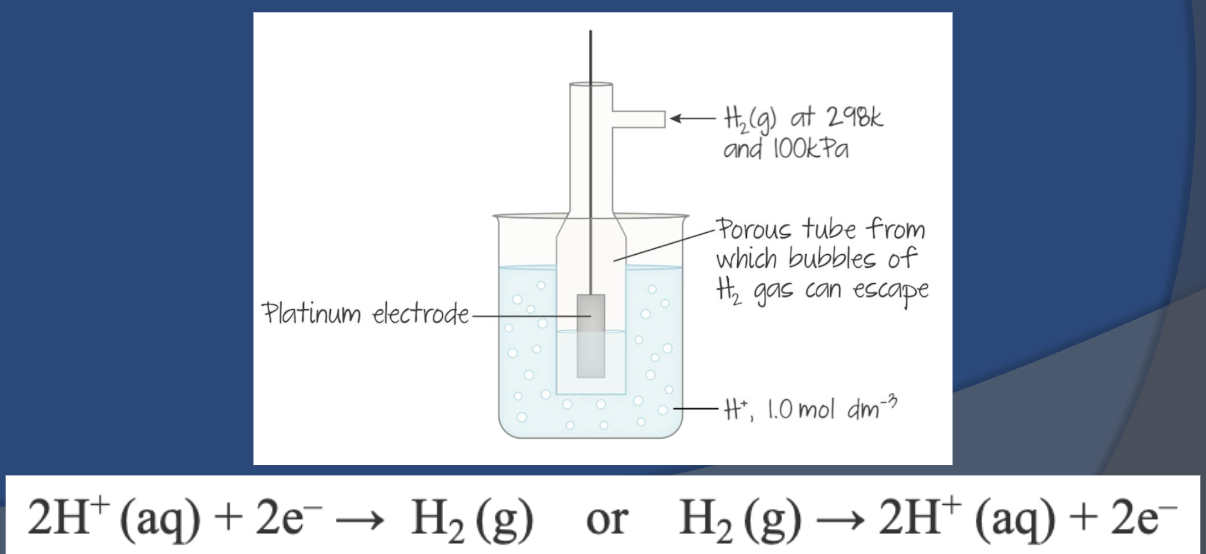
E∅ for an element determined by connecting half cell of element to standard hydrogen electrode (SHE)
SHE assigned arbitrary E∅ = 0 volts → E∅ of element determined as voltage of cell E∅ cell
Reducing power of element determines if SHE = anode or cathode
E∅ cell > 0 = anode
E∅ cell < 0 = cathode
standard electrode potentials - listed as reduction half-reactions of metal ions forming reduced metal product
reactivity series - potentials ranked in order from most negative → most positive
higher up → most oxidized
bottom → most reduced
more negative E∅ → more easily oxidized → stronger reducing agent
more positive E∅ → more easily reduced → stronger oxidizing agent
E∅ values determine what overall chemical reaction will be for an electrochemical cell
compare E∅ for 2 species connected in cell
more negative = anode
more positive = cathode
half cell potentials determine voltage output of electrochemical cell (cell potential)
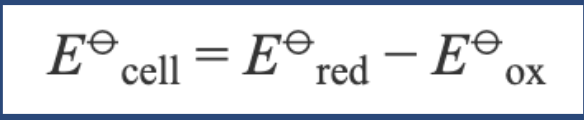
all E∅ are in reduction perspective
subtracting oxidation potential is inherently reversing sign
DO NOT CHANGE THE SIGN
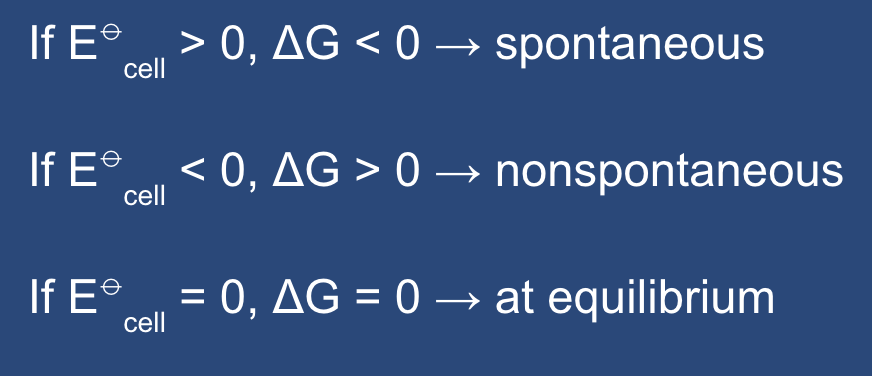
E∅ cell > 0 = spontaneous
E∅ cell < 0 = nonspontaneous
Voltaic cells
E∅ cell ALWAYS positive
electrolytic cells
E∅ cell ALWAYS negative
calculate gibbs free energy from cell potential
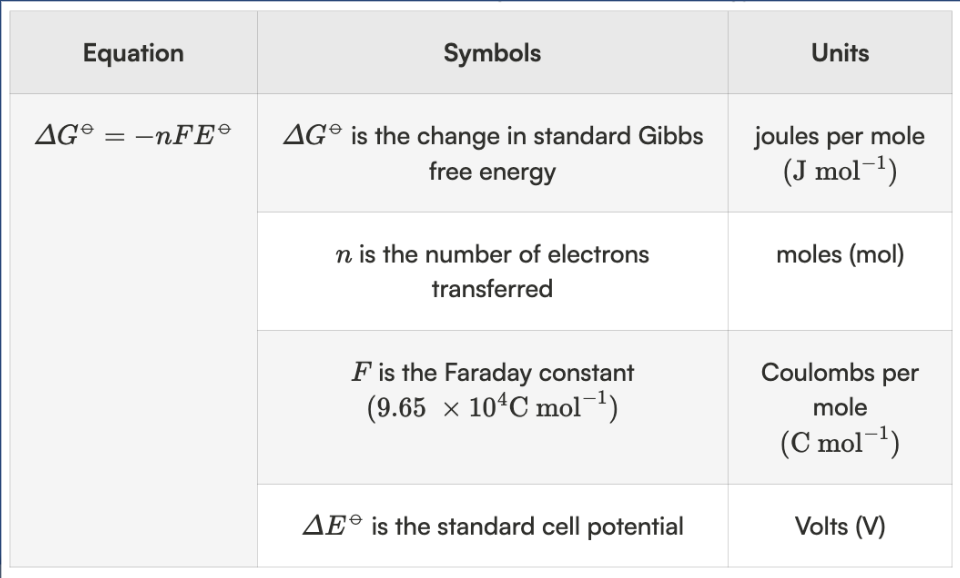
electrolysis in molten ionic compound is simple
only 2 species available
can also occur in aqueous solution
ionic compound in aqueous solution → water competes with ions
water can be oxidized/reduced instead of ions in solution
at anode - concentration of salt solution determines which species oxidized
in dilute solutions - water oxidized to produce oxygen gas
in concentrated solutions - anion is oxidized
at cathode - standard electrode potential determines which species reduced
more positive E∅ = more readily reduced
electroplating - use of an electrolytic cell to coat an object in a thin layer of metal
electrolyte has ions to be plated
reduction at cathode → metal deposition on object’s surface
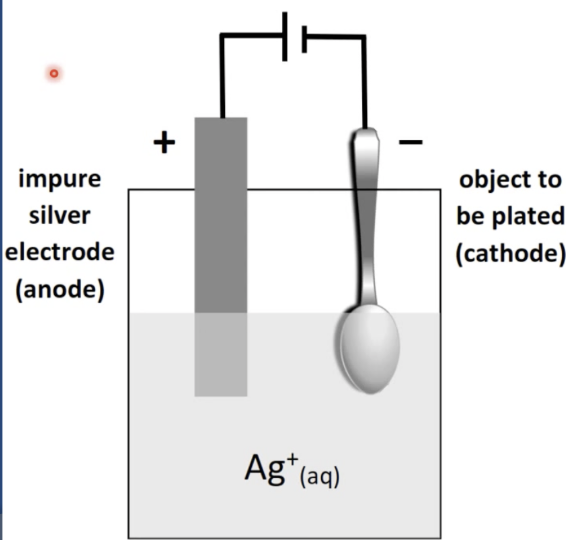
electroplating for physical appearance or improvement of physical properties
set up
power supply
cathode
object to plate
metal anode
metal plating with
electrolyte solution
has ions to be plated