Ch 10b Bonding/Lewis Model lecture notes
Covalent Bond
Definition:
A covalent bond is characterized primarily by the sharing of electrons.
The term "covalent" stems from:
"co" meaning share.
"valent" referring to valence electrons.
Characteristics of Covalent Bond:
Pair of electrons is shared between two nuclei (or atoms or ions).
Stability arises when the shared electrons are located equidistant between two atoms, drawing them together.
Example of a Covalent Bond: Water
Simplest molecule representation: Water (H₂O)
Formation requires:
Two hydrogen (H) atoms
One oxygen (O) atom
Lewis Diagram representation involves:
Representing H as a proton with one electron.
Oxygen has six electrons.
Lewis Symbol Representation:
H: ● (dot for 1 electron).
O: ●●●●●● (6 dots representing 6 valence electrons).
Pairing electrons:
Hydrogen shares its electron with the oxygen.
Shared electrons in molecular bonds are termed bonding pairs.
Electrons not involved in bonding are termed lone pairs.
Stability Conditions in Water Formation:
Hydrogen requires 2 electrons to be stable (duplet).
Oxygen completes its octet with 8 electrons.
Resulting configuration is stable due to fulfilling the octet rule.
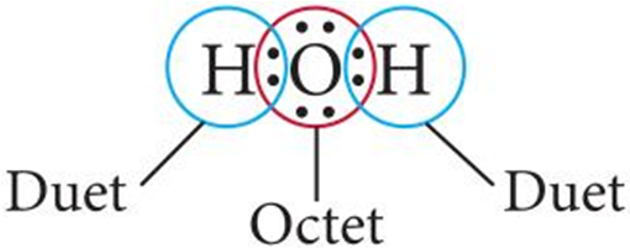
Simplification
Using Lewis Diagrams to visualize covalent bonds:
Bonding pairs can be represented with lines (single bonds).
Example configurations:
Normal representation: H:● + O:●●●●●●
Simplified representation: H-O-H
Both representations illustrate connections among atoms accurately.
Bond Types and Properties
Types of Bonds:
Single Bond:
Definition: Sharing one pair of electrons between two atoms.
Example: Water (H₂O).
Double Bond:
Definition: Sharing two pairs of electrons between two atoms.
Example: Oxygen (O₂) which has 2 pairs of electrons shared gives:
Representation: O=O
Triple Bond:
Definition: Sharing three pairs of electrons between two atoms.
Example: Nitrogen (N₂) which has 3 pairs of electrons shared gives:
Representation: N≡N
Number of electrons shared in bonds:
Single bond: 2 electrons (1 pair).
Double bond: 4 electrons (2 pairs).
Triple bond: 6 electrons (3 pairs).
Visual representation:
Single bond: —
Double bond: =
Triple bond: ≡
Valence Electrons Reference
Group (Column) | Type of Elements | # of Valence Electrons | Examples |
|---|---|---|---|
1 | Alkali metals | 1 | H, Li, Na, K |
2 | Alkaline earth metals | 2 | Be, Mg, Ca |
3–12 | Transition metals | 1 or 2 (variable) | Fe, Cu, Zn, Ag |
13 | Boron group | 3 | B, Al, Ga |
14 | Carbon group | 4 | C, Si, Ge, Sn |
15 | Nitrogen group | 5 | N, P, As, Sb |
16 | Oxygen (chalcogen) group | 6 | O, S, Se, Te |
17 | Halogens | 7 | F, Cl, Br, I |
18 | Noble gases | 8 (He has 2) | He, Ne, Ar, Kr |
Covalent Bonding: Model vs Reality
Lewis model implies that some combinations should be stable, whereas others should not.
Because the stable combinations result in “octets”
Using these ideas from the Lewis theory allows us to predict the formulas of molecules of covalently bonded substances.
Hydrogen and the halogens are all diatomic molecular elements, as predicted by Lewis theory.
Oxygen generally forms either two single bonds or a double bond in its molecular compounds, as predicted by Lewis theory.
Lewis model accounts for or predicts:
Why particular combinations of atoms form molecules and others do not.
That H2O should be stable, while H3O should not be, and that is in fact the case.
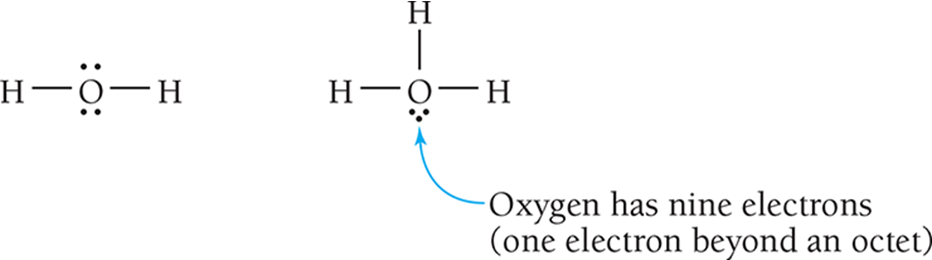
H3O+ should be stable, and in fact it is.
Lewis model accounts for or predicts:
Why covalent bonds are highly directional, in contrast to ionic bonds, which are nondirectional and hold together an entire array of ions.
Therefore, Lewis model predicts covalently bonded compounds will be found as individual molecules.
Rather than an array like ionic compounds
Compounds of nonmetals are made of individual molecule units.
Lewis model accounts for or predicts:
Why covalent bonds are highly directional, in contrast to ionic bonds, which are nondirectional and hold together an entire array of ions.
Properties: Model vs Reality
Lewis model accounts for or predicts:
That molecular compounds have low melting points and boiling points
Melting points generally < 300 °Celsius
Molecular compounds are found in all three states at room temperature.
Lewis model accounts for or predicts:
That the hardness and brittleness of molecular compounds should vary depending on the strength of intermolecular attractive forces.
The kind and strength of the intermolecular attractions vary based on many factors.
Some molecular solids are brittle and hard, but many are soft and waxy.
Lewis model accounts for or predicts:
That neither molecular solids nor liquids should conduct electricity.
There are no charged particles around to allow the material to conduct.
Molecular compounds do not coduct electricity.
Electronegativity and Bond Polarity
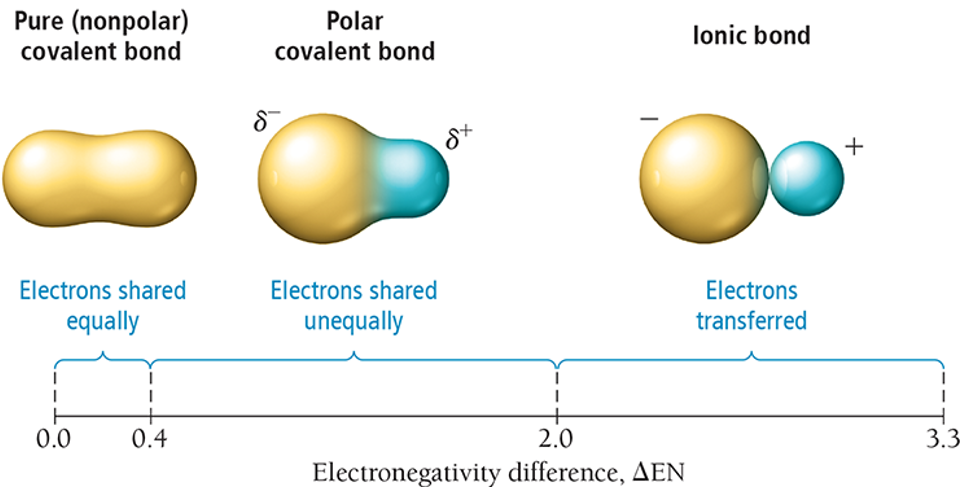
Covalent bonding between unlike atoms results in unequal sharing of the electrons.
One atom pulls the electrons in the bond closer to its side.
One end of the bond has larger electron density than the other.
The result is a polar covalent bond.
Bond polarity
The end with the larger electron density gets a partial negative charge.
The end that is electron deficient gets a partial positive charge.
Can be expressed as:
delta negative (δ-) and delta positive (δ+), indicating the distribution of electrical charge across the molecule.
where (δ-) represents a region of partial negative charge, typically found near more electronegative atoms, while (δ+) signifies a region of partial positive charge, usually located near less electronegative atoms.
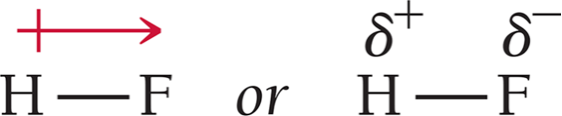
Most bonds have some degree of sharing and some degree of ion formation to them.
Bonds are classified as covalent if the amount of electron transfer is insufficient for the material to display the classic properties of ionic compounds.
If the sharing is unequal enough to produce a dipole in the bond, the bond is classified as polar covalent.
The ability of an atom to attract bonding electrons to itself is called electronegativity.
Increases across period (left to right) and decreases down group (top to bottom)
Fluorine is the most electronegative element.
Francium is the least electronegative element.
Noble gas atoms are not assigned values (do not form bonds)
Opposite of atomic size trend
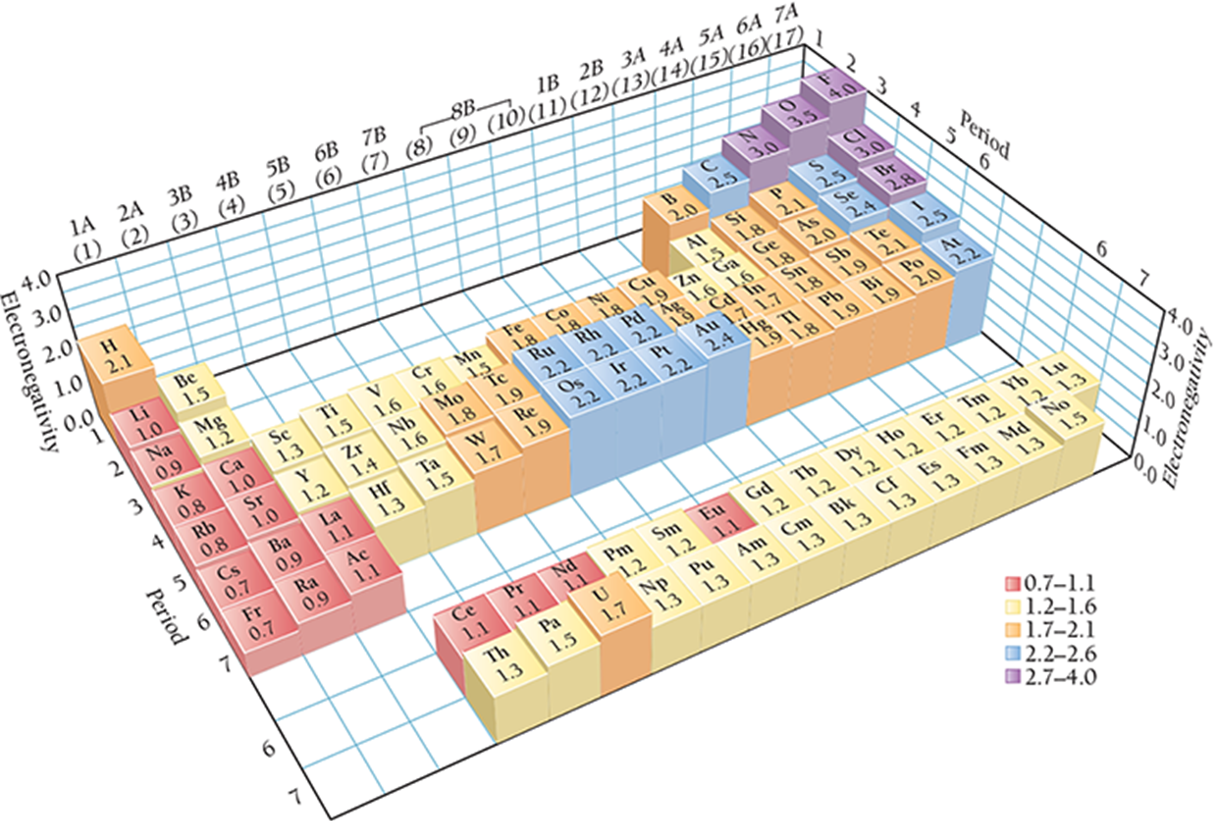
The larger the difference in electronegativity, the more polar the bond.
Negative end toward more electronegative atom
If the difference in electronegativity between bonded atoms is 0, the bond is pure covalent.
Equal sharing, also nonpolar
If the difference in electronegativity between bonded atoms is 0.1 to 0.4, the bond is nonpolar covalent.
If the difference in electronegativity between bonded atoms is 0.4 to 1.9, the bond is polar covalent.
If the difference in electronegativity between bonded atoms is larger than or equal to 2.0, the bond is ionic.
Electronegativity Difference (ΔE N) | Bond Type | Example |
Small (0–0.4) | Nonpolar Covalent | C l 2 |
Intermediate (0.4–2.0) | Polar covalent | H C l |
Large (2.0+) | Ionic | N a C l |
Dipole Moment
Dipole moment, μ, is a measure of bond polarity.
A dipole is a material with a + and − end.
It is directly proportional to the size of the partial charges (q) and directly proportional to the distance between them (r)
μ = (q)(r)
not Coulomb’s law
Measured in Debyes, D (1D = 3.34 x 10⁻³⁰ C•m)
Generally, the more electrons two atoms share and the larger the atoms are, the larger the dipole moment.
We can get a sense for the dipole moment of a completely ionic bond by calculating the dipole moment that results from separating a proton and an electron (q = 1.6 x 10⁻¹⁹ C) by a distance of r = 130 pm (avg. length of a short chemical bond)
μ = (1.6 x 10⁻¹⁹ C)(130 x 10-12 m)
μ = 2.1 × 10^-29 C•m
μ = (2.1 x 10^-29 C•m)[1D/(3.34 x 10^-30 C•m)
μ = 6.2 D
Molecule | ΔE N | Dipole Moment (D) |
Cl 2 | 0 | 0 |
Cl F | 1.0 | 0.88 |
H F | 1.9 | 1.82 |
Li F | 3.0 | 6.33 |
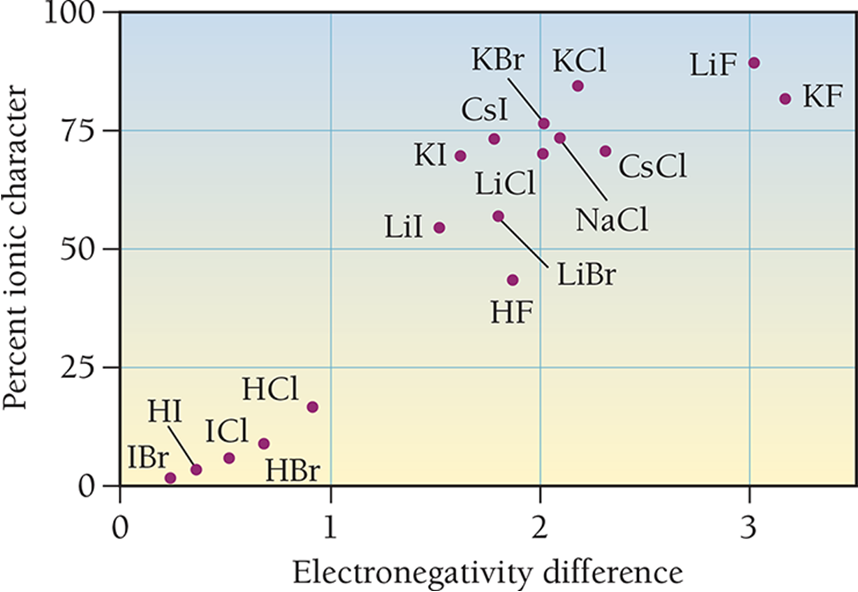
Percent Ionic Character
The percent ionic character is the percentage of a bond’s measured dipole moment compared to what it would be if the electrons were completely transferred.
The percent ionic character indicates the degree to which the electron is transferred.
Lewis Structures: How to Draw Molecules
Write the correct skeletal structure for the molecule.
Hydrogen atoms are always terminal.
After that, the more electronegative atoms are placed in terminal positions.
Calculate the total number of electrons for the Lewis structure by summing the valence electrons of each atom in the molecule.
Distribute the electrons among the atoms, giving octets (or duets in the case of hydrogen) to as many atoms as possible.
If any atoms lack an octet, form double or triple bonds as necessary to give them octets.
Example: Write the Lewis structure for the NH4+ ion
valence e- in N = 5
valence e- in H = 4 x 1
accounting for charge of cation = -1
total valence e- = 4 + 5 -1 = 8
Thus, when drawing the Lewis structure, we need to ensure that there are 8 electrons distributed appropriately among the atoms to satisfy the octet rule.

Resonance and Formal Charge
Lewis model localizes the electrons between the atoms that are bonding together.
Extensions of Lewis model suggest that there is some degree of delocalization of the electrons; we call this concept resonance.
Delocalization of charge helps to stabilize the molecule.
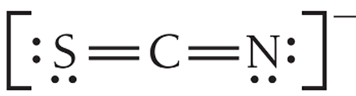
When there is more than one Lewis structure for a molecule that differ only in the position of the electrons, they are called resonance structures.
The actual molecule is a combination of the resonance forms—a resonance hybrid.
The molecule does not resonate between the different forms, though we often draw it that way.
Look for multiple bonds or lone pairs.
Represented with a double headed arrow

Resonance Structures:



Formal Charge
Formal charge is a fictitious charge assigned to each atom in a Lewis structure that helps us to distinguish among competing Lewis structures.
In a Lewis structure, we calculate an atom’s formal charge, which indicates the charge it would have if all bonding electrons were shared equally between the bonded atoms.
FC = # valence e- - [nonbonding e- + ½bonding e-]
Sum of all formal charges in a molecule = 0
In an ion, total equals to the charge of the ion

FCH = 1 - [0 + ½(2)] = 0
FCN = 5 - [0 + ½(8)] = +1
Example: Draw the Lewis structure (including resonance structures) for nitromethane (CH3NO2). Assign all formal charges.
Calculate # of valanece e-
valence e- in N = 5
valence e- in O = 2 x 6
valence e- in C = 4
valence e- in H = 3 x 1
total valence e- = 5 + 12 + 4 + 3 = 24
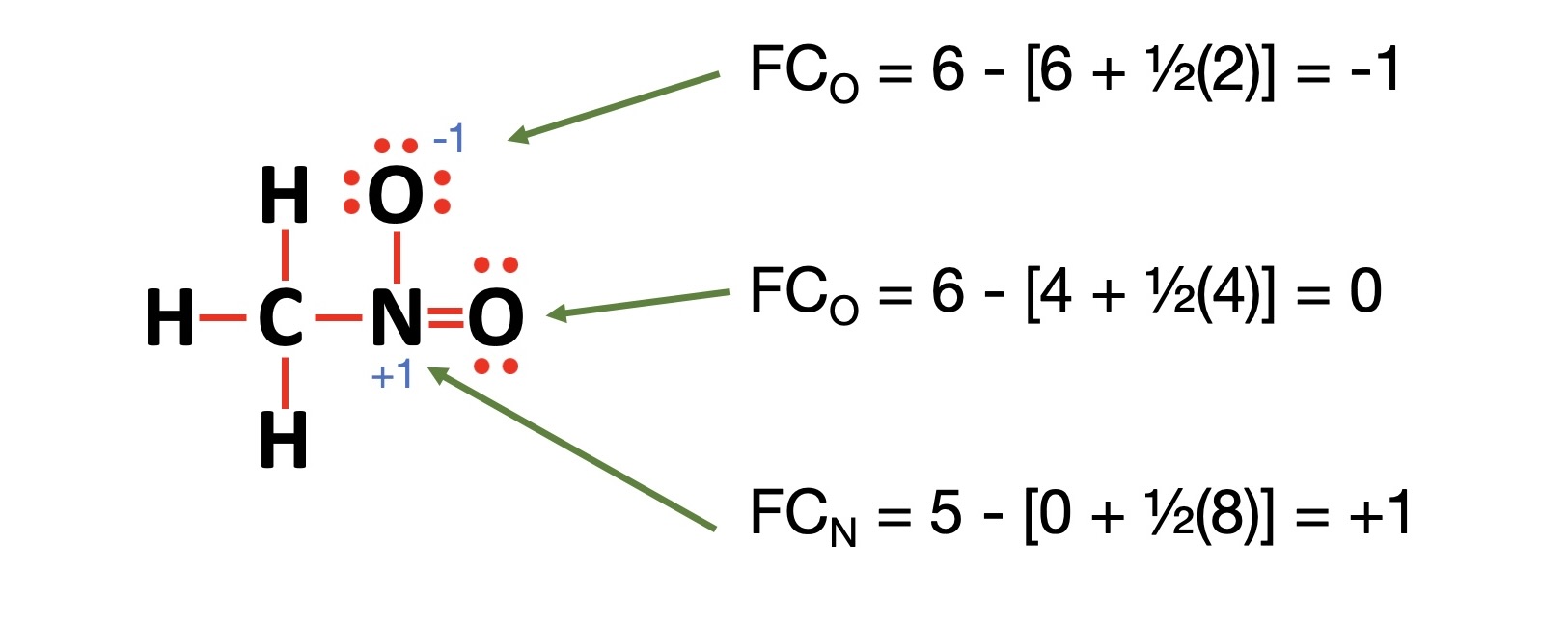
FCO = 6 - [6 + ½(2)] = -1
FCO = 6 - [4 + ½(4)] = 0
FCN = 5 - [0 + ½(8)] = +1
Rules
In general, when we calculate formal charges, these four rules apply:
The sum of all formal charges in a neutral molecule must be zero.
The sum of all formal charges in an ion must equal the charge of the ion.
Small (or zero) formal charges on individual atoms are better than large ones.
When formal charge cannot be avoided, negative formal charge should reside on the most electronegative atom.
Bond Energies
The Bond Energy of a chemical bond is the energy required to break 1 mol of bonds in the gas phase
The bond energy of Cl2 is 243 kJ mol^-1: this value indicates the strength of the Cl–Cl bond, reflecting the amount of energy needed to separate chlorine molecules into individual atoms.
Breaking bonds: Endothermic (+)
Forming bonds: Exothermic (-)
These values are found in a table
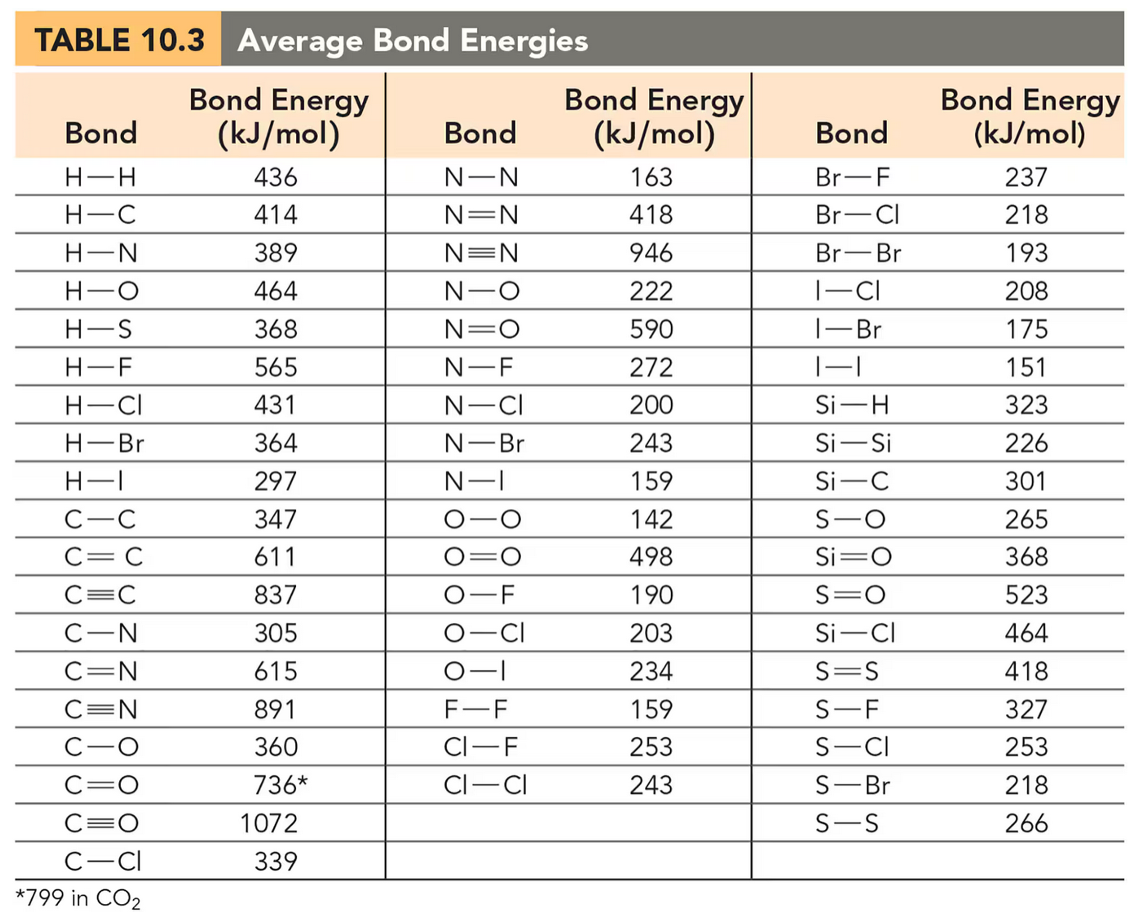
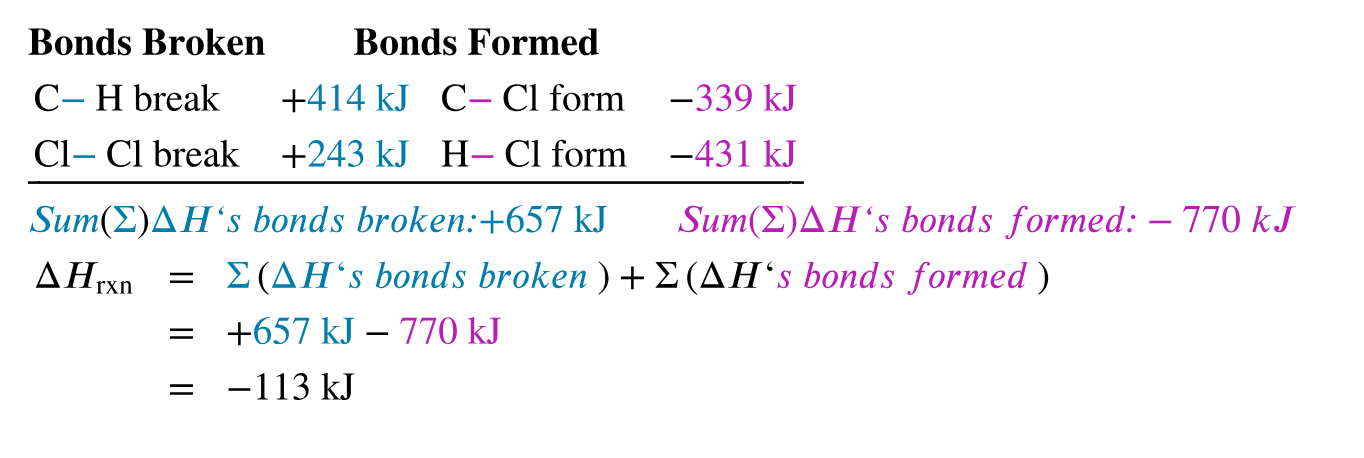
The enthalpy of a reaction can be estimated based on bonds broken and formed during a chemical reaction:

Example:
H3C–H(g) + Cl–Cl(g) → H3C–Cl(g) + H–Cl(g) ΔHrxn = ?
Incomplete/Expanded Octets
Octet rule can never be broken in O, C, F, and NE
Can form Duplet (2e):
H
Li (Li+)
Be (Be+2)
He
Can have an incomplete octet (free radical, will oxidize environment to stabilize)
B = 6e
N = 7e or 8e
Example:
Borane (BH3)

B has 6 electrons
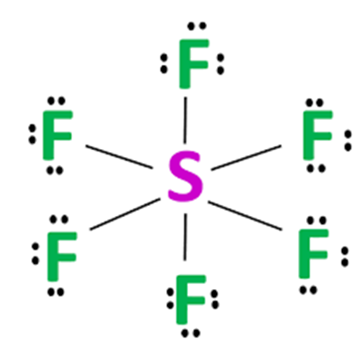
Can have expanded octets, allowing elements in the third period or below to accommodate more than 8e:
Sulfur hexafluoride (SF6)
S has 12 electrons
Can form bonds with six fluorine atoms, utilizing d-orbitals for expansion.
Phosphorous Pentafluoride (PF5)
P has 10 electrons
Can bond with five fluorine atoms, also involving d-orbitals to accommodate the additional bonds.
