AP Biology 25-26
Unit 1 - Chemistry of Life
1.1 - Structure of Water and Hydrogen Bonding
A water molecule is made up of two hydrogen atoms and one oxygen atom which are bonding through polar covalent bonds making the molecule polar
Oxygen in general is a very electronegative atom so this causes a dipole which means that the oxygen side is negative and the hydrogen side is positive
The same rules that apply to magnets apply to water molecules
Opposites attract (+/-)
Same sides repel (+/+ and -/-)
Because of this the positive side of one water molecule becomes attracted to the negative side of another water molecule forming a hydrogen bond
A hydrogen bond isn’t a bond in the sense of a covalent or ionic bond but rather like a intramolecular force which bring two different water molecules closer together and making it hard to pull apart one from another
These hydrogen bonds (opposites attracting) are what explain the many different unique properties of water
One is its high specific heat capacity meaning that it is very difficult to heat up water
This is because water is a fluid which means that the molecules are constantly moving around but stick together because of the hydrogen bonds
To heat it up they need to move quicker but that is made difficult because of the hydrogen bonds that are keeping them stuck together
So it is tough to heat up water because of the hydrogen bonds keeping water molecules together
Another is its high heat of vaporization which means that it takes a lot of heat to vaporize water
When you are sweating you are hot and for water to evaporate it has to have enough heat (100oC) to move the water molecules apart from each other
And as the water absorbs heat it actually cools down the surface on which the water is and that’s what’s called evaporative cooling
This is really important for temperature regulation because if our bodies operated at high temperatures we wouldn’t be able to regulate our temperature
Our enzymes would not be able to work in high temperatures which we talk about in unit 3
Water also has many “sticky” properties
Cohesion
Adhesion
Surface Tension
Cohesion is when water molecules stick to one another so basically sticking to itself
In this the positive side of hydrogen in one water molecule is sticking to the negative side of oxygen in another water molecule
Adhesion is when water molecules stick to other polar substances
This property allows for capillary action in vascular plants
So water is cohesive so when a tree pulls up the water into its stem it brings up more because the water is pulling along more water with it
And the water that is being pulled up is sticking to the polar walls of the plant so all of the water being pulled up from the water itself is able to stick to the polar plant walls
This would not be possible if it weren’t for water’s unique properties
Those tubes are called xylem (may not be on the exam)
Surface tension is caused because of cohesion so the water sticking to itself because of the hydrogen bonds and this makes the surface of water really hard to break
Because of this many animals can take advantage of this that you float on the surface of water because of those hydrogen bonds that are forming between individual water molecules
1.2 - Elements of Life
Carbon is the most essential element because it is the backbone of all Earth life
The reason it is the backbone is because it is able to have four covalent bonds
If you were to build something like legos you would want the piece that can connect with the most things in the middle so that you can branch out, the same thing goes for when you are building macromolecules
So carbon is the backbone of all life on Earth
Carbon is so important that a whole branch of chemistry was made just for it called organic chemistry which is the study of all things organic
Organic means when something is living and is made of carbon
Anything inorganic is the complete opposite so nonliving and not made of carbon
So when something at the grocery store says its organic it means it was grown with nothing inorganic so completely organic
Along with carbon, even though it is the most important one, are other elements, carbon, oxygen and hydrogen which are the most prevalent elements in macromolecules and all three elements exist in each and every macromolecule
Carbohydrates (CHO)
Made up of Carbon, Hydrogen, and Oxygen
Called that because its carbon made and hydrates as the edges are made up of water molecules (H2O)
Proteins (CHONS)
Made up of Carbon, Hydrogen, Oxygen, Nitrogen, and Sulfur
Nitrogen makes up each and every amino acid
While Sulfur is used to form a type of bond in proteins called disulfide bridges
Lipids (CHOP)
Made up of Carbon, Hydrogen, Oxygen, and Phosphorous
Nucleic Acids (CHONP)
Made up of Carbon, Hydrogen, Oxygen, Nitrogen, and Phosphorous
All five exist in each building block of nucleic acids called nucleotides
1.3 - Introduction to Macromolecules
When you eat food you are taking apart and rebuilding the carbon in the food to fit your system and to get energy
So while you aren’t really what you eat like part ham sandwich, the sandwich does rearrange in you to make you
And that’s exactly what metabolism is
Metabolism can be broken down into two categories
The breakdown of large molecules into smaller ones (Hydrolysis)
The buildup of large molecules from smaller ones (Dehydration Synthesis)
But before that we must know that parts
Polymer - A large molecule made up of smaller subunits
Monomer - A small subunit of a large molecule
A monomer builds up polymers so they are opposites of each other
Polymers can become monomers through hydrolysis
Hydrolysis is a type of biological reaction that breaks down large molecules into smaller ones by adding a water molecule, which breaks the covalent bond
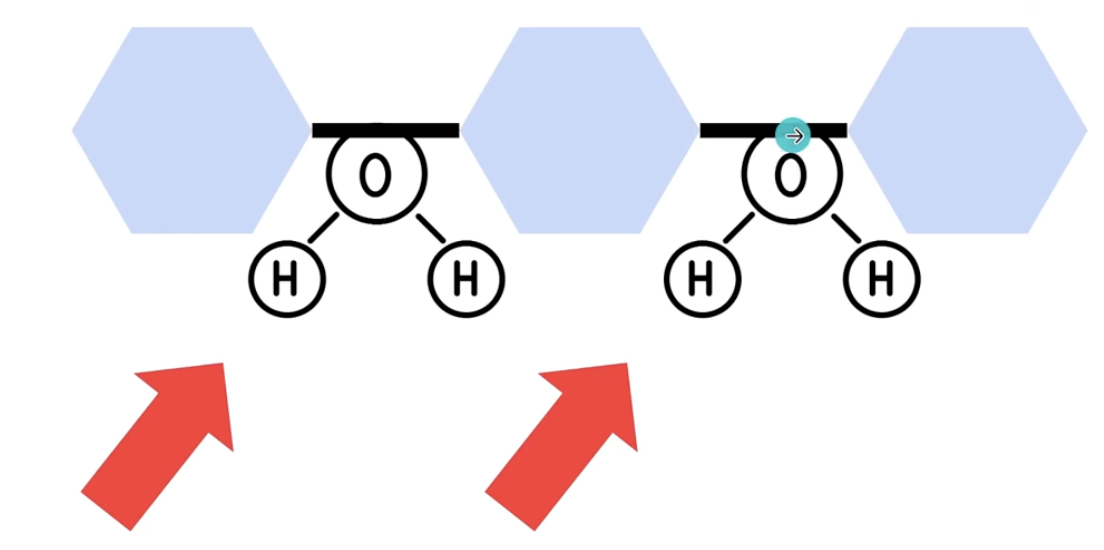
Water is also technically made up of a hydroxyl group and an O, so the hydrogen ion (-H) from one water molecule attaches to one monomer, and the hydroxyl group (-OH) is added to the other
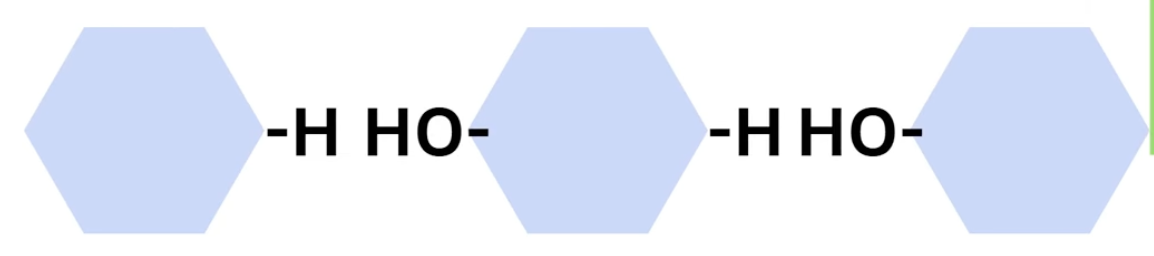
Therefore, those monomers are no longer covalently bonded to each other
The complete opposite of hydrolysis is dehydration synthesis
Dehydration synthesis is a type of biological reaction where two smaller molecules are joined together by covalent bonds by taking away a water molecule to form a covalent bond
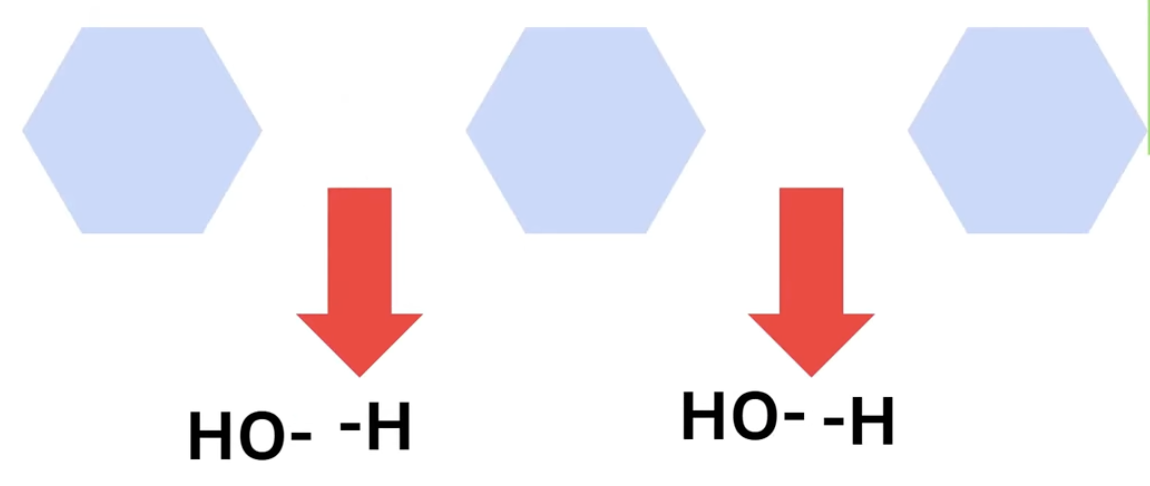
A hydrogen ion (-H) is removed from one monomer and hydroxyl (-OH) is removed from the other
Connecting many monomers together to form polymers is called polymerization which is talked about when making proteins and nucleic acids
1.4 - Carbohydrates
Carbohydrates are organic macromolecules characterized by carbon atoms bonded to -OH and H so being made of CHO
Carbohydrates can be interchanged with the name Sugars as they are technically sugars
They function as fuel for cellular energy and in some instances for structure
The monomers of carbohydrates are called monosaccharides also known as simple sugars including glucose and fructose
Disaccharides that are made of two monosaccharides like sucrose or maltose are also some relatively sweet tasting sugars
But glucose is the most important monosaccharide or sugar just in general it is made up of 6 carbons, 12 hydrogens, and 6 oxygens
They can come in two different shapes either cyclic so in a pentagon or hexagon or linear so in a string
They taste sweet
The polymers of carbohydrates are polysaccharides which are linked by covalent bonds through dehydration synthesis also known as complex carbohydrates
These are what we normally think of as carbs
They can form straight lines (linear) or can be branched
Cellulose is a linear polysaccharide that composes plant cell walls which is an important part of dietary fiber which is basically carbs in our body that can’t break down but help to move things forward and also makes plant cell walls which is the most important
When you think of carbs starch is the big one it is a linear or branched polysaccharide comprised of many glucose molecules found in plants; used for energy storage
Glycogen is a highly branched polysaccharide and is how animals (including ourselves) store glucose for energy in muscles and liver
1.5 - Lipids
The thing that ties all lipids together is that they are all nonpolar or hydrophobic organic molecules
Lipids are a group of nonpolar/hydrophobic organic molecules with different functions depending on how they’re assembled
So how they’re put together determines their function
The have different functions but the main thing is that they are all nonpolar or hydrophobic so they’re afraid of water because water is polar
Nonpolar only interact with nonpolar and polar only interact with polar
Each type of lipid has a different monomer so while fatty acids are a type of monomer of lipids they are also not
The reason being that when I put a bunch of fatty acids together doesn’t mean I get a poly fatty acid unlike when I put monosaccharides together to form polysaccharides
But fatty acids are a monomer because if you put some of them together with other molecules, you can form some very functional lipids
So a fatty acid is a type of monomer and type of lipid
It is a hydrocarbon chain found in fats and phospholipids
There are two types based on double bonds between carbons
A saturated fatty acid has only single bonds between carbon atoms
An unsaturated fatty acid has at least one double bond between carbon atoms
A double bond is what causes the chain to bend or kink
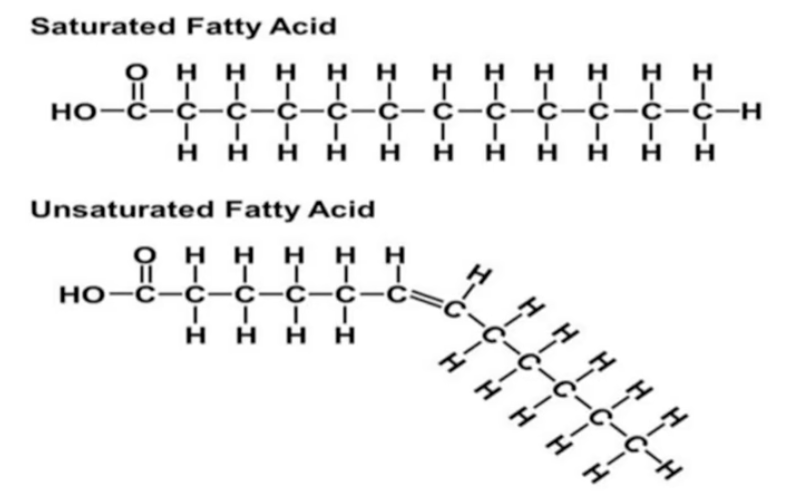
If you were to stick a bunch of unsaturated fatty acids together they’re not going to pack very well together
An example of an unsaturated fatty acid would be an oleic acid which we would call a monounsaturated fatty acid mono because it’s got one double bond
Then linoleic acid is a polyunsatured fatty acid poly meaning many because it has more than one double bond
The more double bonds that an unsaturated fatty acid has the more unsaturated it is and the more unsaturated it is the more liquid it is at room temperature
And the double bonds prevent the packing together or fatty acids
Unsaturated fats are considered to be healthy while saturated fats are unhealthy because they tend to be solid at room temperature while unsaturated fats tend to be liquid because of their double bonds
You would much rather have liquid going through your body because it doesn’t end up blocking any arteries or causing any problems so that’s why generally speaking unsaturated fats are the way to go
So if you take three fatty acids and you put them together and you attach them to a molecule called glycerol, you get something called a triglyceride which is a lipid responsible for energy and storage and some cellular functions
If you have unsaturated fatty acids then you are a unsaturated fat but if you don’t then you are a saturated fat
Fats are lipids responsible for energy storage which is its main function and some cell functions which can act as insulation for mammals
Steroids are lipid molecules that are used to make hormones
Hormones are long-distance cell signaling molecules responsible for growth/development, metabolism and homeostasis
Steroids provide the chemical basis for your cells to build hormones that allow your muscles to grow
It’s going to result in growth hormone and some other hormones
This is sort of the precursor to hormones which will be discussed in later units like unit 4
Cholesterols stabilize animal cell membranes; ensure fluidity
Too much cholesterol can build in blood vessels (LDL)
Most cholesterols are really good its mainly just LDL low density lipoprotein which needs to be kept low to not block your arteries or anything causing issues
Phospholipids which are lipids when formed in a bilayer form plasma membranes
Contain phosphate groups
These are two fatty acids tails at the bottom of one and one phosphate head at the top
The head is polar or hydrophilic meaning it loves and absorbs water and the two fatty acids tails are nonpolar meaning hydrophobic meaning it hates and repels water
1.6 - Nucleic Acids
DNA is an important part of nucleic acids; it exists in all living things
Nucleic acids are organic macromolecules that contain genetic information based on sequences of monomers
DNA contains information that all living things can read so sort of like the letters in a language or words from a sentence in a language
The different sequences of the nucleotides, a nucleic acids monomer, is what determines what message cells are able to read and what messages your cells are able to decode and do something with
Instructions for cells are based on the sequence or the order of the monomers
Just like with other monomers becoming polymers when you put a bunch of them together, when you take a bunch of nucleotides and put them together you start to make a DNA molecule
The order in which you put those nucleotides determines what message it’s going to send; this doesn’t necessarily matter for other macromolecules
That’s how cells are able to convey information to themselves and one another
DNA and RNA are made of long unbranched strands of nucleotide monomers
This is the structure of a nucleotide (one monomer of a nucleic acid of DNA or of RNA)
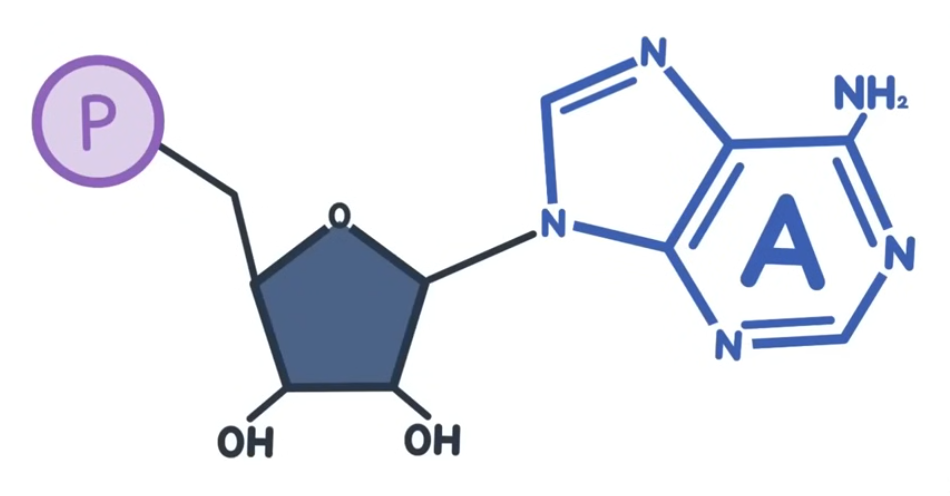
There are three different parts of a nucleotide
The first is a phosphate which contains one phosphorous and four oxygens which is it (The P Purple Circle)
Attached to that is a five carbon sugar, which is a carbohydrate, but yes this is also a component of a nucleotide, which is therefore a component of a nucleic acid, so they’re coming back (Dark Blue Pentagon) it has five carbons
But this differs between DNA and RNA
In DNA there is deoxyribose which lacks an oxygen atom at the 2’ (prime) position in comparison to RNA
In RNA there is ribose because it has all the oxygens
The third component is what’s called a nitrogenous base and it’s called this because it has a whole bunch of nitrogen in it
There are four different nitrogenous bases
Adenine
Guanine
Cytosine
Thymine
Adenine goes with Thymine (Apple in the Tree)
Cytosine goes with Guanine (Car in the Garage)
These two components the phosphate and the five carbon sugar comprise what’s called the backbone of the DNA molecule
And the nitrogenous base makes up the middle
The five carbon sugar in both DNA (deoxyribose) and RNA (ribose), each of those carbons actually have names
They have numbers for them (1’, 2’, 3’, 4’, and 5’)
The two most important ones are the 5’ and 3’
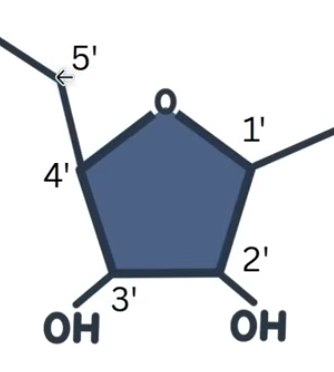
DNA molecules are made of two strands of nucleotides and it’s important to know how these strands are oriented with respect to one another in reference to one another
These nucleotides connect to each other via their 5’ and their 3’ carbons
The 5’ is connected to the phosphate
The 3’ is attached to the next phosphate