Masculinity-Femininity
Masculinity - Femininity & Sexual Orientation
The Spectrum of Male Androphilia (homosexual men)
A Continuum for Gender Roles
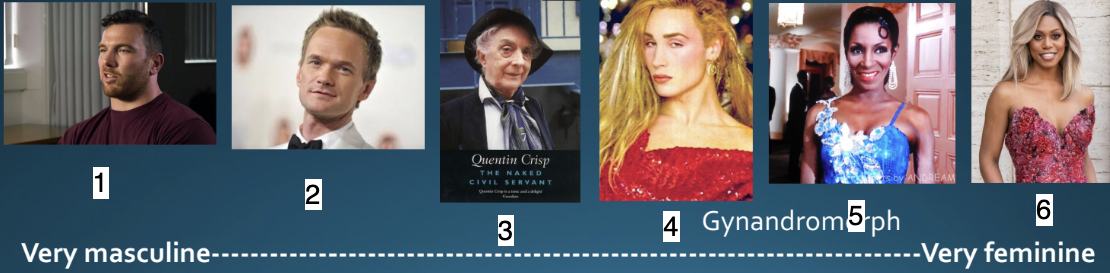
1) Very Masculine Homosexual
confused of sexual orientation
minority for androphilic males (about 10%)
2) Intermediate
gay man
largest group from all other groups (most common)
more interested in more female occupations
intermediate level
Behaviour = Atypical
Sex atypical in behaviour in childhood compared to heterosexual men (shifted to what is seen for females)
Psychology = Typical
same psychology as men tho (typical in this way)
3) Feminate Androphilic males
feminate androphilic male
behaviour and psychology is similar to androphilic women (heterosexual women)
Hyper feminine (maybe even more feminine than hetero women)
sex a typical
4) Gynandromorphs with no Surgery/Hormones
sex a typical
dont modify body with hormones or surgery
cross dressing varies
5) Pure Gynandromorphs with some surgery
Routinely cross dresses
had surgery (has breasts, still kept penis)
Gyanandromorph with or without breasts
6) Male Transexuals (MtF)
go through body modification (surgery, hormones)
had surgery (gets rid of penis, has breasts)
transsexuals (rare about 1%)
The Spectrum of Female Gynephilia (homosexual women)
A Continuum for Gender Roles
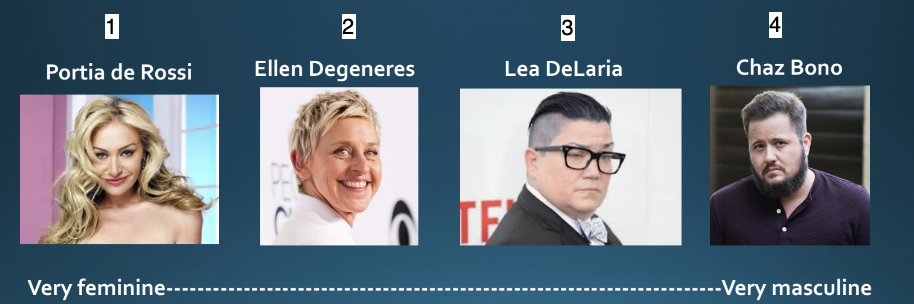
1) Very Feminine
the feminine one in usual homosexual relationship (in the west)
normal west binary
2) “The Dike”
the masculine one in usual homosexual relationship (in the west)
normal west binary
3) Gynandromorph Equivalent
routinely cross dress
no body modification
similar to Gynandromorphs for androphilic males
4) Female Transexuals (FtM)
transsexuals
has body modification and hormone treatment
still a minority to modify the genitals
Looking at the data for both the Spectrum of Female Gynephilia and Male Androphilia, is it common to have genitals also changed with surgery?
only a minority of highly feminine males get their penises removed. Most would keep the penis and get breasts
same pattern seen with gynephilic females (genitals not changed usually)
changes with surgery usually for transexuals
Original definition of Gynandromorph and Gynandromorphophilic?
Gynandromorph = has had surgery (has breasts, still kept penis)
Gynandromorphophilic = attracted to feminized males who still have penis
The Categorization of Same Sex Attracted Individuals: The 2 Main Groups
These two groups are distinguished by their presentation and behaviour (the Continuum for Gender Roles spectrum is divided)
1) Cisgender
2) Transgender
Cisgender
a person whose presentation and identity is relatively typicalfor their sex and corresponds to the gender assigned at birth
Transgender
a person whose presentation and identity is atypical for their sex and does NOT correspond to the gender assigned at birth
Body Modification plays a crucial role
MtF or FtM
Categorization of Same Sex Attracted Individuals in different cultures: Ivory Coast, West Africa and Androphilic Males
An example of a culture categorizing androphilic males into transgender and cisgender types
Woubi:
feminine transgender. (MtF)
identify more with the feminine gender expression.
Yossi:
masculine cisgender.
identify with the gender assigned to them at birth
individuals adopt a gender presentation or role that is different from their assigned sex at birth without undergoing physical modifications
no surgery or hormones
Does the term “Body Modification” mean the same in every culture?
No, there is two main meanings found for “Body Modification” in different cultures
1) West Culture
body modification means surgery to feminize or masculine face and body
Cultures intolerant — More of the Binary (not lots of Gyanandromorphs)
2) Other Cultures
body modification means just getting more feminized or masculine WITHOUT need for surgery
enacting (behaving) gender presentation to desired ones seen as Body modification for Gyanandromorphs
Cultures tolerant — Like in Samoa, you will see more of a population for Gyanandromorphs (faaffine)
Categorization in different cultures: Binary Categorization of Gynephilic females in Thailand
An example of Binary Categorization of Gynephilic females outside of the West (currently)
Tom (ทอม):
“tom" is derived from the English word "tomboy."
women who express a more masculine gender identity and appearance.
more masculine gender role in their relationships
Transgender Dee (ดี):
"dee" comes from the English word "lady."
Individuals who express a more feminine gender identity and appearance.
more feminine gender role in their relationships
Relationship Dynamics:
Toms and dees often form couples where the tom adopts a more dominant or masculine role, while the dee adopts a more submissive or feminine role in the relationship.
The dynamic within these relationships may mirror traditional gender roles. (same binary gender roles seen in the West)
Categorization in different cultures: Binary Categorization of Androphilic males in Ancient Past India (2100 BP)
Two types of androphilic males (klibás) were recognized — Ancient
Masculine Klibá (सहोदर):
Definition: Masculine klibás were androphilic males who maintained a more stereotypically masculine appearance and behavior.
Feminine Klibá (पुंसःस्नेह):
Definition: Feminine klibás were androphilic males who expressed themselves in a manner considered more feminine in terms of appearance and behavior.
Kamasutra (Vatsyayana)
these categorizations were part of a cultural understanding of androphilic individuals during the specified time period
documented in the Kamasutra, a classical text attributed to Vatsyayana
The Kamasutra widely known for its discussions on sexuality, also includes insights into various aspects of human behavior, relationships, and societal norms prevalent during ancient times.
The Start of Binary Categorization of Gynephilic females
Occurred at least since the 19th century
emerged in the context of understanding and categorizing female sexuality.
Critical Arrows (1879)
Karl Heinrich Ulrich
where Ulrich described the classification of gynephilic females into two distinct categories: Mannlingin and Weiblingin.
Mannlingin = very masculine
gynephilic females who exhibited more masculine traits, both in terms of appearance and behavior.
Weiblingin = very feminine
gynephilic females who expressed themselves in a manner considered more feminine, conforming to societal expectations of traditional femininity
The Objective and Intersubjective Elements of the spectrum of Male Androphilia or Female Gynephilia
Objective Reality:
encompasses the actual diversity within expressions of male androphilia or female gynephilia,
acknowledging a spectrum ranging from more traditionally masculine to more traditionally feminine presentations.
2. Intersubjective: Binary Categorization/Social Construction:
Binary categorization, as a social construct, simplifies the nuanced reality of sexual orientations into binary terms
it is a cognitive tendency to simplify information into binary categories for ease of understanding
this bias limits the ways individuals think about and categorize experiences, resulting in a constrained conceptualization of diverse sexual orientations.
Distortions of Objective Reality
For the spectrum of Male Androphilia or Female Gynephilia, are they similar or different in Natural kind and Expression?
Same Natural Kind — Different Expressions
They are part of the same natural kind (male), just brought up differently because of culture (leads to different expressions)
vary with gender role presentation (expressions) not dealing with absolute differences (natural kind)
the West says that there is no spectrum, see socially construct categories as separate
culture or environment has a huge impact (depends on where someone develops)
Whitam (1987): The two types of Transexuals (MtF)
male homosexual and heterosexual transsexuals have separate spectrums / different objective categories
1) Homosexual / Androphilic MtF Trans individuals
2) Heterosexual / Gynephilic MtF Trans Individuals
Whitam (1987): Evidence for the two types of Transexuals
1) Homosexual / Androphilic MtF Trans individuals
Extremely feminine in childhood, including non-fetishistic cross- dressing
Extremely feminine in adulthood
Exclusively sexually attracted to men (homosexual/androphilic)
If they transition, they often do so early in life
anormophilic = directed outward attraction (attracted to someone different looking than themselves, male homosexual = likes males)
2) Heterosexual / Gynephilic MtF Trans Individuals
Not feminine in childhood
Sexually attracted to women, but will sometimes engage in sex with men
Not particularly feminine in adulthood
Often marry and father children
Sexually aroused to the thought of themselves as women (autogynephilia)
Autogynephilia expressed in adolescence via fetishistic cross- dressing (arousing)
If they transition, they often do so later in life
directed outward attraction and themselves (attracted to someone similar looking to themselves, male heterosexual = likes females)
How are Androphilic MtF Trans individuals related to Cisgender androphilic “gay” man
SAME NATURAL KIND
attraction for both is anormophilic = directed outward attraction
intrinsically attracted to someone different looking than themselves
Cisgender androphilic “gay” man = attracted to feminine gay guys, looks masculine
Androphilic MtF Trans individuals = attracted to masculine guys, looks feminine
How are Androphilic transwoman and Gynephilic transwomen different
DIFFERENT NATURAL KINDS
directed outward attraction and to themselves
intrinsically attracted to someone similar looking to themselves
Androphilic transwoman = attracted to masculine guys, looks feminine
Gynephilic transwomen = attracted to feminine guys, looks feminine
The two types of FtM trans individuals (whats the evidence)
way less research for women than with men
Childhood Onset
masculine in childhood (crossdressing)
masculine in adulthood
most are sexually attracted to women, although some report bisexual attraction (more gynephilic)
developmental contiguity for staying masculine from childhood to adulthood
Adolescent Onset
Prior to mid 2000s it was rare to non existent
not masculine in childhood
sexually attracted to women, men, or both
Trans identification occurs “out of the blue” typically in adolescence and often in the context of other in their peer group making similar declarations (peer to peer social contagion)
more variability
adoption of a belief that one is trans from others, can lead to mental decline
affirming identity using body modification sometimes