Bio1A Lecture 27 Study Guide: Principles of Cell Signaling and the GPCR System
Introduction to Cell Signaling
Physiological Responses to Fear: The Adrenaline Case Study
Physiological Reactions to Being Scared:
Heart rate increases.
Pupils dilate (expand).
Blood supply to muscles increases.
Piloerection occurs (hairs raise on the back of the neck).
Respiration rate increases.
Adrenaline (Epinephrine) Signaling Pathway:
1. Perception: An individual sees something frightening, which activates "flight mode" signaling in the brain.
2. Endocrine Activation: The pituitary gland releases chemical signals to the adrenal gland.
3. Hormone Release: The adrenal gland releases adrenaline into the bloodstream.
4. Cardiac Response: Adrenaline binds to "pacemaker cells" in the heart, resulting in an increased heart rate.
5. Muscular Response: Adrenaline binds to muscle cells, causing them to contract.
6. Vascular Control: Adrenaline binds to cells surrounding the blood vessels, causing either constriction or dilation to regulate blood supply.
These are all examples of cell signaling
General Principles of Cell Signaling
Communication Requirements between Cells Requires :
Ligand: A signaling molecule.
Receptor Protein: A protein that binds the ligand.
Ligand-Receptor Interaction: This interaction initiates the process of signal transduction.
Signal Transduction Pathway Definition: The pathway through which a signal is converted into specific cellular responses.
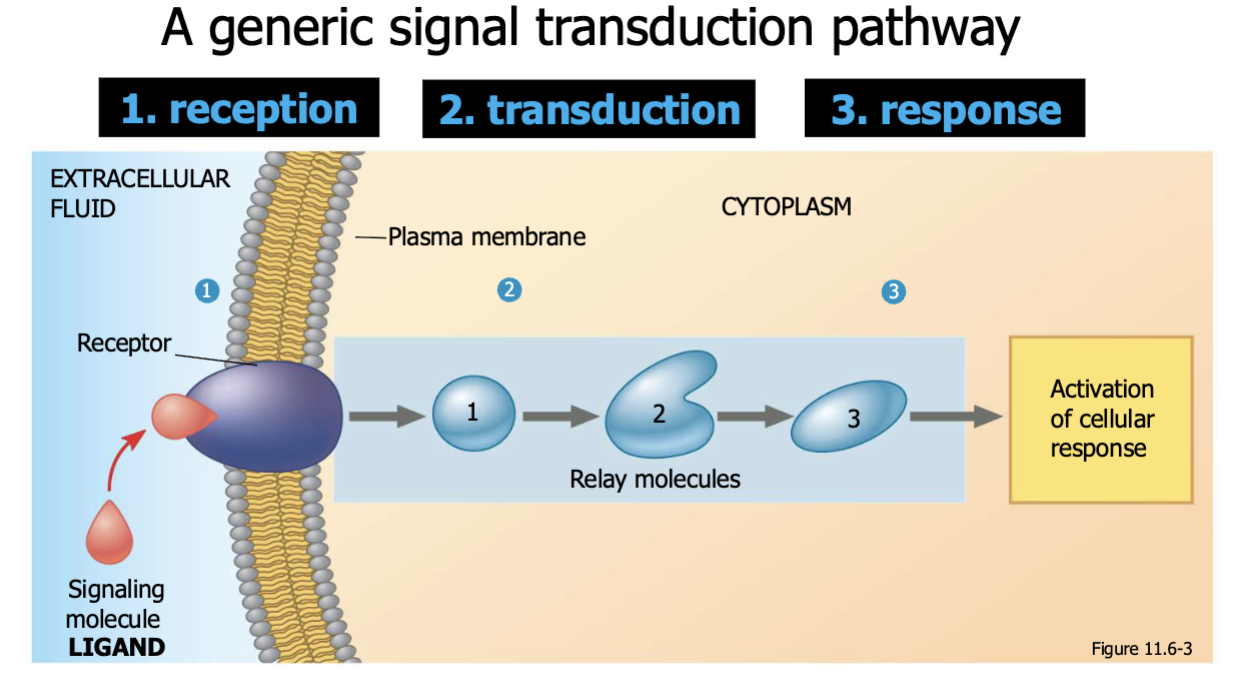
Stages of a Generic Signal Transduction Pathway:
1. Reception: A signaling molecule (ligand) binds to a receptor on the plasma membrane or within the cytoplasm.
2. Transduction: Relay molecules convey the signal through the cytoplasm.
3. Response: Activation of a specific cellular response.
Four Types of Signaling in Animals
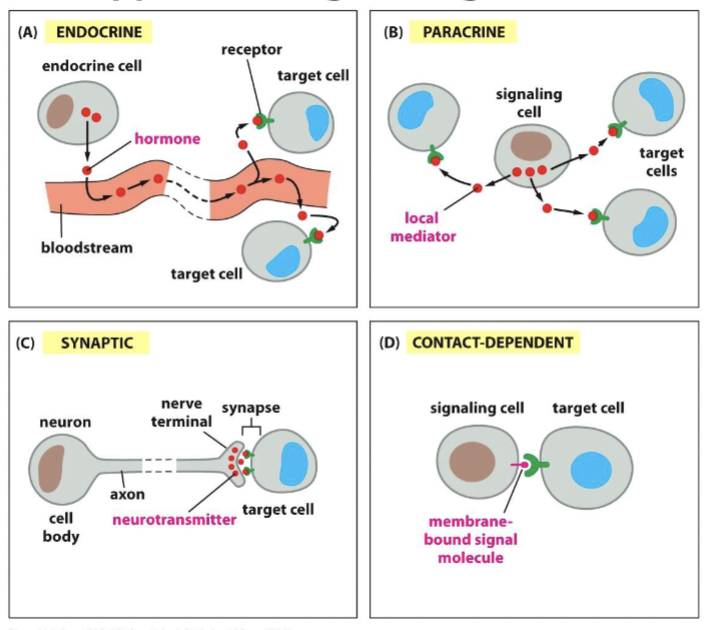
(A) Endocrine Signaling:
Involves endocrine cells releasing hormones into the bloodstream.
Hormones travel through the blood to reach distant target cells.
(B) Paracrine Signaling:
Involves a signaling cell releasing local mediators.
Target cells are in the immediate vicinity of the signaling cell.
(C) Synaptic Signaling:
Occurs in the nervous system.
A neuron sends an electrical signal along its axon to the nerve terminal.
Neurotransmitters are released across the synapse to the target cell.
(D) Contact-Dependent Signaling:
Involves direct physical contact between the signaling cell and the target cell.
The signaling molecule is membrane-bound rather than secreted.
Key Players in Signal Transduction: GPCRs
Key Player #1: G-Protein Coupled Receptors (GPCRs):
Structure: GPCRs contain seven transmembrane domains (identified as segments passing through the lipid bilayer).
Functional Sites:
Signaling molecule binding site (extracellular).
Segment that interacts with G-proteins (intracellular).
Diversity: GPCRs are found across a wide range of organisms including pufferfish, chicken, sea squirt, ameba, sea urchin, fruit fly, nematode, lancelet, sea anemone, diatom, placozoan, and protists.
Discovery and Scientific Recognition:
Major Achievement: The 2012 Nobel Prize in Chemistry was awarded to Robert Lefkowitz (Duke University) and Brian Kobilka (Stanford University) for their studies of GPCRs.
Beta-adrenergic receptor = adrenaline receptor
Technical Milestone: Purification of the beta-adrenergic receptor (adrenaline receptor) was achieved in 1984 using affinity chromatography.
Pharmaceutical Importance: Approximately 30-50% of drugs
Examples:
Psychedelic receptors (5HT2A-R).
Cannabinoid receptors (CB1 and CB2).
The Mechanics of G-Protein Signaling
Key Player #2: GTP-binding proteins (G-proteins):
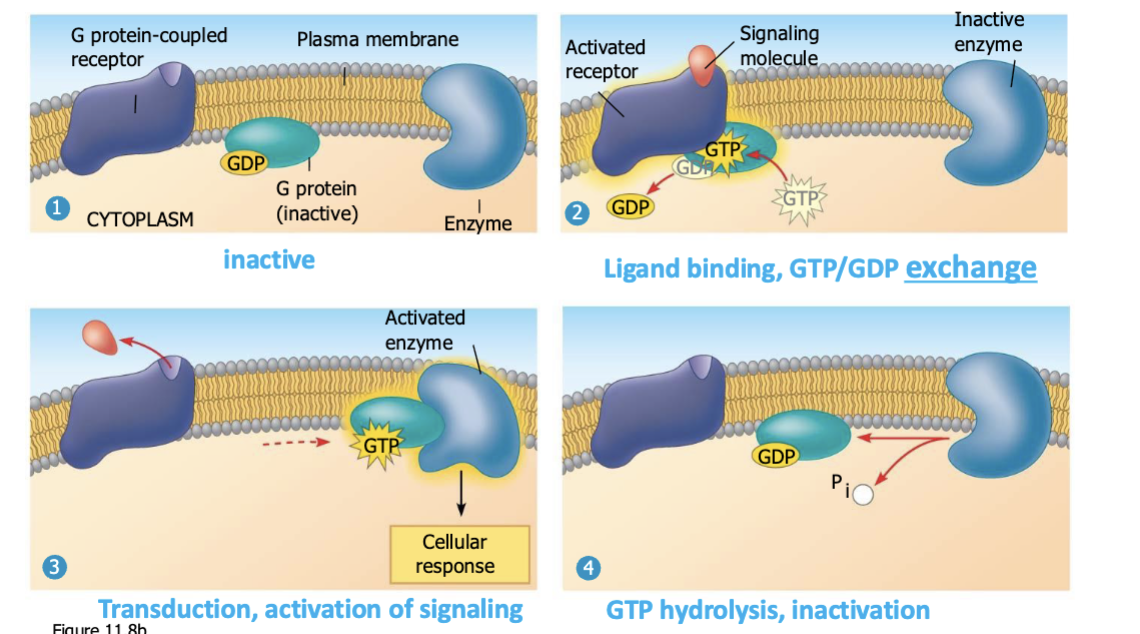
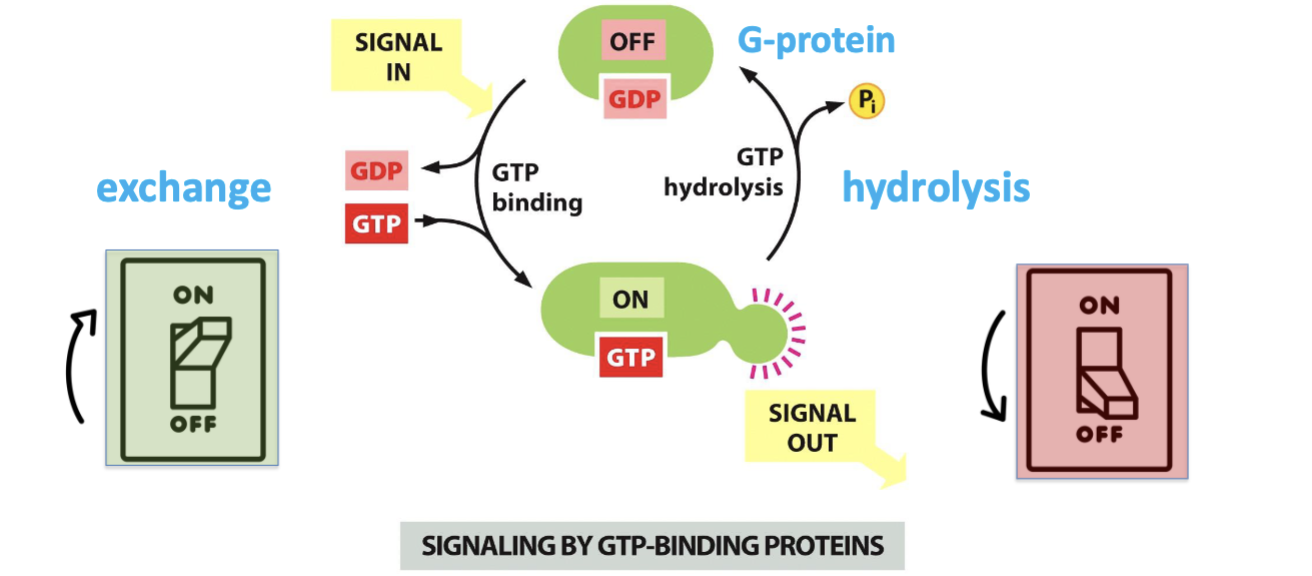
G-proteins act as molecular switches regulated by the exchange and hydrolysis of nucleotides.
The GPCR Signaling Cycle:
1. Inactive State: The G-protein is inactive when bound to GDP. The enzyme is also in an inactive state.
2. Activation: The signaling ligand binds to the GPCR (receptor). This causes a conformational change that allows the G-protein to bind to the receptor, triggering the exchange of GDP for GTP.
3. Transduction: The activated G-protein (now bound to GTP) dissociates from the receptor and binds to an enzyme, activating it to trigger a cellular response.
4. Inactivation: The G-protein has intrinsic GTPase activity and hydrolyzes GTP back into GDP and an inorganic phosphate ($P_i$). The G-protein becomes inactive again, and the signaling cycle resets.
The Gustatory (Taste) System and Signal Transduction
Anatomy of Taste:
Tongue: Covered in Papillae.
Taste Buds: Located within papillae, containing a taste pore, sensory receptor cells, and other supporting cells.
Sensory Neurons: Transition signal from receptor cells to the brain.
Primary Taste Modalities:
1. Sweet
2. Salty
3. Sour
4. Bitter
5. Umami
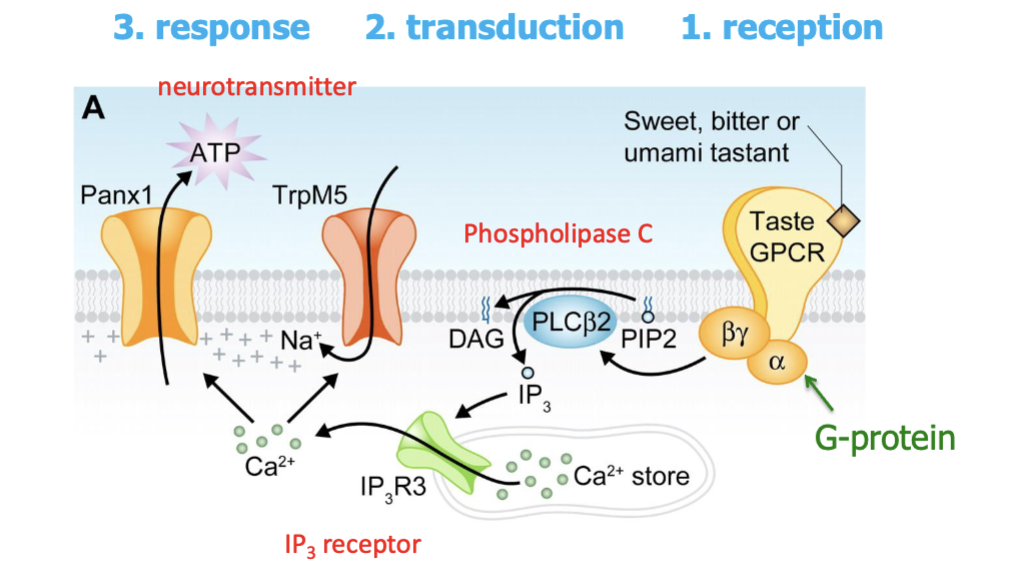
GPCR Involvement in Taste: • Sweet, Umami, and Bitter tastes are primarily mediated through GPCRs.
Genetic Variation: Mutations in the gene TAS2R38 can lead to significant differences in an individual's ability to perceive bitter tastes
Molecular Steps in Bitter Taste Transduction
1. Reception: A bitter food molecule binds to a GPCR on the taste receptor cell.
2. Transduction:
The GPCR activates a G-protein.
The G-protein activates Phospholipase C (PLC).
This produces IP3R3, which binds to an IP3R3 receptor, releasing calcium ions.
3. Response: The increase in intracellular signals leads to the release of neurotransmitters to the sensory neuron.
Extended Biological Context: "Taste" receptors are not exclusive to the tongue; they are also found in other internal organs, such as the pancreas.
pancreas plays a crucial role in integrating taste signals, as taste receptors within the pancreas can sense nutrients, triggering the release of digestive enzymes and hormones such as insulin. This shows that the taste signaling pathway is not only important for flavor perception but also essential for coordinating digestive and metabolic responses to ensure effective nutrient absorption and utilization in the body.