ATOMIC THEORY
The Development of Atomic Theory
• The concept of the atom has been around for over 2000 years. • Over that time our models of the atom have changed significantly as scientists used them to help explain
• how matter behaves.
Democritus
• Proposed that matter was made up of tiny indivisible particles
• These particles could not be seen by the naked eye and could not be cut or subdivided into smaller bits
• They were called atoms
Period of Alchemy
• From the first century CE to the seventeenth century is sometimes known as the period of alchemy.
• During this period, alchemists explored the nature of matter intensely.
Dalton's Atomic Theory

• In 1808, English scientist and schoolteacher John Dalton proposed a theory to explain the observations of matter.
• Dalton proposed that atoms are solid spheres like billiard balls.
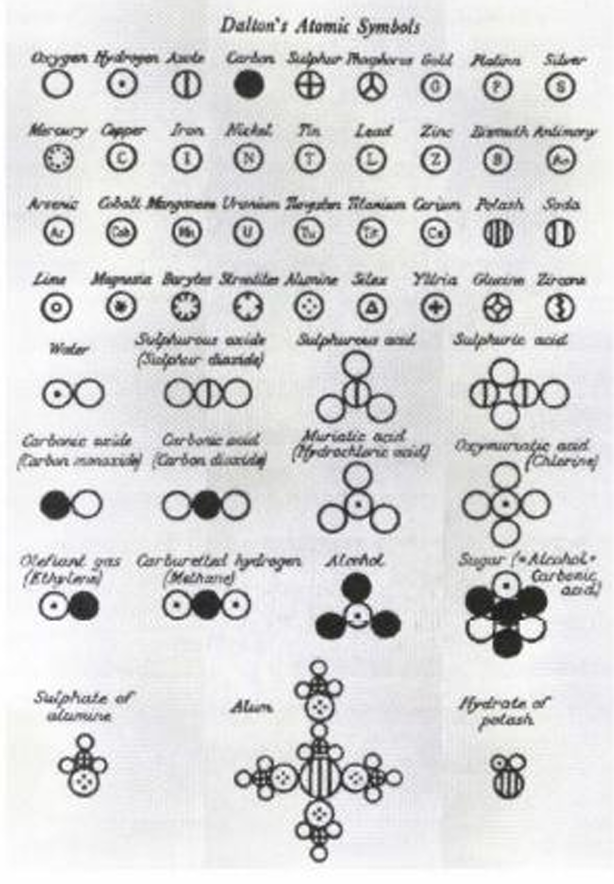
More specifically, Dalton proposed that
all matter is made up of tiny, indivisible particles called atoms
all atoms of an element are identical atoms of different elements are different – atoms are rearranged to form new substances in chemical reactions, but they are never created or destroyed
J.J. Thomson’s Atomic Theory
In 1897, J.J. Thomson used an apparatus called a cathode ray tube to discover a "new" type of particle: the electron.
Through experiments, he proposed that an electron is a negatively charged, extremely small part of an atom.
Rutherford Atomic Theory

• In 1909 Ernest Rutherford performed a series of important experiments
• He aimed tiny positive alpha particles at a thin sheet of gold foil. (An alpha particle, like a helium nucleus, has 2 protons and 2 neutrons.)

He famously declared "it was almost as incredible as if you fired a 15 inch shell at a piece of tissue paper and it came back and hit you."
• From these observations, Rutherford reasoned that each atom contained a small, dense, positively charged central nucleus.
• In 1920, he proposed that the nucleus is made up of positively charged particles, each one called a proton.
Chadwick's Discovery of Neutrons

• In 1932, James Chadwick's experiments confirmed that nuclei contain neutral particles (neutrons) as well as protons.
• A neutron is a particle in the nucleus of an atom or ion.
• A neutron has no charge: it is neither positive nor negative.
Bohr’s Atomic Theory

• Niels Bohr experimented with applying electricity and thermal energy to hydrogen gas.
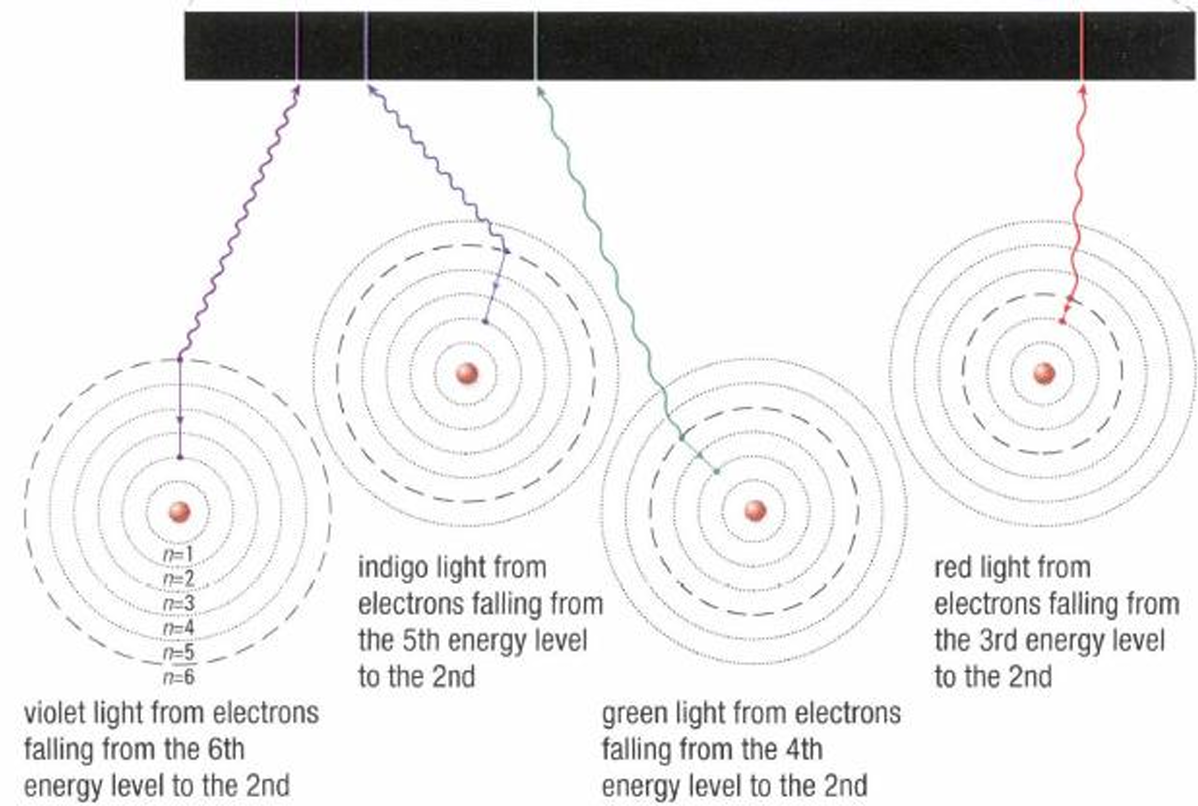
• He realized that hydrogen has a unique atomic spectrum: a pattern of coloured lines that is not produced by any other element.

His revision is called the planetary model of the atom where electrons only exist in certain allowed orbits.
• Each orbit has a specific quantity of energy associated with it.
• As a result, electron orbits are sometimes called energy levels.
• Each energy level can hold a certain number of electrons.
• Electrons can jump energy levels if “excited” called an electron transition • Energy is released as the electrons fall back to their ground state

Bohr- Rutherford Diagrams
• Combining the ideas of Dalton, Thomson, Rutherford, Chadwick, and Bohr we draw a model of the atom called a Bohr Rutherford diagram.
• Most chemical reactions involve only the electrons in the outermost energy level.
• The outermost energy level is also known as the valence shell.
• The electrons in the valence shell are valence electrons.
A Summary of Subatomic Particles

Atomic Number and Atomic Mass
• Atomic number Z, tells us where the element is on the Periodic Table (# protons and # electrons).
• Atomic mass number A is the sum of all the particles in the nucleus.
• Neutron number N is the number of neutrons in an atom. N = A - Z

The Mass of an Atom
• Atoms are extremely small.
• In the head of a pin there are approximately 8.0 X 10¹⁹ iron atoms or 80 000 000 000 000 000 000 atoms.
UIPAC and SI Convention
• The accepted unit to measure the mass of atoms is the atomic mass unit, u.
• The atomic mass unit is defined as 1/12th the mass of a carbon-12 atom.
• 1 u = 1.660 540 2 X 10-27 kg