3.4 - Cognitive Development Across the Lifespan
Cognition: all the mental activities associated w/ thinking, knowing, remembering, and communicating
Schemas: a concept/framework that organizes and interprets info
→ Assimilation: interpreting our new experiences in terms of our existing schemas
→ Accommodation: adapting our current schemas to incorporate new info
Piaget’s Theory of Cognitive Development
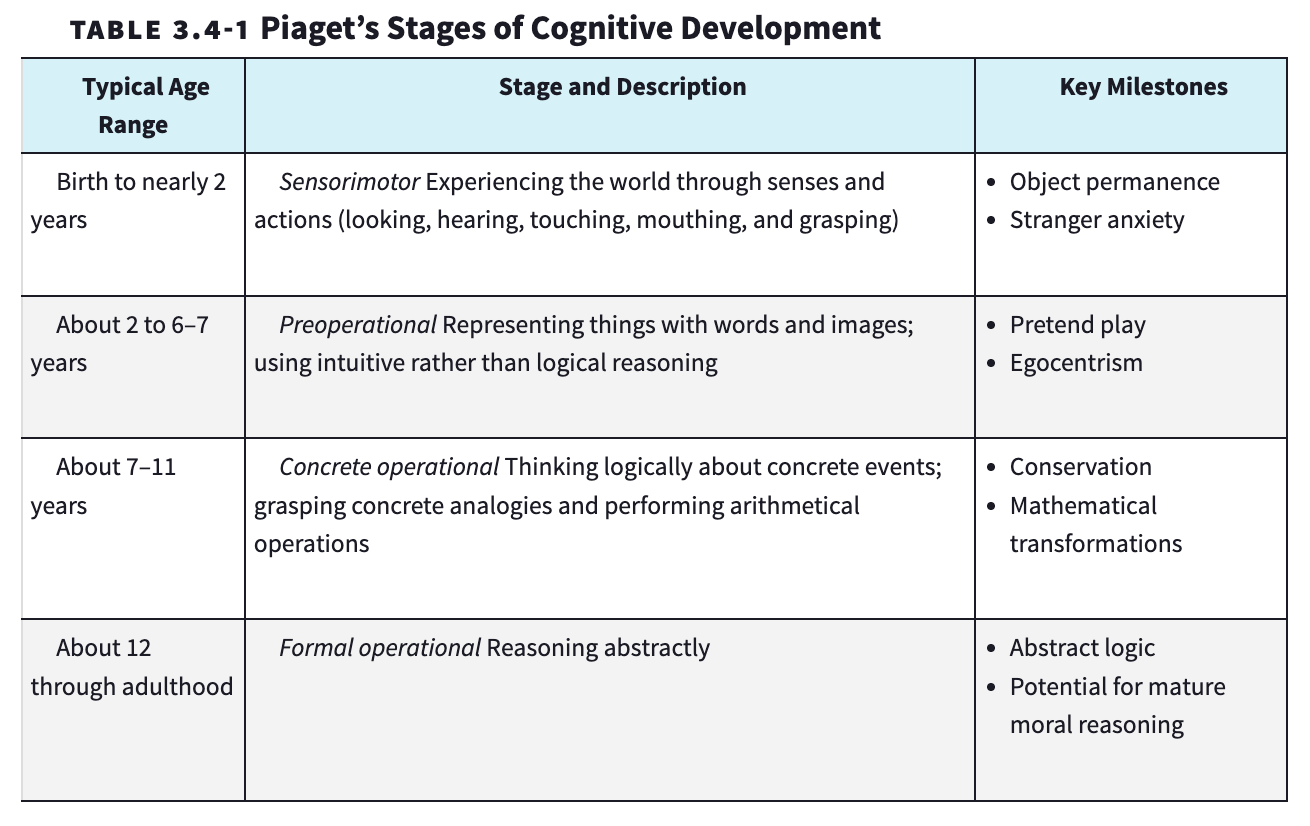
Sensorimotor Stage:
Object permanence: the awareness that things continue to exist even when not perceived
Stranger anxiety: the fear of strangers infants commonly display
Preoperational Stage:
Pretend play: using imagination to create scenarios, act out roles, and form new symbolic connections
Egocentrism: a child’s difficulty taking another’s POV
Concrete Operational Stage:
Conservation: the principal that properties such as mass, volume, and number remain the same despite changes in the forms of objects
Children grasp more complex operations (spatial, mathematical, relationships)
Formal Operational Stage:
Abstract reasoning and logic
Formal operational thinkers have no problem answering correctly
Video Resource:
Lev Vygotsky - An Alternate Viewpoint
Scaffold: a framework that offers children temporary support as they develop higher levels of thinking
* A child’s zone of proximal development is the zone between what a child CAN & CAN’T do — what they can do with help
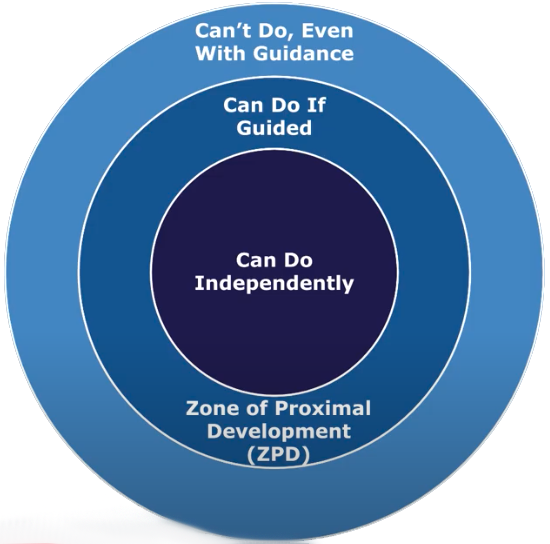
* Vygotsky emphasized how a child’s mind grows through interaction w/ the social-cultural environment
Other Important Terminology
Theory of Mind: people’s ideas about their own and others’ mental states — about their feelings, perceptions, and thoughts, & the behavior these might predict
Moral intuition: “quick gut feelings”
→ the mind makes moral judgements quickly and automatically
→ feelings of disgust/elation trigger moral reasoning