Genes
The genetic code is non-overlapping and directional: reads 5’ → 3’
The code is degenerate - several codons can encode for the same amino acid, reducing the impact of mutations
The Relationship between DNA Mutations and Protein Mutations:
If there is a mutation in the DNA (e.g. insertion), the mRNA will contain the wrong base, the codon will change so the amino acid may change and the protein’s structure and function may change.
Deamination of cytosine → uracil, resulting in a mutation
Nonsense mutation is when there is a premature stop codon
Missense - mutation causes another amino acid to form
Basic structural anatomy of a gene:
A transcription unit - promotor, coding region (exons and introns), terminator
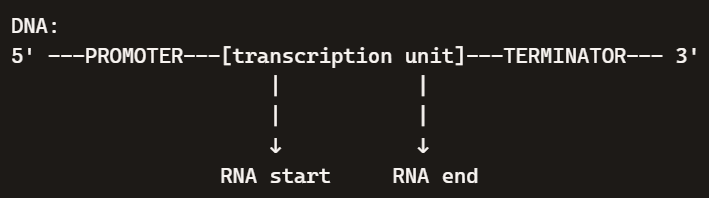
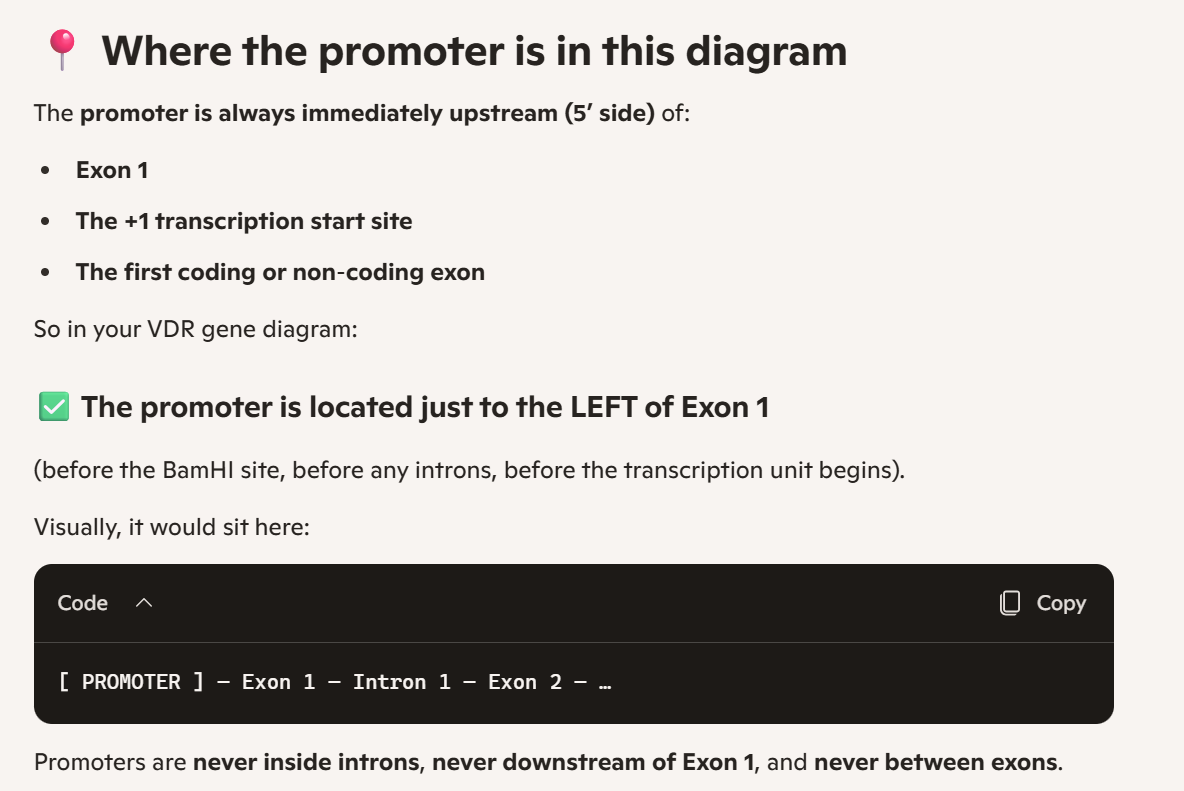
RNA polymerase binds to the promotor.
Structure of the mRNA:
1. Untranslated regions (UTRs)
5′ UTR (before the start codon)
3′ UTR (after the stop codon)
These are not translated, but are essential for:
stability
translation efficiency
regulation
2. Open Reading Frame (ORF)
This is the coding region that is translated into protein.
3. Cap and Poly(A) tail (eukaryotes)
5′ cap (7‑methylguanosine, 5′–5′ linkage)
Poly(A) tail added at the 3′ end
These protect the mRNA and regulate translation.
A gene consists of a transcription unit controlled by promoter and terminator sequences; the resulting mRNA contains a coding region (ORF) embedded within untranslated regions and undergoes capping, polyadenylation, and splicing to become a mature transcript.
Lagging Strand Synthesis
Max 6 marks
Helicase unwinds DNA (1)
Primase synthesises short RNA primers (1)
DNA polymerase III extends primers → Okazaki fragments (1)
DNA polymerase I removes RNA primers (5’→3’ exonuclease) (1)
DNA polymerase I replaces RNA with DNA (1)
DNA ligase seals nicks between fragments (1)
PCR
Max 5 marks
Denaturation (≈94°C): strands separate (1)
Annealing (≈55°C): primers bind (1)
Extension (≈72°C): Taq polymerase synthesises DNA (1)
Taq used because it is heat‑stable (1)
Exponential amplification (1)
Transcription → RNA processing → Translation