Module AA- Measurement (Vital Signs)
]]Vital Signs]]
- Shows us how well vital organs are functioning.
- Include temperature, pulse, respiration, and blood pressure
{{Importance{{
- Changes in vital sign measurements can indicate that resident’s condition is worsening
- Can reflect how body is responding to medication and/or treatment
- Report abnormal vital sign immediately to the nurse and per facility policy and per facility policy
- Never guess when taking vitals
{{5th Vital Sign- Pain{{
- Whatever the resident says it is and response to pain varies from resident to resident.
- Other vital signs are objective, while pain is subjective
{{Respiratory System{{
- Involves the breathing in of oxygen and the breathing out of carbon dioxide.
- The left lung has two lobes and three lung has three lobes
Respiration
- The process that supplies oxygen to the cells and removes carbon dioxide from cells
- Involves inspiration and expiration
- Each respiration involves one inspiration and one expiration
- Respiratory rate is the number of inspirations the person takes in one minute.
- We count as the chest rises (inspirations)
<<Respiration Values- Abnormal<<
- Bradypnea: Less than 12 breaths per minute
- Tachypnea: more than 20 breaths per minute
- Apnea: no breathing
- Hypoventilation: slow, shallow breathing that may be irregular
- Hyperventilation: rapid, deep breathing
- Dyspnea: painful or difficult breathing
- Cheyne-Stokes: Alternating periods of slow, irregular breathing and rapid, shallow breathing, plus short periods of absent breathing.
- Document and notify nurse
}}Checking Respiration}}
- Equipment
- Analog watch
- Note pad/assignment sheet and pen
- Analog Watch
- When counting respiration for 60 seconds, while watching the second hand, start counting and stop counting on the SAME number.
- Respiration Observation
- The nurse aide counts respiratory rate for 60 seconds
- While watching the second hand of an analog watch, the nurse aide starts counting and stops counting on the same number; do not wait until 12
- Document on the resident’s record if the respirations…
1. Fall between 12-20 2. Regular, quiet, with both sides of chest rising and falling equally.
- Document on resident’s record and notify the nurse, if respirations are abnormal.
- Stealth Respirations
- Check respirations right after checking pulse (without moving hand from wrist), so resident does not realize respirations are being counted; patients tend to change breathing pattern if they are aware that it is being checked.
{{Cardiovascular System{{
- Cardiovascular system: continuous movement of blood through the body.
Structure and Function of the Blood Vessels
- Veins: Blood vessels that carry blood with waste products away from the cells and to the heart.
- Arteries: Blood vessels that carry blood with oxygen and nutrients away from the heart and to the cells.
- Pulse: Is the beat of the heart felt at an artery, as a wave of blood passes through the artery
- Pulse rate: The number of heart beats (or pulses) per minute.
- Pulse Rhythm: The regularity of the heart beats (pulses) and should be the same interval between beats.
- Pulse force: The strength of the pulse and should be easy to feel.
}}Pulse Sites}}
- Temporal
- Carotid: never check pulse rates on both carotid arteries at the same time
- Apical: Over the heart, taken with a stethoscope
- Brachial: typically used during BP checks
- Radial: used most often, easy to reach, easy to find, used for routine vital signs
- Typically used to take pulse during during routine vital signs checks
- Does not expose resident
- Located on the thumb side of the wrist
- Use first two or three fingers; NEVER thumb
- Pedal: used to check circulation of the leg
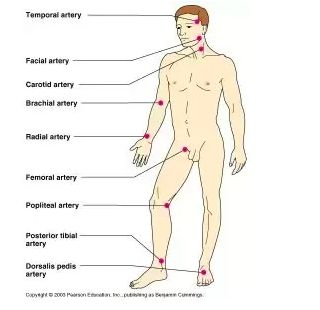
<<Pulse Values<<
- Normal pulse for adults (document)
- Rate between 60-100 beats per minute
- Regular, and strong
- Abnormal pulse for adults (document and notify nurse)
- Bradycardia: less than 60 beats per minute
- Tachycardia: more than 100 beats per minute
- Irregular pulse rhythm
- Weak in strength
}}Counting Pulse}}
- Analog watch
- When counting pulse for 60 seconds, while watching the second hand, start counting and stop counting on the same number.
- Document on the resident’s record if the pulse falls within the range of 60-100 and is regular and strong
- Document and notify nurse, if it is abnormal
- Notepad/assignment sheet and pen
Structure and Function of the Heart
- The pump of the circulatory system
- Consists of four chambers (right and left atria, right and left ventricles)
- Has two phases
- Systole: The working phase of the heart when the heart is pumping blood to the body; the top number of a blood pressure reading.
- Diastole: The resting phase of the heart when the heart fills with blood; the bottom number of a blood pressure reading (diastolic
Blood Pressure
- Blood Pressure: The amount of force exerted by the blood against the walls of the artery.
- Shows how well the heart is working
- Can change minute to minute depending on:
- The activity of the resident (for position, BP is higher lying in bed than seated in chair or standing; for exercising, BP increases)
- Lifestyle choices (BP increases with smoking and drinking; BP higher if resident is overweight and decreases as weight is lost; BP may be high if resident eats a high salt diet)
- Reaction to stressful events (BP increases with anxiety, emotional responses, and stress)
- Acute injury or emergency (a blood volume decrease from injury will decrease BP; BP increases with pain)
- Medications (raises or lowers BP depending on the medication)
- Genetic factors affect blood pressure:
- Age (BP increases with age)
- Gender (women’s BP usually lower)
- Race (black residents BP higher than white
- Blood Pressure Site
- The brachial artery and the upper arm are sites most often used by nurse aide when checking blood pressure
- %%The blood pressure Value%%
- Measured in mm Hg
- Recorded in a fraction
- Normal Blood Pressure ranges of adult
- Systolic (top number): 90 mm Hg to 119 mm Hg
- Diastolic (bottom number): 60 mm Hg to 79 mm Hg
- Document on record
- Abnormal Blood Pressure Values
- Elevated blood pressure ranges (likely to develop high blood pressure unless steps are taken to control the blood pressure)
- Systolic: 120 mm Hg to 129 mm Hg @@AND@@
- Diastolic: below 80 mm Hg
- Hypertension: consistent elevated systolic or diastolic values
- Systolic: 130 mm Hg or higher OR
- Diastolic: 80 mm Hg or higher
- Hypotension: too low systolic and/or diastolic values
- Systolic: less than 90 mm Hg
- Diastolic: less than 60 mm Hg
- Always document on the record and report abnormal blood pressures to nurse
- The nurse aide uses three senses simultaneously when checking a resident’s blood pressure:
- Seeing: watches the needle’s movement in relation to the numbers on the manometer
- Hearing: using the stethoscope, listens for sounds indicating changes in blood flow in the brachial artery
- Touching: controls the inflation and deflation of the cuff using the thumb and index finger
- Checking Blood Pressure
- Stethoscope
- Sphygmomanometer: BP cuff
- Alcohol wipes
- Note pad/assignment sheet and pen
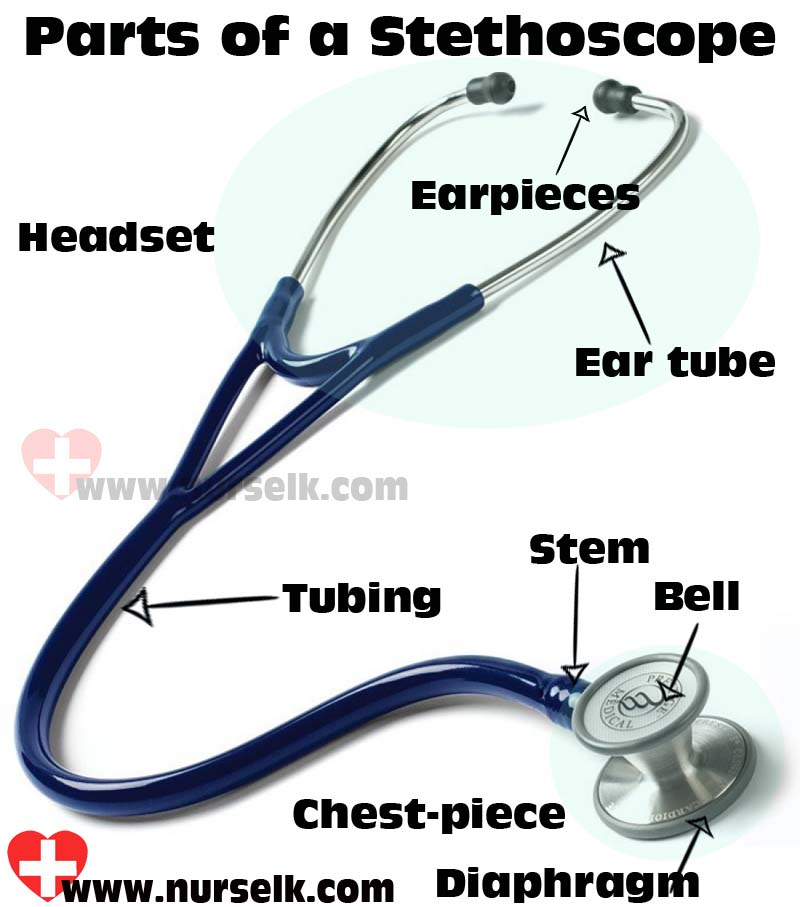
- Stethoscope
- Used to listen to brachial artery
- May be single-head (with diaphragm only) or dual-head (with diaphragm and bell)
- Parts
- Ear pieces
- Binaurals
- Rubber or plastic tubing
- Chest-piece (with diaphragm or diaphragm/bell)
- Ear Pieces
- To prevent infection, always clean before and after use with an alcohol wipe
- Insert ear pieces into ears so that they point forward toward the nose
- Should snugly fit in ears to block out noise.
- Dual-head Stethoscope- Diaphragm
- Before using dual-head stethoscope to take blood pressure, determine which side of chest-piece is active
- To check blood pressure, diaphragm needs to be active
- Two Ways to Check for an Active Diaphragm
- After inserting ear pieces into ears, tap diaphragm lightly to determine if tap is heard; if tap not heard, rotate chest piece at tubing, and repeat the tap
- If chest piece has an indicator dot, rotate chest-piece so indicator dot is closed
- Diaphragm Concepts
- To prevent infection, always clean before use, between residents, and after use with an alcohol wipe
- Warm diaphragm with hand before making contact with resident
- To use diaphragm, apply enough pressure to make a seal against the brachial artery at the crook of the elbow
- BP Cuff
- Two types
- Manual (aneroid)
- Electronic (digital)
- Aneroid BP Cuff- Parts
- Manometer
- Cuff with bladder
- Inflation bulb with air-release valve
- Tube from cuff to manometer
- Tube from cuff to the handheld inflation bulb
- Manometer
- Marked with long and short lines and has a needle
- the long lines mark 10 mm Hg
- The short lines mark 2 mm Hg
- Watch the needle as the cuff inflate while listening for sounds through stethoscope
- If needle lands between two dashes, the number is rounded up to the next dash.
- Odd numbers are not recorded when using a manual BP cuff
- When checking a blood pressure, you will be watching the needle as it drops from a higher number to a lower number, so you will be counting backwards
- Cuff
- After wrapping the cuff around the bare upper arm
- the cuff inflates and puts pressure on the brachial artery
- As cuff deflates, BP is determined.
- Comes in child size (7-9 inches) and regular (9-13 inches), and extra large (13-17 inches)
- Important to choose the correct size because a too big or too small cuff can impact accuracy of reading.
- Typically has 1 or 2 arrows (left arm/right arm) on cuff which align with brachial artery
- Cuff positioned/wrapped at least an inch above the elbow
- Cuff or stethoscope should not be placed over clothing
- \
- Tubing
- Made of rubber
- Inflation Bulb with the Air-release Valve
- To inflate cuff, turn air-release valve clockwise to close valve; then squeeze the bulb; remember thumb goes up, needle goes up
- To deflate cuff and open valve, turn air release valve counterclockwise with the thumb and index finger in a slow and controlled manner, remember thumb goes down, needle goes down.
- Inflate cuff to between 160 mm Hg to 180 mm Hg
- If a beat is heard immediately, deflate the cuff; wait 30-60 seconds; inflate cuff to no more than 200 mm Hg.
- Nevers
- Do not take blood pressure on an arm with an IV, dialysis shunt, or other medical device in place
- Avoid taking blood pressure on a side that has been injured or burned, is paralyzed, has a cast or had a mastectomy
- Orthostatic Hypotension
- Abnormal low blood pressure occurring when the resident suddenly stands up; resident complains of weakness, faintness, dizziness, and seeing spots
- May be a complication from bed rest
- Nurse aide may be asked to take an orthostatic blood pressure measurement; process includes;
- BP checked while laying down, record in note pad
- Have resident sit up, wait two minutes, check BP, record in notepad
- Have resident stand up, wait 2 minutes, check BP, record in notepad
- Record and report findings to nurse
- Throughout process, nurse aide should check to see if resident is feeling weak, dizzy, faint, or seeing spots
- Prevention
- Per care plan and directive from nurse
- Increase activity in stages: bed rest then sitting on side of bed (dangling) then walking
- Before standing, while sitting on side of bed (dangling), have resident cough/deep breathe and move legs back-and-forth in circles, 1 to 5 minutes
- Ask resident to report weakness, dizziness, faintness, or seeing spots.
- May need two people if resident has an inability to stand
Body Temperature
- How much heat is in the body and balances the heat created by the body and heat lost to the environment.
- Is typically stable
- Produced: created in the body when cells use food for energy
- Lost to the environment through skin, breathing, urine, and stool
- Terminology
- Fever: an elevated temperature
- Febrile: with a fever
- Afrebile: without a fever
- Thermometer: device used to measure body temperature
- Fahrenheit and Centigrade: scales used to measure temperature; stated in degrees
- Factors Affecting Temperature
- Age (older lower temperature than younger)
- Illness (typically increases with infection)
- Stress (causes an increase)
- Environment (dependent upon humidity and temperature)
- Exercise (causes an increase)
- Time of day (lowest in the morning; higher in afternoon and evening)
- Sites
- Important to check with nurse or care plan to see what type of thermometer is used
- Mouth (oral)
- Rectum (rectal): most accurate; never let go of rectal thermometer while checking temperature
- Armpit (axilla): least accurate
- Ear (tympanic)
- Temporal artery (forehead)
- When to NOT take oral temperature
- Is unconscious
- Recent facial or mouth surgery
- Recent injury to face
- Has sores, redness, or mouth pain
- Is confused or agitated
- History of seizure
- Is using oxygen
- Is a mouth breather
- Has a feeding tube
- When to NOT Take a Rectal Temperature
- Has Diarrhea
- Has rectal problem
- Has heart disease
- Recent rectal surgery
- Is confused or agitated
- Temperature Values
- Oral
- Baseline- 98.6 F
- Normal Range: 97.6-99.6 F
- Rectal
- Baseline- 99.6 F
- Normal Range- 98.6-100.6 F
- Axillary
- Baseline- 97.6 F
- Normal range- 96.6-98.6 F
- Tympanic Membrane
- Baseline- 98.6
- Normal Range- 97.6-99.6 F
- Temporal
- Baseline- 98.6 F
- Normal Range- 97.6-99.6 F
- Types of Thermometers
- Digital: oral, rectal, axillary
- Electronic: oral, rectal, axillary
- Tympanic: ear
- Temporal: forehead
- Non-mercury, liquid-filled glass (oral- green tipped)
- Non-mercury, liquid-filled glass (rectal- red tipped)
- Digital Thermometer
- Oral, rectal, or axillary
- Display results digitally and is quick, within 2-60 seconds, and beeps or flashes when done
- Battery-operated
- Requires a disposable sheath
- Electronic Thermometer
- Oral, rectal, or axillary
- Have oral (blue tipped) and rectal (red tipped) probes; for axillary temperature use oral (blue tipped) thermometer
- Displays results digitally and is quick, within 2-60 seconds, and beeps or flashes when done
- Battery-operated and stored in recharging device
- Requires a probe cover
- Tympanic Thermometer
- Ear
- Registers temperature in seconds
- May need practice to operate accurately
- Temporal Thermometer
- Measures heat from skin over the forehead, specifically over temporal atery
- Done by a stroke or scan over the area
- Registers within 3 seconds
- Noninvasive
- Non-mercury, Liquid-filled Glass Thermometers- Equipment
- Thermometer
- Sheath
- Gloves
- Watch
- Pen
- Notepad
- alcohol wipe
- Water soluble lubricant (rectal temperature only)
- Non-mercury, Liquid-filled Glass Thermometers
- Oral, rectal, or axillary
- Color-coded
- Either blue or green for oral
- Red for rectal
- Takes a long time to register- 3 to 10 minutes based on site
- Held at the stem of the thermometer and read at eye level
- The nurse aide must read the thermometer after it registers the temperature; held at stem; read at eye level
- Most health care providers use the Fahrenheit scale to measure temperature, even though both Fahrenheit and Celsius values are typically seen on thermometer
- Reading the Non-mercury, Liquid-filled Glass Thermometer
- For Fahrenheit readings:
- the long line represents 1 degree
- The short line represents two tenths (2/10) of a degree