LN4
New businesses and Venture capital
- New businesses can’t usually get bank financing without revenue or collateral
- They are considered too risky
- They don’t meet the minimum “time in business requirements” and haven’t built a credit history
- Venture capital investors can provide equity financing in exchange for an ownership share in the company
Seed Capital
- Seed capital refers to the financing used in the formation of a startup
- Typical sources of seed capital are:
- Founder’s own money
- FFF (“Friends, Family, and Fools”)
- Angel Investors
- Startup accelerators
- Fixed-term, cohort-based programs, that include mentorship and educational components
Angel investors
- Angel investors are wealthy individuals who invest in startups
- They also frequently serve as mentors
- They are willing to invest in promising but unproven business ideas
Startup accelerators
- Startup accelerators and incubators are mentor-based programs that provides guidance, support and limited funding in exchange for equity
- They typically have a competitive application process
- Famous ones are for example Y Combinator and TechStarts
How do founders meet investors?
- Personal network and introductions
- Online communities
- Pitch competitions
- Startup events
- i.e. Refresh Miami & eMerge Americas
- Often founders try to make connections with investors already before raising money
- “I’m not raising money yet, but I will be in the next 6 months or so.”
Signals that can help a founder
- Receiving an investment from a top-tier investor
- Especially if the “star investor” invests on the same terms that the startup is offering to others
- Media attention in a top outlet
- A top-tier entrepreneur or advisor is recommending the company and is throwing their time and reputation behind it
- Introductions made through other investors even if they have chosen not to invest in the company
J Curve
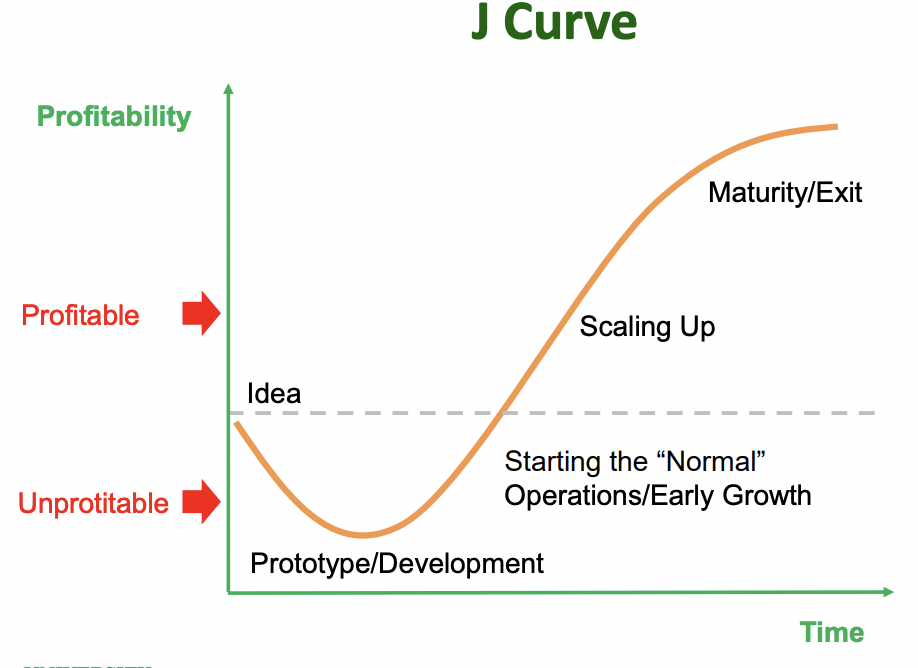
- The “J Curve” depicts how startup profitability varies over time
- The stages are illustrative and vary across businesses
Valley of Death
- Valley of death refers to the time period when a startup has begun operations but has not yet generated revenue
- The name comes from the shape of a startup company’s cash flow burn when plotted on a graph
- During this period, the company depletes the initial equity capital provided by its shareholders
- Many companies fail simply because they run out of money
Most startups fail
- The conventional wisdom is that 90% of startups fail
- Failure can be hard to define but
- 2/3 of startups never show a positive return
- Approx. 20% of new small businesses don’t survive the first 12 months
Startup budgeting
- “How did you go bankrupt?” “Two ways: gradually and then suddenly”
- Many startups die simply because they run out of money - realistic budgeting is important both for the founder and the investors
Cash burn rate
- Cash burn rate represents the speed at which an unprofitably company burns its cash reserves
- Gross burn rate = total monthly operating costs
- Net burn rate = gross burn rate - (monthly revenue - cost of goods sold)
- As a rule of thumb, a startup should have 6 to 12 months of expenses on hand
Runway
- A related concept is “runway,” which tells the amount of time the company has before it runs out of money
- Runway = total capital available for expenses / monthly operating expenses
- Example: if a company has $1 million in bank and spends 100k per month, its runway is 10 months
- This is a metric that both the founders and investors should be interested in
- Basically you gotta “take off” before the runway runs out or you’re going to crash
Typical components of a business plan
- market analysis
- company and product description
- Competitive analysis
- Execution plan: operations, development, management, marketing
- Current ownership structure
- Current and projected financial information
- Planned budget and use of capital
- Information on the management team
Funding rounds
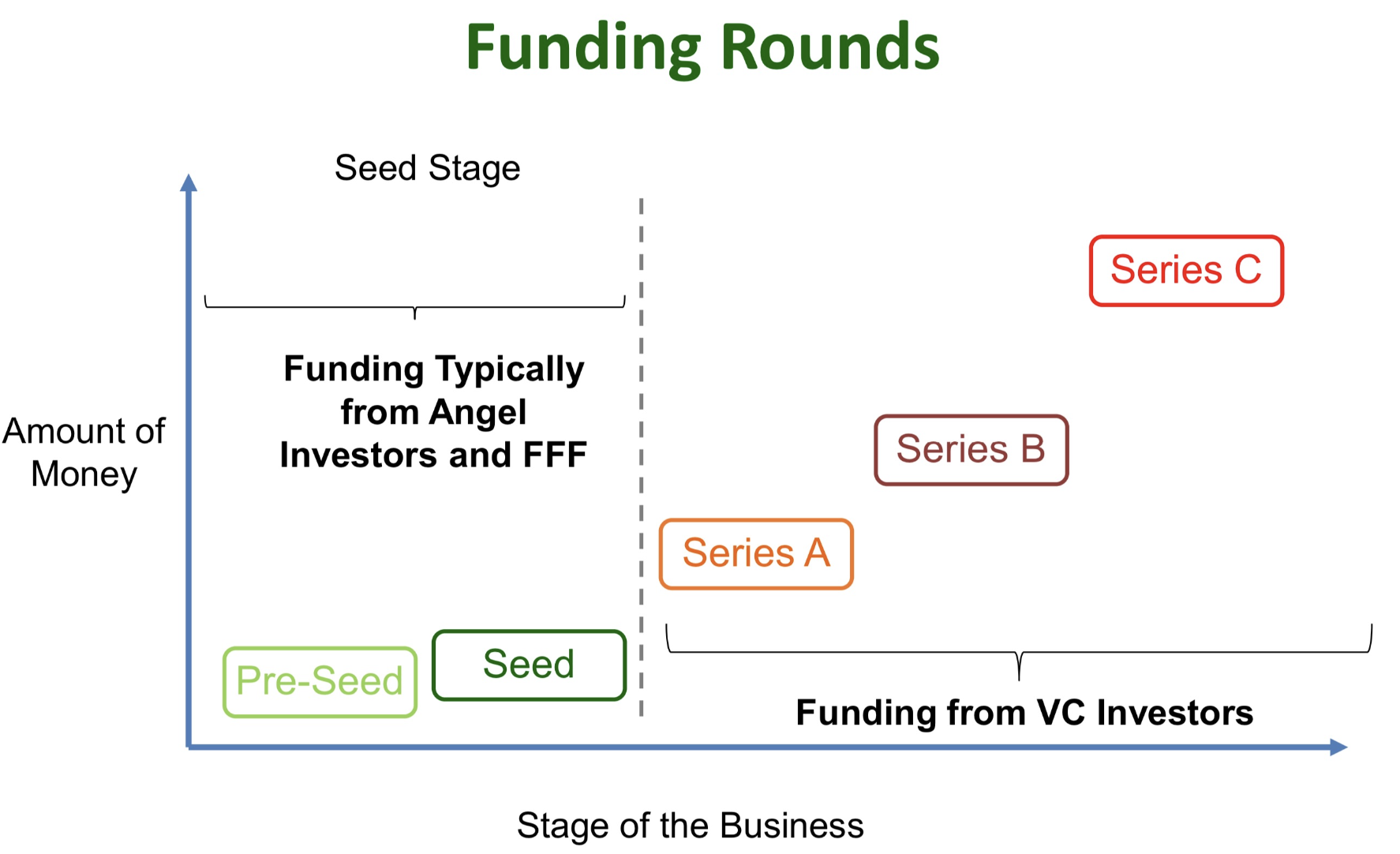
- Startups raise money from investors through funding rounds
- At each round, the startup receives more money from investors and typically new investors come along
- Funding rounds are typically categorized as
- Seed (sometimes preceded by pre-seed)
- Series A
- Series B
- Series C
- Series D, E
- There are no strict formal definitions for these terms, but they are connected to the stage of the business
Founding rounds
What happens during a funding round?
- The startup receives more capital, which helps it reach the next milestone
- New investors come along
- Ownership structure changes
- The original investors get diluted (own a smaller fraction of the company)
- The startup gets revalued
- Board composition may change
- Operational and strategic changes
- The startup often enters a new lifecycle stage with different goals
- Sometimes the business strategy and goals change
- Employee compensation plans may get revamped
Pre-seed
- Description:
- In this round, the founders are first getting their operations started
- Money is used for early-stage product development
- There is a business/product idea and often the goal is to develop a minimally-visible product as “proof of concept”
- The plan is to prepare the startup for more serious fundraising
- Planned use of funds:
- Early-stage product development
- Who invests in this round?
- Typically founders, friends, family, angel investors, and accelerators
- Some companies go directly the seed stage
Seed
- Description:
- The first “official” equity funding stage
- You need to show that there is a market for the product and a good product-market fit
- Planned use of funds:
- Typically financing for product development, market research, and the first steps of the business
- Who invests in this round?
- Angel investors, specialized in seed funds, and VCs who invest in early-stage ventures
- Fewer than 10% of seed-funded companies will go on to raise Series A funds
Series A
- Description:
- In this round, you are usually seeking funding to get the business seriously started
- You need a business model that can generate long-term profit
- You need to tell convincingly how you are planning to make money with the product
- In 2021, the median Series A funding was $10m
- Planned use of funds:
- The funding is often used to get the actual business fully started
- Who invests in this round?
- Typical investors are VC funds, but angel investors invest in this stage too
Series B
- Description:
- In this round, you are usually taking the business to the next level, past the development stage
- To reach this stage, you usually need a substantial user base and evidence that there is potential for success on a larger scale
- Planned use of funds:
- Expanding the business and reaching new markets
- Who invests in this round?
- Typically, the same investors that invested in Series A are also participating in Series B. Additionally, you often get other VC funds or VC funds that specialize in later-stage investments
Series C
- Description:
- Businesses that raise a Series C funding are already successful
- Series C funding is usually used for scaling up the business and preparing for a successful exit through an acquisition or IPO
- Planned use of funds:
- Funding for further growth: For example, expansion into new markets or products, and acquisitions of other companies
- Who invests in this round?
- Previous investors are often accompanied by PE funds, growth equity funds, and other institutional investors
- Often a company ends its external equity funding with Series C
Series D and later
- Companies that continue with Series D funding (or E, F, G…) tend to either:
- Seek capital for a final push before an IPO or exit
- Seek additional funding because they didn’t reach the goals set in Series C
What VC funds do
- Venture capital funds are PE funds that invest in startups and early-stage businesses
- VC funds don’t just provide capital - they also mentor and assist the management team
- VC investors often have board seats in early-stage businesses, and they are involved in key corporate decisions
How VC funds help businesses
- VCs can help businesses in many ways by providing
- expertise through their business knowledge and industry knowledge
- connections with suppliers and distributors
- help with developing marketing, PR, legal, and HR functions
- assistance in financial modeling
- connections to other investors in future funding rounds
- plans and guidance with exits (IPO or getting bought)
Only a fraction of VC investments are profitable
- Most VC investments lose money
- Studies indicate that on average
- 7/10 portfolio companies will not return even the money invested in those startups
- 2/10 are expected to return enough to cover all the losses
- 1/10 generate the 20-30% IRR that investors anticipate
Home runs are important
- Even though most VC investments fail, the few successful ones can provide amazing returns. These are referred to as home runs
- Home run potential is one of the key aspects VCs are looking for
- Everyone wants to find the next Amazon or Google
Due diligence for a startup investment
- Typical things VCs evaluate before an investment
- Financial and ownership information
- Validation of user/product data
- Quality of founders’ projections and forecasts
- Quality of the founding team
VC portfolios
- The number of portfolio companies varies from a dozen to over a hundred
- Smaller funds invest in fewer companies
- Funds that invest in later-stage startups invest in fewer companies
- It is common to reserve 40-60% of the capital for follow-on investments
- This money is reserved for additional investments in successful portfolio companies
Why follow-on matters
- Famous VC firm Andreessen Horowitz invested in Instagram at seed stage and earned an impression 31,100% return
- Unfortunately, they didn’t make any follow-on investments because they also supported a competing firm
- They sold their stake for $78m, which is microscopic compared to their portfolio size
Keys to successful VC portfolio management
- Focus on finding the potential home runs
- Follow-on investments are important: double down on the few winners
- Limit losses in unsuccessful investments where you can
- Don’t throw good money after bad - exit unsuccessful investments early
Pros and cons of VC funding
- Pros
- Can provide crucial capital for growing the business
- Unlike with bank loans, you don’t need cash flow or collateral to secure funding
- VCs provide mentoring and expertise
- VCs have valuable connections
- Cons
- VCs usually want a significant ownership share
- VCs want growth and returns fast, which is not what all founders want
- VCs will be involved in decision-making
- VCs may pressure a company to an early exit
Evaluating a start-up investment
- What kind of things do VCs focus on when evaluating a startup investment?
- Quality of the product
- Business model (“how will you make money with the product”)
- Scalability and potential for growth
- How big is the market?
- What’s the competition?
- Quality and commitment of the management team
- Potential exit strategies
- Current ownership and funding situation