Fungi
Defining Fungi
Mycologists believe that there may be as many as 1.5 million fungal species. Fungi can be categorized as single-celled or multicellular organisms. They can reproduce both sexually and asexually and exhibit a distinctive form of mitosis that differs from other eukaryotic cells. Fungi are specialized to extract and absorb nutrients from their surroundings. Notably, fungi and animals last shared a common ancestor approximately 460 million years ago (MYA).
Phylogenetic Relationships
The phylogenetic relationships among fungi are debated among mycologists. However, they generally agree on the existence of six major monophyletic phyla and one paraphyletic phylum:
Zygomycota
Microsporidia: Sometimes included in discussion, representing a unique category of fungi.
Fungal Taxonomy - Table 31.1
Group | Typical Examples | Key Characteristics | Approximate Number of Living Species |
|---|---|---|---|
Chytridiomycota | Batrachochytrium | Aquatic, flagellated fungi that produce haploid gametes by sexual reproduction or diploid zoospores by asexual reproduction. | 1000 |
Zygomycota | Rhizopus, Pilobolus | Multinucleate hyphae lack septa, except for reproductive structures. Fusion of hyphae leads directly to the formation of a zygote in a zygosporangium, where meiosis occurs just before germination; asexual reproduction is most common. | 1050 |
Glomeromycota | Glomus | Forms arbuscular mycorrhizae; multinucleate hyphae lack septa. Asexual reproduction is standard. | 150 |
Ascomycota | Truffles, morels | In sexual reproduction, ascospores are produced inside a sac termed an ascus; asexual reproduction is also prevalent. | >30,000 |
Basidiomycota | Mushrooms, toadstools | In sexual reproduction, basidiospores are produced on club-shaped structures called basidia; asexual reproduction is less common. | >30,000 |
Neocallimastigomycota | Neocallimastix | Lacks mitochondria and relies on anaerobic metabolism to grow in the guts of herbivores; capable of degrading cellulose. | 20 |
Blastocladiomycota | Allomyces | Exhibits alternation of generations similar to plant reproduction; characterized by a nuclear cap composed of membrane-bound ribosomes. | <200 |
General Features of Fungi
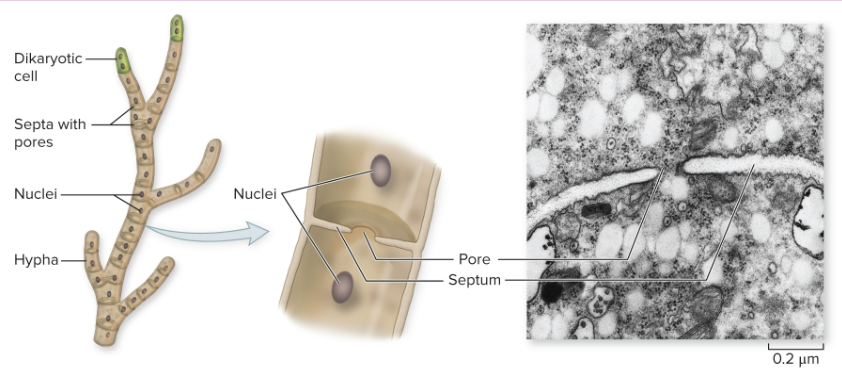
Multicellular fungi are primarily composed of long, slender filaments known as hyphae. Some hyphae are continuous, while others are septate, meaning they are divided by septa. The cytoplasm flows throughout the hyphae, facilitating rapid growth in favorable conditions.
Mycelia and Cell Walls
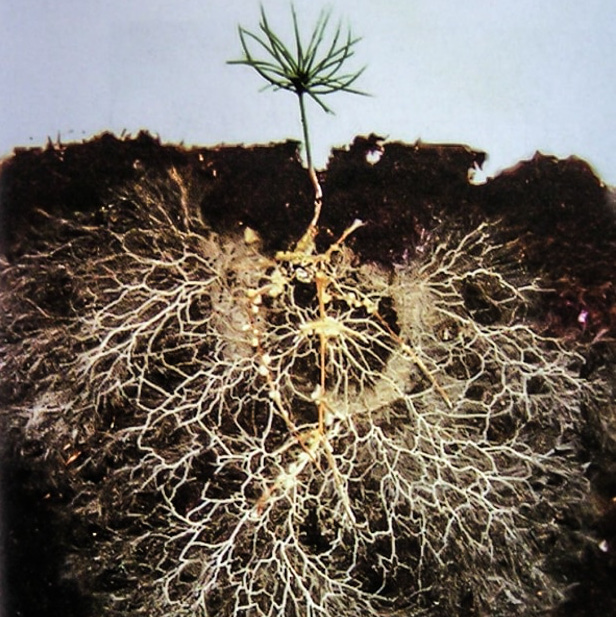
A mycelium is defined as a mass of connected hyphae that grows through and digests its substrate.
The cell walls of fungi contain chitin, a structural component that is also found in the exoskeletons of arthropods.
Fungal Genetics
Fungal hyphae may have multiple nuclei. They can be classified based on the number and genetic similarity of their nuclei:
Monokaryotic: Contains one nucleus.
Dikaryotic: Contains two nuclei, where both genomes are transcribed.
Heterokaryotic: Contains nuclei from genetically distinct individuals.
Homokaryotic: Contains nuclei that are genetically similar.
Mitosis in Fungi
Fungi engage in a distinctive form of mitosis where the nucleus, rather than the cell, is the primary unit of reproduction. The nuclear envelope remains intact during mitosis; hence, the spindle apparatus forms within it. Fungi lack centrioles (except for chytrids) and have spindle plaques that regulate microtubule formation during mitosis.
Reproductive Strategies
Fungi are capable of both sexual and asexual reproduction.
In sexual reproduction, two haploid hyphae of compatible mating types fuse. In some species, this fusion results in a diploid cell immediately; in others, a dikaryotic stage precedes the formation of a diploid nucleus. This process can lead to the development of structures like mushrooms or puffballs.
General Reproductive Steps
Spores are released into the environment, forming haploid hyphae/mycelia.
Haploid hyphae fuse, leading to a dikaryotic (or sometimes diploid) state.
Plasmogamy produces a dikaryotic mycelium, which matures into a mushroom or other fruiting body structure.
Within the mushroom, karyogamy produces spores via meiosis.
Spores are released, perpetuating the cycle.
Spores
Spores serve as the primary reproductive units for fungi, capable of forming through both sexual and asexual processes. They are predominantly dispersed by wind.
Nutritional Strategies
Fungi absorb nutrients by secreting digestive enzymes into their environment, allowing them to break down complex organic molecules and absorb by-products of this external digestion. Their anatomy provides a large surface area to volume ratio, which is advantageous for nutrient absorption. Fungi can decompose tough plant materials like cellulose and lignin, playing a significant role in nutrient cycling as decomposers. Some species even exhibit carnivorous behaviors.
Fungal Ecology
Fungi, in conjunction with bacteria, are key decomposers in the biosphere. Many fungi are challenging to culture in the laboratory, complicating species diversity assessments. Researchers utilize environmental DNA to reveal species without needing to culture. Fungi contribute to nutrient cycling by breaking down cellulose and lignin in wood, releasing carbon, nitrogen, and phosphorus for use by other organisms.
Interactions with Other Species
Fungal interactions can be categorized as follows:
Obligate symbiosis: Essential for the fungus's survival.
Facultative symbiosis: Nonessential.
Pathogens: Cause disease.
Parasites: Harm the host but do not cause disease.
Commensal relationships: Benefit one partner without harming the other.
Mutualistic relationships: Benefit both partners.
Endophytic Fungi
These fungi inhabit the intercellular spaces of plants. Depending on their nature, they can act as parasites, commensals, or mutualists, providing protection against herbivores through toxin production. For instance, perennial rye grass exhibits increased resistance to aphid feeding in the presence of endophytic fungi.
Lichens
Lichens represent symbiotic associations between fungi and photosynthetic partners (cyanobacteria, green algae, or both). Most lichen species exhibit mutualistic relationships, although some fungi act parasitically towards their photosynthetic partners. The presence of ascomycetes is noted in all but about 20 of the 15,000 known lichen species.
Lichen Biology
The fungal component of lichens is unable to thrive without its photosynthetic partner, which provides essential nutrients.
The fungi protect their partners from extreme light and dehydration.
Lichens are adapted to harsh environments and are sensitive to pollutants, which serves as bioindicators of environmental quality.
Mycorrhizae
Mycorrhizae are mutualistic associations between fungi and plant roots, present in about 90% of vascular plant species. They function as extensions of the root system, enhancing soil contact and nutrient absorption. There are two primary types:
Arbuscular Mycorrhizae (AM): Present in 80% of plant species, glomeromycete fungi are the fungal partners. They lack aboveground fruiting structures and can enhance agricultural yields with lower phosphate requirements.
Ectomycorrhizae (EM): Commonly associated with forest trees (pines, oaks), these fungi surround root cells without penetrating them and extract nitrogen and other nutrients to share with the host.
Animal Mutual Symbioses
Some ruminant animals harbor neocallimastigomycete fungi in their digestive tracts, aiding in the breakdown of plant materials.
Leaf-cutter ants cultivate basidiomycete fungi in specialized underground gardens, where they provide leaves to the fungi, which in return serve as food for the ants.
Fungal Parasites and Pathogens
Fungi can cause various health issues in humans, contributing to allergic reactions and mycoses (infections of skin and nails), as well as producing harmful toxins.
Fungal Toxins
Many fungi secrete mycotoxins, rendering food unpalatable or even poisonous. For example, Aspergillus flavus produces aflatoxin, while Ustilago maydis leads to corn smut, which harms plants without affecting animals that consume them.
Fungal Diseases in Humans
Fungi can inflict diseases in both humans and animals, including athlete’s foot, ringworm, and nail fungus. Due to the close phylogenetic relationship between fungi and animals, treatment of fungal infections poses significant challenges.
Chytridiomycota
Batrachochytrium dendrobatidis is a chytrid responsible for chytridiomycosis, a fungal disease linked to dramatic declines in amphibian populations worldwide.
Fungal Plant Diseases
Fungal species are among the most hazardous pests affecting living plants, and they can spoil harvested or stored food products as well.
Basidiomycota
Basidiomycetes are among the most recognizable fungi, including mushrooms, toadstools, puffballs, shelf fungi, and essential plant pathogens like rusts and smuts. They are referred to as "club fungi" due to their club-shaped sexual reproductive structure known as the basidium.
Basidiomycota Reproduction
Karyogamy, the fusion of nuclei, occurs within the basidia, which is the only diploid cell in the life cycle of basidiomycetes. Subsequent meiosis generates four haploid products, forming basidiospores.
Basidiomycota Development
The life cycle begins with spore germination, which results in monokaryotic hyphae forming a monokaryotic mycelium. Different mating types of these monokaryotic hyphae can fuse, resulting in a dikaryotic mycelium (secondary mycelium), which may further develop into basidiocarps (mushrooms) entirely composed of secondary mycelium.
Ascomycota
Ascomycota comprise around 75% of known fungi, including species such as bread yeasts, common molds, and truffles. They are responsible for severe plant diseases like chestnut blight and Dutch elm disease. Many are vital for biotechnology; for instance, Penicillium is known for penicillin production. Ascomycota are commonly termed hermit “sac fungi,” named for their unique reproductive sacs called asci.
Reproduction in Ascomycota
Karyogamy occurs within asci, leading to the formation of the only diploid nucleus in their life cycle. Following this, meiosis and ensuing mitosis yield eight haploid nuclei that develop into walled ascospores.
Asexual Reproduction in Ascomycota
Asexual reproduction is prevalent in Ascomycota, with conidia forming at the tips of specialized hyphae called conidiophores. This method facilitates rapid dispersal and colonization of new substrates; the hyphae are characterized by perforated septa that enable cytoplasmic flow, although later perforations may seal off.
Yeast
Yeasts are single-celled members of the ascomycetes, primarily reproducing through cell fission or budding. They ferment carbohydrates, converting glucose into ethanol and carbon dioxide, and are instrumental in the production of bread, beer, and wine, particularly Saccharomyces cerevisiae.
Yeast in Genetic Research
Yeasts, particularly Saccharomyces cerevisiae, have long served as model organisms for genetic research, as they are the first eukaryotes to undergo extensive genetic engineering. In 1996, Saccharomyces cerevisiae became the first eukaryote to have its genome sequenced.
Glomeromycota
Glomeromycetes comprise a small group of fungi that establish intracellular associations with plant roots, known as arbuscular mycorrhizae. They are essential for plant survival and growth and lack sexual reproduction evidence.
Zygomycota
Zygomycetes are diverse but are not monophyletic.
They include common bread molds and several human pathogens.
Zygomycota Reproduction
Sexual reproduction involves the fusion of gametangia through plasmogamy, leading to karyogamy which results in the formation of diploid zygote nuclei. The zygosporangium develops, and meiosis occurs during the germination of the zygospore, ultimately releasing haploid spores. Asexual reproduction is more common, facilitated by sporangiophores that produce sporangia to release spores.
Chytridiomycota
Chytridiomycetes, or chytrids, are aquatic, flagellated fungi closely related to ancestral forms. Chytrids have motile zoospores, and Batrachochytrium dendrobatidis has been implicated in the global decline of amphibian populations.
Blastocladiomycetes
These fungi can inhabit aquatic and terrestrial environments, functioning as parasites of plants, animals, algae, and other fungi. They are characterized by uniflagellated zoospores and exhibit a haplodiplontic life cycle, alternating between haploid and diploid generations in multicellular forms, exemplified by Allomyces.
Neocallimastigomycota
These fungi play a crucial role in digesting plant biomass within the rumens of mammalian herbivores, such as sheep, cows, kangaroos, and elephants. The fungi have undergone significant evolutionary changes, resulting in greatly reduced mitochondria that lack cristae. They possess multiple flagella on their zoospores and have acquired cellulase genes from bacteria through horizontal gene transfer, indicating potential applications in biofuel production.
Microsporidia
The classification of microsporidia is still being debated; they are minute, obligate, intracellular animal parasites with exceedingly small genomes. Long believed to be protists, they lack mitochondria and do not engage in aerobic respiration. They rely entirely on their host for adenosine triphosphate (ATP) production.
Encephalitozoon cuniculi
This specific microsporidian commonly infects immunocompromised individuals. It infects hosts through its spores, which contain a polar tube, targeting intestinal and neuronal cells, leading to diarrhea and neurodegenerative diseases.
Fun Fungus Chapter 31 Review Questions
List at least three key differences between plants and fungi.
Understand and identify the basic anatomy of a fungus.
What is a fruiting body (include its appearance), and what kind of reproduction is involved in its formation?
Define and describe mycorrhizal fungi, endophytes, and lichens.
Provide some ecological and/or biotechnological benefits that fungi provide for their ecosystems or human society.