EconS ch. 19 - The philips curve and inflation (Exam 3)
What plays a central role in pricing decisions across the whole economy? Expectations of ongoing inflations
What are inflation expectations? The rate at which average prices are anticipated to rise next year. For example: If Outback expects inflation to be 2% next year then they’ll probably follow and raise next year’s prices by 2% next year.
How do you maintain profit margin: Raise prices in line with the rate of inflation
Why does expectations about future inflation matter? 1) You want to know what’s going to happen in the future, so that you can ensure your prices are appropriate for whatever the months ahead might hold, 2) they are a key driver of inflation in the long run
Two key driving factors for pricing decision: 1) marginal cost, 2) Competitor’s prices
If most prices in economy are rising, what can you expect of your competitors? That they’ll also raise their prices by the same amount
How do you maintain competitive positioning? Raise your prices in line with your expectations of how your rivals will raise their prices
In some states minimum wages automatically rise each year with inflation
Inflation occurs because? We expect inflation
What is that self-fulfilling prophecy? The widespread expectation of any particular inflation rate is enough to push suppliers to raise their prices so that they’ll create that inflation
What is the Virtuous Cycle: 1) High inflation expectations = high inflation, 2) Low inflation expectations = low inflation
How can any inflation rate become a long-run equilibrium? The inflation rate that people expect ultimately determines the price rises that supplier set
In the LR, what is the key to achieving persistently low inflation? By convincing people that inflation is going to be low
Actual inflation moves around more than the expected inflation rate
What are three ways to track inflation expectations over time? 1) analyzing surveys, 2) pouring over economic forecasts, 3) looking at financial markets
1) Analyzing surveys: Simplest way to find out average inflation expectations is to survey a representative group
2) Pouring over economic forecasts: Relies on the inflation forecast that professional economists publish
3) Looking at financial markets: The Federal Reserve publishes a 10-year break-even rate, which tells you how much interest you need to earn on your savings to be able to buy the same amount of stuff in 10 years. Can be imperfect measure because traders may bid the price of bonds higher or lower, depending on how risky they’re perceived to be
What are the 4 ways people might form their expectations? 1) Adaptive, 2) Anchored, 3) Rational, 4) Sticky
1) Adaptive: Some manager might expect recent levels of inflation to continue
2) Anchored: Those who might believe that the Federal Reserve will deliver on its promise to ensure that inflation will be around 2%
3) Rational: Those who use all available data and a deep understanding of macroeconomic relationships to come up with the most accurate forecast possible with available data
4) Sticky: They stick with their previous views for long periods of time and not revisit them only irregularly
As you think about your inflation expectations: Remember big ticket items like medical care, cars, or insurances should be the central to your inflation expectations
What else plays a role in rising prices? Demand, as more people demand, companies see this as an opportunity to raise prices
For example: If business is good and Outback fills the entire restaurant, in the LR this will lead manager’s to consider opening new restaurants. In the SR, outback can’t increase its supply of meals, so it’s best bet is to raise its prices
What is Demand-pull inflation? Arises when demand exceeds the economy’s productive capacity, pulling prices up. Imagine when whole economy booms = Actual output > potential output, their demand outstrips their productive capacity which raises prices when demand surges.
What is insufficient demand? As quantity of restaurant meals demanded at the prevailing price was far below the quantity that Outback wished to supply = leads inflation to fall below expected inflation
How do businesses respond to insufficient demand? By raising prices by a bit less than they otherwise would or cutting them
When economy if operating at full capacity, inflation equals inflation expectations
Demand-pull inflation is a separate force that operates in addition to inflation expectations = 1) when there’s excess demand, it pulls inflation to raise above expectations, 2) when there’e insufficient demand, it pulls inflation to fall below expectations
Excess demand and insufficient demand = where demand matches economy’s productive capacity = no demand-pull inflation = no pressure for prices to rise faster or slower than expected = when economy is operating at full capacity = inflation is equal to inflation expectations
What is the driver of demand-pull inflation? The imbalance between buyers’ demand for output and the productive capacity of suppliers. What does this mean? That demand-pull inflation is driven by the output gap
Observation #1 Demand-pull inflation is driven by the output gap
When output exceeds potential output — meaning the output gap is positive — there is excess demand
The more positive the output gap is — the greater the degree of excess demand —the greater the pressure to raise prices
When output falls short of potential output —meaning output gap is negative — There is insufficient demand
More negative the output gap = the greater the degree of insufficient demand = greater the pressure for price restraint
Observation #2: Demand-pull inflation leads inflation to diverge from inflation expectations
Demand-pull inflation occurs in addition to inflation expectations — demand-pull factors cause inflation to either rise above inflation expectations (when there’s excess demand), or fall (when there’s insufficient demand)
What is unexpected inflation equation? Inflation - Inflation Expectations
What does the Phillips curve describe? How the output gap is linked to unexpected inflation and tells you by how much actual inflation will be above or below expected inflation
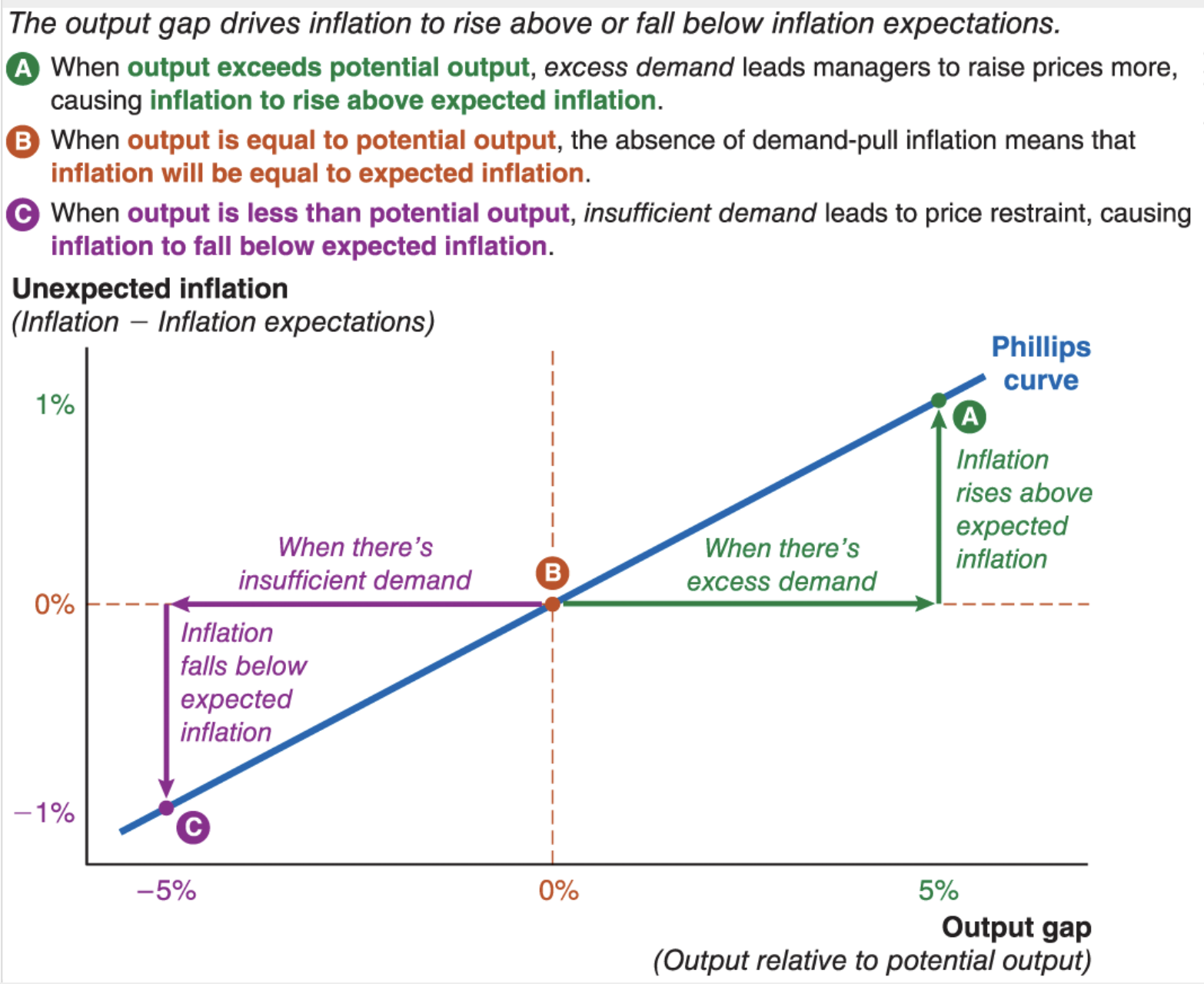
Who discovered the relationship between the output gap and unexpected inflation? Bill Phillips
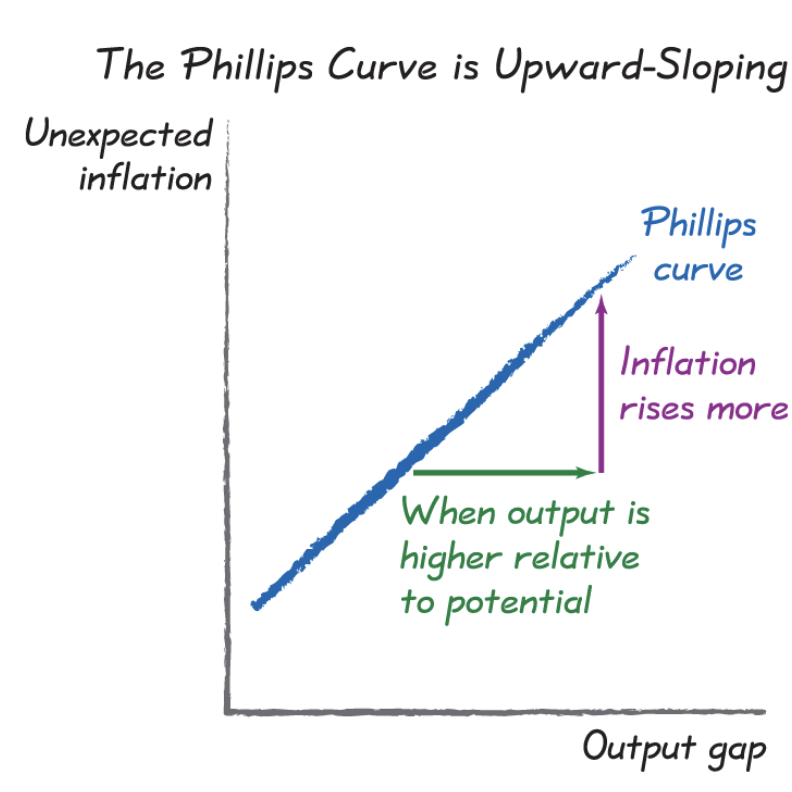
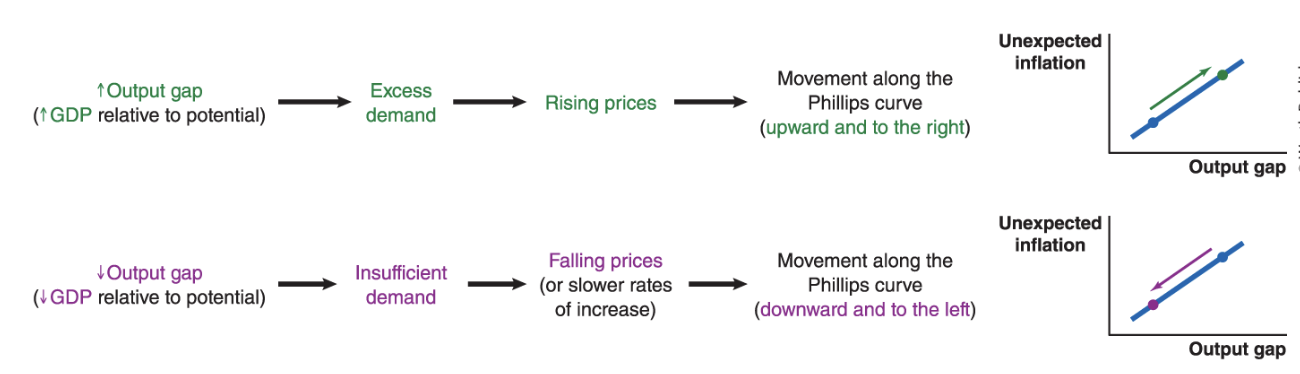
Why is the Phillips curve upward-sloping? B/c higher output relative to potential output — a more positive output gap — leads to greater inflationary pressure, causing inflation to rise about inflation expectations
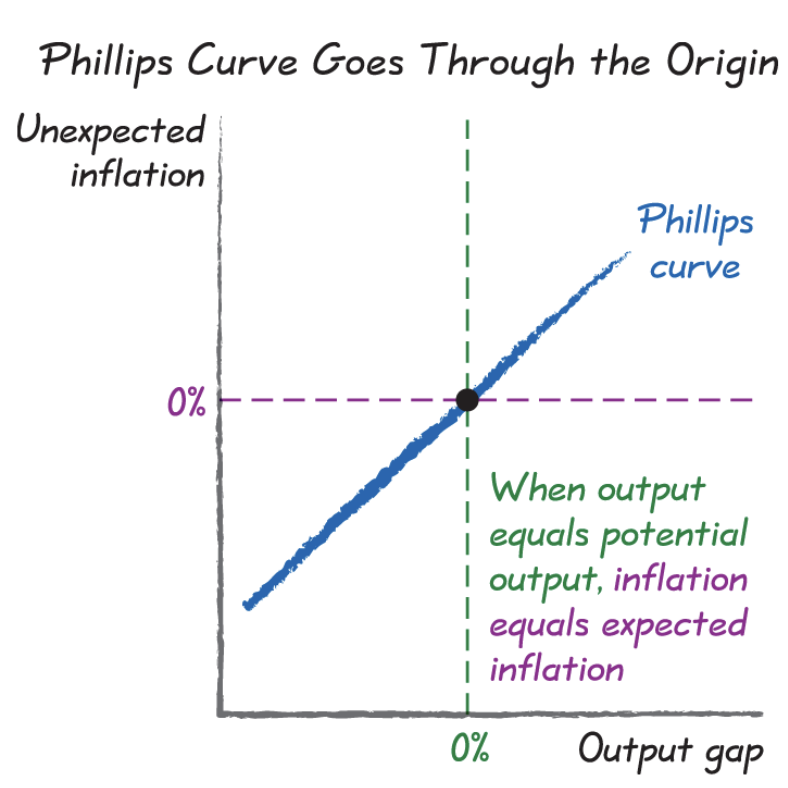
How do inflation equal expected inflation? If output is equal to potential output — absence of demand-pull inflation means that inflation is pulled neither above nor below inflation expectations
What is the two step process?
1) Access inflation expectations (analyzing surveys, economists forecasts, and financial markets)
2) Forecast unexpected inflation: plot the estimated output gap and find the corresponding unexpected inflation
How can inputs rise prices? These supply shocks increase production costs which is a key factor driving prices higher
What principle drives the supply shocks and cost-push inflation? The interdependence principle - higher oil prices = higher prices for a range of oil-based inputs (plastics, fertilizers, and rubber)
Marginal costs rise = businesses raise prices
What is the cost-push inflation? Prices rise in response to an unexpected rise in production costs
Name the 3 causes of inflation: 1) Inflation expectations, 2) Demand-pull inflation(the Phillips curve), 3) Supply shocks and cost-push inflation
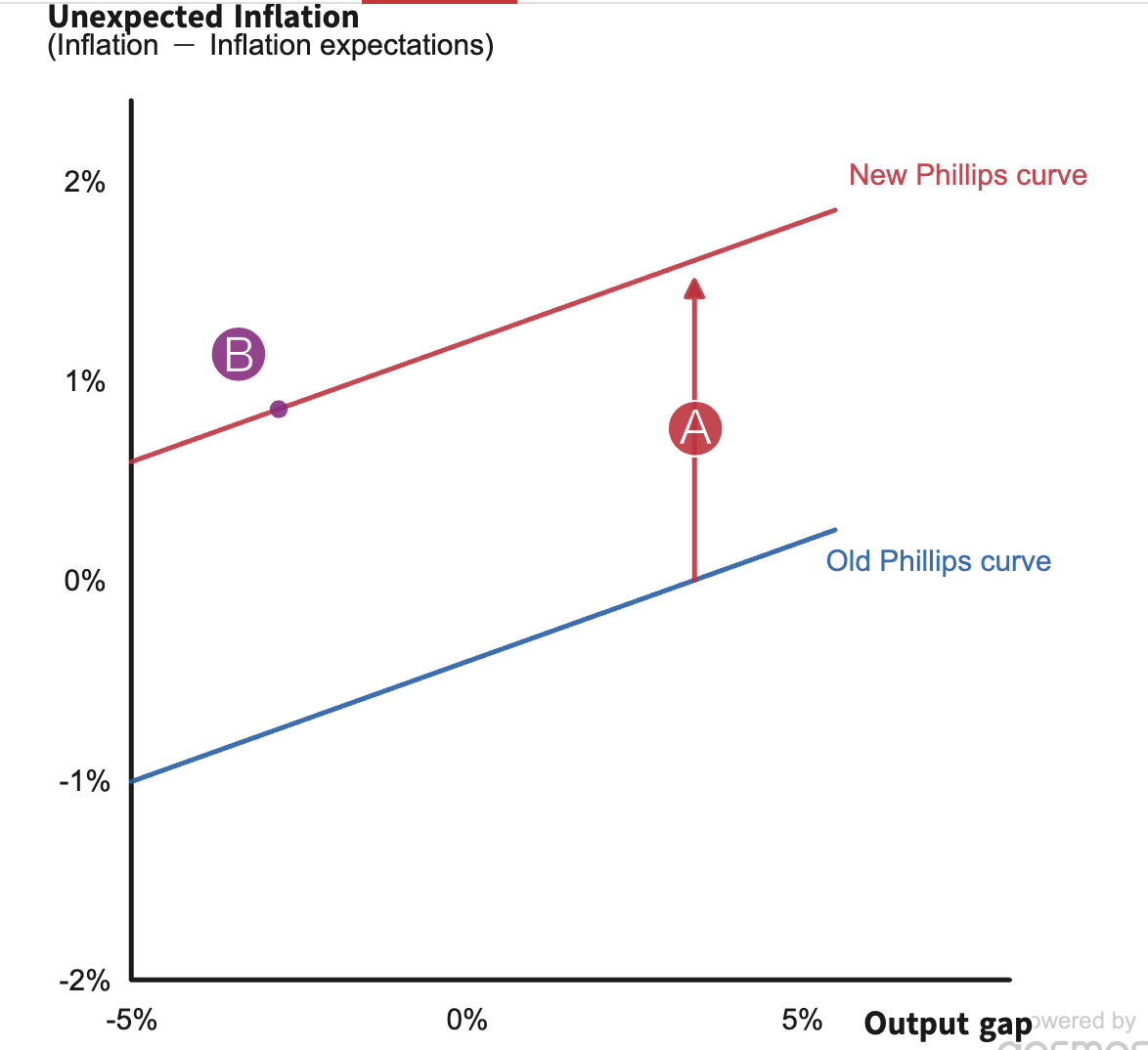
Rising costs shift the Phillips curve up: any factor that leads to an unexpected rise in production costs will cause the curve to shift upwards
Phillips curve shifter #1: Input prices: Anytime that inputs rise, marginal costs will rise too = sellers raising their prices
What are some important input prices?
1) Oil: Rising in oil has ripple effects throughout the economy — leading to higher electric, heating bill, and gas prices —> higher transportation prices —> raise the prices of nearly everything at your local supermarket
2) Commodity prices: Agricultural goods — create supply shocks (when severe weather disrupts harvest)
3) Global supply chains: Advantage - cheap and efficient through specialization. Disadvantage: Global linkage can cause disruption is other countries
4) Rising wages: Can cause a wage-price spiral — sharp rise in wages to attract quality workers —> higher marginal costs —> managers will raise prices
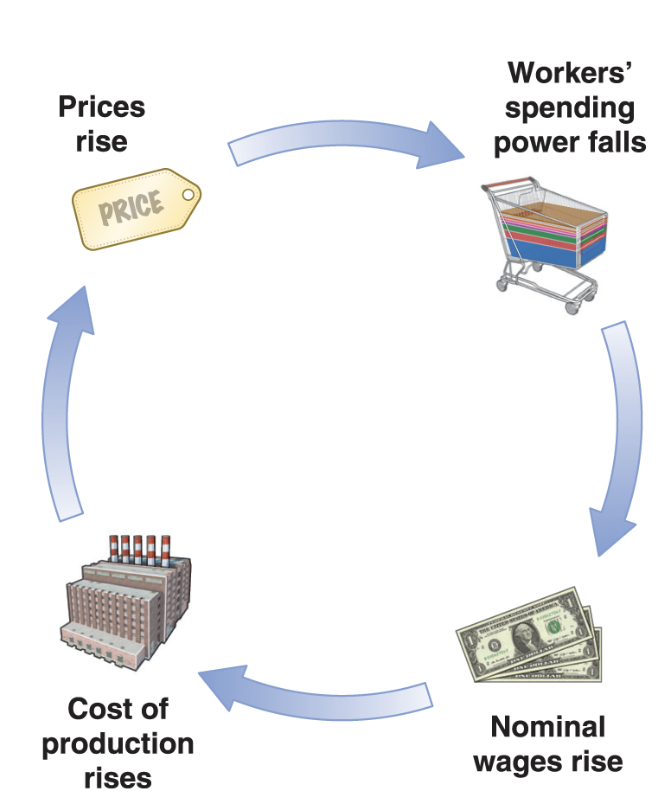
What is the wage-price spiral? Workers respond to inflation by demanding higher normal wages to maintain their spending power —> businesses respond by raising prices
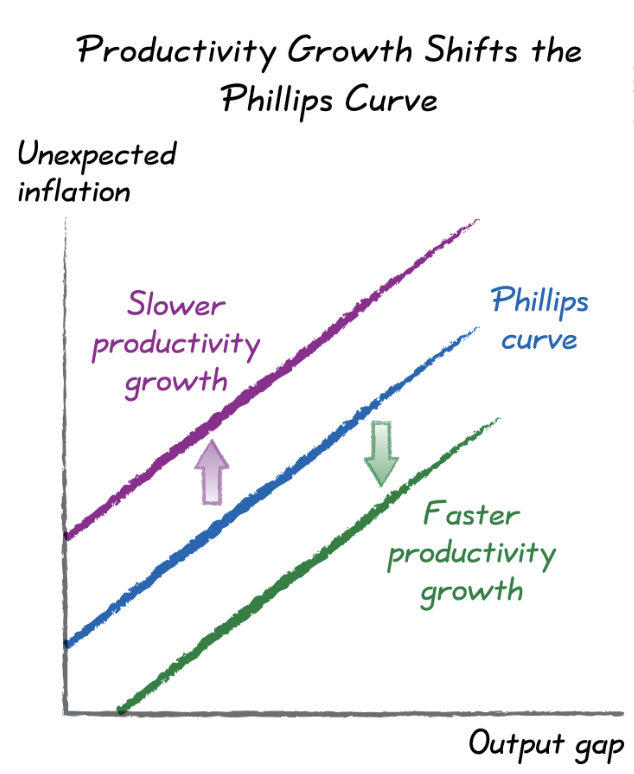
Phillips curve shifter #2: Productivity: Stronger productivity growth pushes the Phillips curve down cause a negative cost-push inflation
Phillips curve shifter #3: Exchange rates: Direct and Indirect effect of nominal exchange rates
Direct effect: when the US dollar depreciates, foreign goods are more expensive
We need foreign currency to buy goods from foreigners
Exchange rate of 120 Japanese yen per dollar depreciates to 100 yen per dollar = It’ll take more US dollars to pay for imported goods
Indirect effect: more expensive foreign foods lead to higher prices on domestic goods
For business that rely on imported inputs: a depreciating US dollar raises the cost of their imported inputs — higher marginal costs —> raise their prices
For business that compete with imported products: a depreciating US raises the price of goods made by foreign competitors — weakens the competitive pressure on domestic businesses —> some of them to raise their prices
For businesses that export their products: a depreciating US dollar means that their foreign customers are now willing to pay more for their products — increases demand from foreign customers —> some companies raise the prices they charge their customers in the US
*A depreciating US dollar shifts the Phillips curve up
*An appreciating US dollar shifts the Phillips curve down
What does the labor market Phillips curve explain?
Focuses on the labor market
Idea that the unemployed workers are an unused resource — provides alternative measure of whether the economy is producing above or below the productive capacity
High unemployment = works who could be hired to help increase output
Low unemployment = high unexpected inflation
What is the Okun’s rule of thumb?
Describes a close link between the output gap and unemployment rate
high unemployment = negative output gap
low unemployment rate = positive output gap
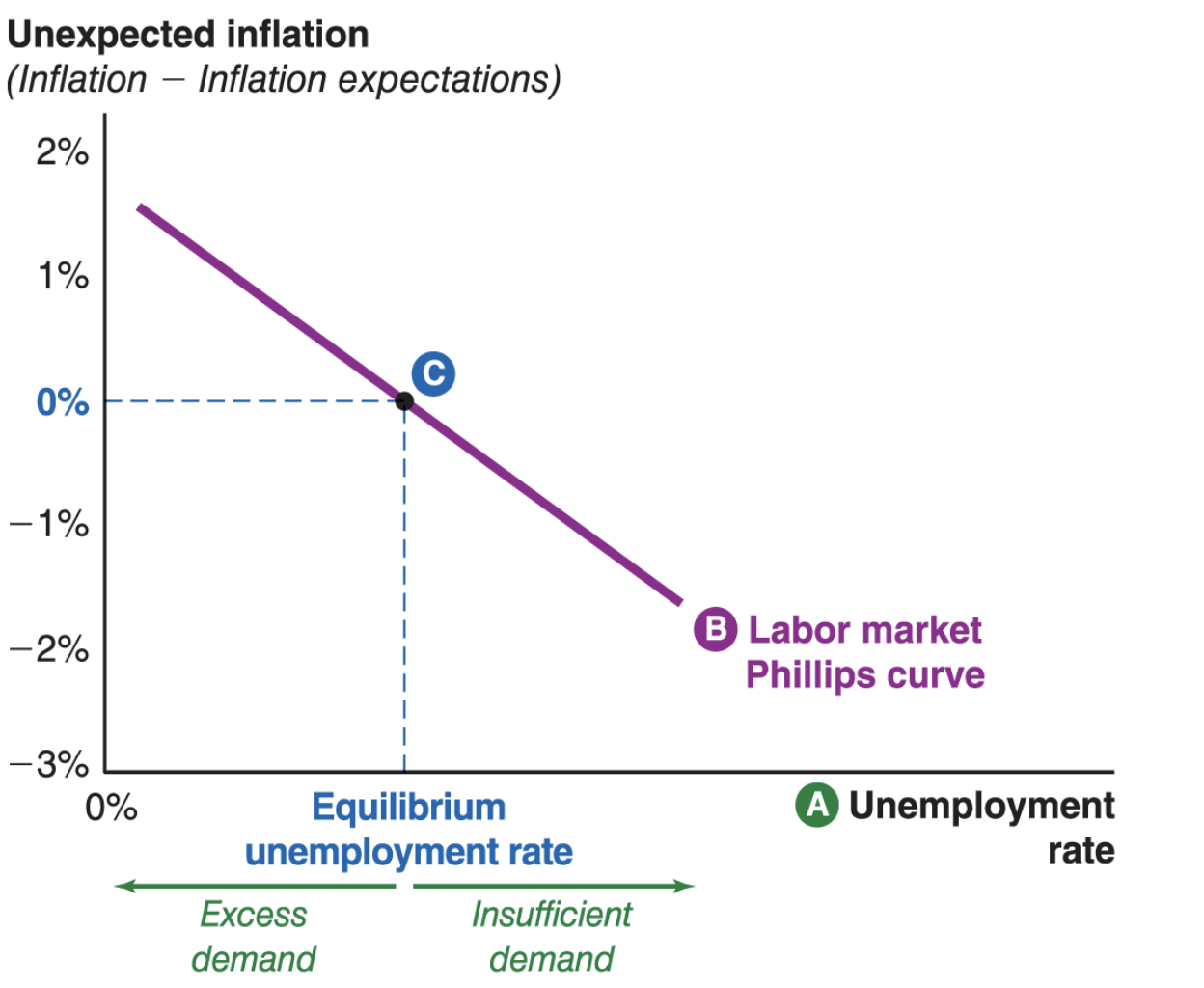
When will inflation rate be stable? ONLY when inflation is equal to inflation expectations (where unexpected inflation = 0%)
Movements along the Phillips curve:
Demand-pull inflation leads to movement along:
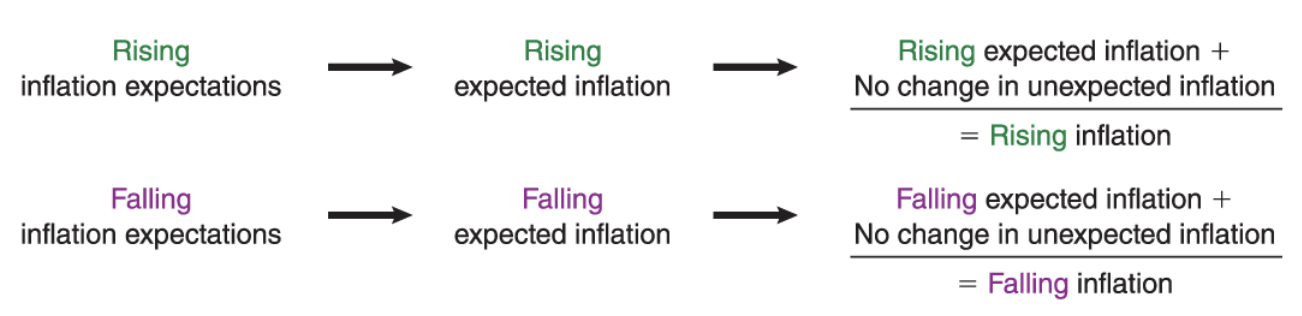
What is total inflation equation? expected inflation + unexpected inflation
Does inflation cause shift or movement along the Phillips curve? Neither, but they play an important role in driving inflation
Is the Phillips curve short or long-run? SR in which inflation deviates from inflation expectations, so it explains unexpected inflation
Why are changes in inflation expectations an important LR factor determining overall inflation? B/c rising inflation expectations lead to a rise in expected inflation
What does demand-pull inflation mean for output gap and unexpected inflation? Means that it will always lead to output gap and unexpected inflation to point in the same direction:
More output leads to higher inflation
Lower output leads to less inflation
If you see output above potential and unexpectedly high inflation = infer that some of the boost to inflation is from excess demand
What do supply shocks mean for unexpected inflation and output? That it will lead to them pointing in opposite directions
Supply shock raises production costs = higher inflation rate at any given output gap
It shifts the Phillips curve up, can lead to higher unexpected inflation and lower output relative to potential
If you see this = infer there has been adverse supply shock, shifting Phillips curve up