TEST 1
CH2: CHROMOSOME AND CELLULAR REPRODUCTION
Prokaryotes: no real nucleus, 1 circular DNA molecule, DNA not complex, small amount of DNA, non membrange organelles.
Eukaryotes: real nucleus, multilinear DNA molecule, complex DNA, large DNA, membrenae organelles present.
Histones: proteins that organize DNA.
Virus: not prokaryote or eukaryote, complex structures.
Prokaryotes Binary fission: a) replicate info, distribute/ separation, division of cell= 2 identical prok. cells.
Eukaryotes replication and homologous pairs:
(n) females=23 pairs
(n) males=22 pairs
=zyote, diploid (2n)
Chromosome structure:
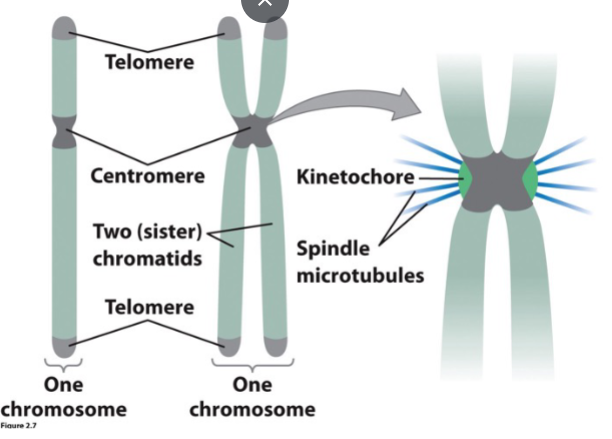
Cell cycle:
Interphase:
G1: cell grows
1st checkpoint: info is accurate
S: DNA replication
G2: cell prepares for mitosis/ continues growing
2nd checkpoint: surveillance/ cell is commited to divide.
M phase: nuclear and cell division
Mitosis and Cytokinesis take place.
Mitosis: almost all cell go through this process=somatic cell in body
Interphase: nuclear membrane is present and relaxed chromosomes
Prophase: chromosomes condense, 2 chromatids, mitotic spindle forms
Pro-metaphase: nuclear membrane desintegrates
Metaphase: chromosomes line up on center plate (vertically0
Anaphase: sister chromatids separate, start moving to opposite poles
Telophase: chromosomes arrive at spindle pole, nuclear membrane reforms
Genetic consequences in mitosis:produce 2 identical cells genetically
Sexual Reproduction and genetic variation:
Meiosis 1: homologous chrom. separate reducing the chrom. # by half
Meiosis 2: sister chromatids separate, resulting in 4 haploid cells with the same chromosome # as the starting cell in meiosis 2.
Product of meiosis= gametes (n), corssing over prodices genetic variation
Spermatogenesis→Spermatogonium (2n) 24 chrom.→Primary spermatocyte (2n) divides in to 2 12 chrom.→seocndary spermatocyte (n) divides into 4→ spermatids (n)→maturation=sperms
Oogenesis→Oogonium (2n)→Primary Oocyte (2n) divides into 2→Secondary oocyte (2n) and first polar body→Ovum (n) and secondary polar body on the other side
Principles of heredity:
Locus: specific location, for specific trait
Pea Plant Experiment: Study of heredity (Mendel) When 2 different plant traits aere crossed.
Mendel removed anthers (male) to prevent self-fertilization
Principle of segregation: 3:1 ratio Monohybrid cross: cross between 2 parents that differ ina single chromosome
dominant (RR) vs recessive (rr) zygote
Multiplication rule: 2 independent events ocurring together “and”
Addition rule: P of 2+ mutually exclusive event ocurring “or”
Binomial expansion: (a+b)^n
n=event occurs
a= P of event 1
b= P of event 2
Dihybrid cross: ration 9:3:3:1 examine 2 traits at a time
P generation
F1 generation:
F2 generation:
Formula to observe and expectance: x²=sum (O-E)²/E