Coupling Constants
Units of Measurement
Chemical shifts are measured in ppm (parts per million).
Coupling constants (J values) are measured in Hz.
To convert ppm → Hz, you must know the spectrometer frequency.
🧪 Chemical Shift vs. Frequency
A hydrogen will always have the same chemical shift in ppm regardless of instrument.
However, its absolute frequency in Hz depends on the spectrometer.
NMR spectrometers (e.g. 400 MHz, 500 MHz) refer to the frequency of hydrogen reference compounds.
🔹 Conversion Examples:
1 ppm on:
400 MHz instrument = 400 Hz
500 MHz instrument = 500 Hz
🔍 Coupling Constant Calculation – Example
✴ Major Couplings
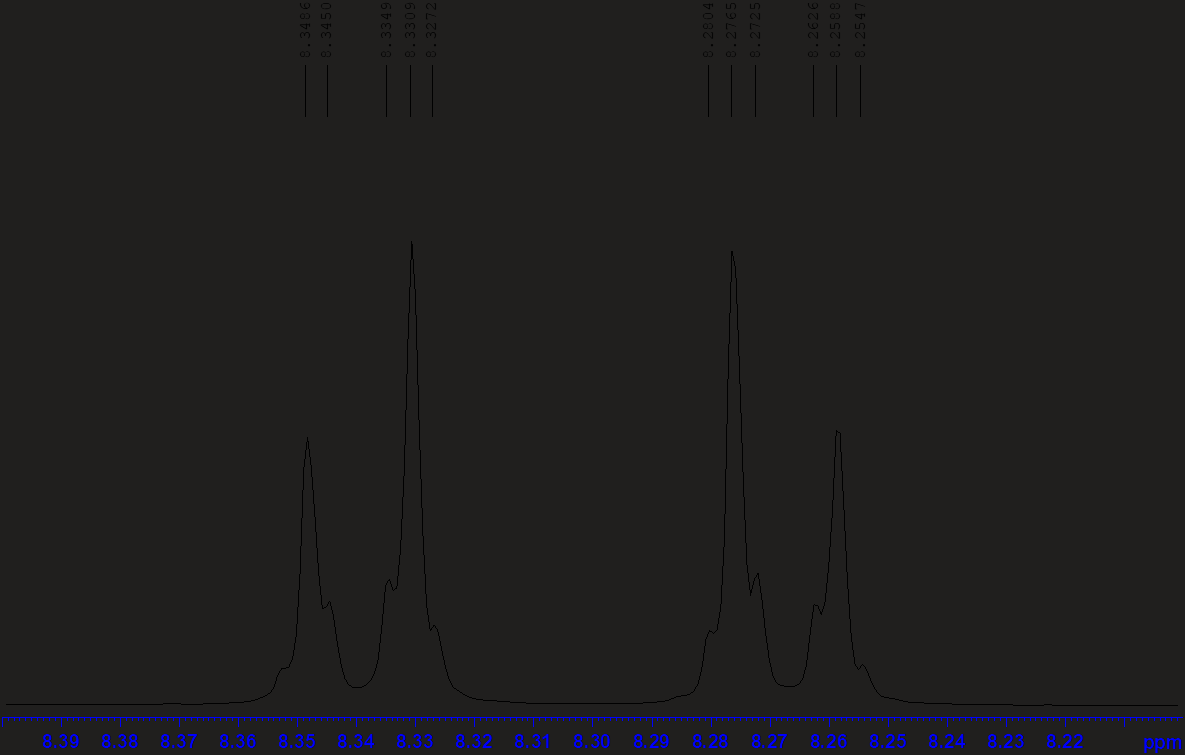
Peak 1: 8.3486 ppm
Peak 2: 8.3309 ppm
Δppm = 0.0177 ppm
On a 500 MHz instrument:
0.0177 ppm × 500 = 8.85 Hz
Matches ortho-coupling (7–9 Hz)
📊 Substitution and J:
Substitution | J (Hz) |
|---|---|
Ortho (1,2-) | 7–9 Hz |
Meta (1,3-) | 1–3 Hz |
Para (1,4-) | ≤1 Hz |
✴ Minor Couplings
Peak spacings:
8.3349 – 8.3309 = 0.0040 ppm
8.3309 – 8.3272 = 0.0037 ppm
Average = 0.00385 ppm
0.00385 ppm × 500 = 1.93 Hz
Matches meta-coupling (1–3 Hz)
🔔 Para-couplings often too small to observe, but may still be present
🔄 Cis and Trans Coupling
Cis-isomer has smaller J value than trans
Cis hydrogens: slightly upfield (to the right)
Trans hydrogens: slightly downfield (to the left)
📊 Typical Ranges:
Isomer | J (Hz) |
|---|---|
Trans | 11–18 Hz |
Cis | 6–14 Hz |
🧪 Example: Determining cis-/trans-alkene
Identify alkene signals – often shifted left due to electronegative groups.
Use integration to assign peaks:
Example:
d/ppm: 7.80 & 7.42
Integration: 1H each
Peaks already marked in Hz → read J directly
Compare J to standard values to determine cis or trans
🧩 Non-First Order Spectra
First-order spectra:
Follow the (n+1) rule
Display Pascal’s triangle intensities
Non-first order spectra:
Appear distorted or “roofed”
Do not follow simple multiplicity rules
🔹 When does this occur?
If:
Δδ (chemical shift difference) ≫ J (coupling constant) → first-order
Δδ ≈ J → non-first order
In non-first order spectra, (n+1) rule does not apply.
🔗 COSY Spectra in Complex Systems
In non-first order spectra, COSY is useful for:
Clarifying obscure coupling patterns
Visualising proton–proton connections