Porosity and Permeability
Porosity
Fraction of the bulk volume of the reservoir that is ==not occupied== by the solid framework of the reservoir.
Sand Grains and particles of carbonate materials that make up sandstone and limestone reservoirs usually never fit together perfectly due to high degree of irregularity in shape. The ==void space== created throughout the beds between grains are called ==pore spaces or interstice== that can be occupied by fluids (liquid or gases)
Factors Governing the Magnitude of Porosity
- approximate limits of porosity values
- Frazer and Graton
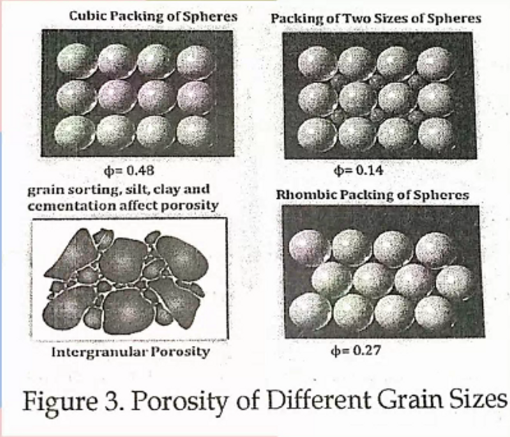
- determined the porosity of various packing arrangements of uniform spheres
- Cubic or Wide-Packed System
- 47.6%
- Rombohedral or Closed-Packed System
- 25.9%
Note: The porosity for such a system is independent of the grain size (sphere diameter)
- Uniformity in Grain Size
- sorting depends on at least four major factors
- size range of materials
- type of deposition
- current characteristics
- duration of sedimentary process
- Degree of Cementation or Consolidation
- highly cemented sand stones have low porosities
- soft consolidated rocks have high porosities
- Cementation
- takes place both at the time of lithification and during rock alteration by circulating groundwater.
- Process: filling void spaces with mineral material, which reduce porosity
- Amount of Compaction During and After Deposition Compaction
- tends to lose voids and squeeze fluid out to bring the mineral particles close together, especially the finer-grained sedimentary rocks.
- Methods of Packing
- With increasing overburden pressure poorly sorted angular sand grains show progressive change from random packing to a closer packing. Some crushing and plastic deformation of sand particles occur.
- With increasing overburden pressure poorly sorted angular sand grains show progressive change from random packing to a closer packing. Some crushing and plastic deformation of sand particles occur.
Engineering Classification of Porosity
- Two Distinct Categories of Porosity
- Absolute Porosity (total) - ratio of total void spaces in the sample to the bulk volume of that sample, regardless of whether or not those void spaces are interconnected.
- Effective Porosity - affected by number of Lithological Factors:
- type
- content
- hydration of the clays present in the rock
- heterogeneity of grain sizes
- packing and cementation of grains
- any weathering and leaching that may affect the rock
Geological Classification of Porosity
- Primary Porosity - above the land
- Intercrystalline - voids between cleavage planes of crystals, voids between individual crystals, voids in crystal lattices.
- Intergranular or Interparticle - voids between grains (interstitial), voids of all kinds in all types of rocks.
- Bedding Planes - voids of many varieties are controlling larger geometry of many petroleum reservoirs.
- Miscellaneous Sedimentary Voids - voids resulting from the accumulation of detrital (very small) fragments of fossils, voids resulting from packing of oolites, vuggy and cavernous voids of irregular and variable sizes at the time of deposition.
- Secondary Porosity - below the land
- Solution Porosity - channels due to solution of rocks by: circulating warm or hot solutions, opening caused by weathering, voids caused by organisms and later enlarged by solutions
- Dolomitization - process by which limestone is transformed into dolomite according to the chemical reaction.
- Fracture Porosity - openings created by structural failure of the reservoir rocks under tension caused by tectonic activities.
- Miscellaneous Secondary Voids - saddle reefs, opeing at the crest of closely folded narrow anticlines, pitches and flats, opening formed by the parting of beds under gentle slumping