Stars & Galaxies - Study Guide
Key Terms:
Nova - faint star that suddenly increases in brightness (100,000 times more) then fades back to its former brightness or dimmer
Supernova - star that suddenly explodes into a brilliant white star
Binary stars - 2 stars which orbit around each other (more than a 1/3 of stars are this type)
Star cluster - loose grouping of stars in space which probably formed from the same nebula
Variable stars - change in brightness in a regular pattern or cycle
Quasars - faint star-like objects which are larger than any star known and the most distant objects in the Universe
Nuclear fusion - two hydrogen atoms fuse together to form Helium and energy
Absolute magnitude /Luminosity - the real brightness of a star depends only on size and temperature
Apparent magnitude - the brightness we see on Earth depends on distance from Earth
Dwarf stars - can vary from the size of Earth to our Sun, which is a dwarf
Giant stars - example would be Arcturus
Supergiant stars - more than 2,000 times the size of our Sun (Betelgeuse, Antares)
Questions?
What color is associated with the hottest stars?
Blue
What color is associated with the coldest stars?
Red
What is a synopsis of the life cycle of a star (generally)?
A star begins as a nebula, it can then become a main sequence star or a massive star (depending on the size), then it will burn to either a red giant or red super giant. If it is a red giant, then it next becomes a planetary nebula. If a red super giant, it becomes a supernova. At this point, the supernova or planetary nebula allows the star’s life cycle to be a cycle, turning back into a nebula. However, if this does not occur, then a star can either become a few things. If it was a supernova, it could then be a neutron star or black hole. If it was a planetary nebula, it could die slowly, by going from white dwarf, to brown dwarf, to lastly black dwarf before death.
What is the life cycle of the Sun?
Will continue to burn for another 5 billion years as a (dwarf) yellow star, when fuel expires it will swell into a red giant as large as Mars’ orbit, then will collapse into a white star where it will cool to death.
What is our closest spiral galaxy?
Andromeda Galaxy, which is 2.2 million light years away
What type of energy can stars produce?
Heat (infrared) energy
Light energy
Radio waves
Gamma and Cosmic rays
X-rays
Ultraviolet rays
What causes star brightness?
Distance from Earth
Temperature
Size of star
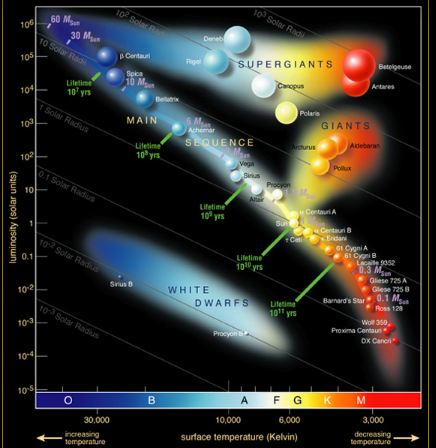
Fill in Diagram: What categories of stars go in the blank spots on the H-R diagram? Shade in the colors of the stars.
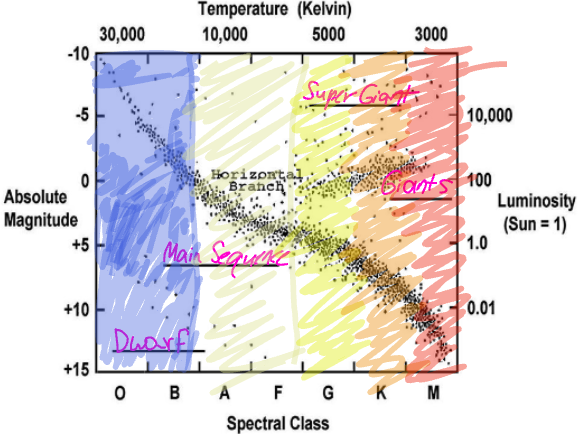
Hertzsprung-Russell Diagram – a scatter plot of stars showing the relationship between the stars' absolute magnitudes or luminosity versus their stellar classifications or effective temperatures. (Shows the brightest stars and their classifications)
What our Sun is classified as - Main Sequence star (dwarf) and G2
What most stars are classified as - Main Sequence stars
Which stars and colors are the most massive/least
massive - Colors that are most massive are mostly blue, Stars are Super giants.