Lymphatic
Which of the following is a lymphoid function of the spleen?
A) production of B and T cells
B) maturation of T cells
C) phagocytosis of damaged or infected cells circulating with the blood
D) addition of many new NK cells to the circulation
E) filtration of lymph
2) Which of the following is NOT a function of the spleen?
A) removal of abnormal blood cells from the blood
B) collection of fluids from the surrounding tissues
C) storage of iron
D) initiation of immune responses from B and T cells
E) production of T cells
3) Which cell population primarily functions in providing antibody-mediated or humoral immunity?
A) B cells
B) helper T cells
C) macrophages
D) granulocytes
E) regulatory T cells
4) Lymph cells normally respond to which of the following?
A) body cells
B) antigens
C) unbalanced ratios of fat to protein in the interstitial fluids
D) an imbalance in blood pressure
E) microglial cells
5) Immunological surveillance is the function of activated macrophages and which of the following?
A) cytotoxic T cells
B) suppressor T cells
C) plasmocytes
D) NK cells
E) helper T cells
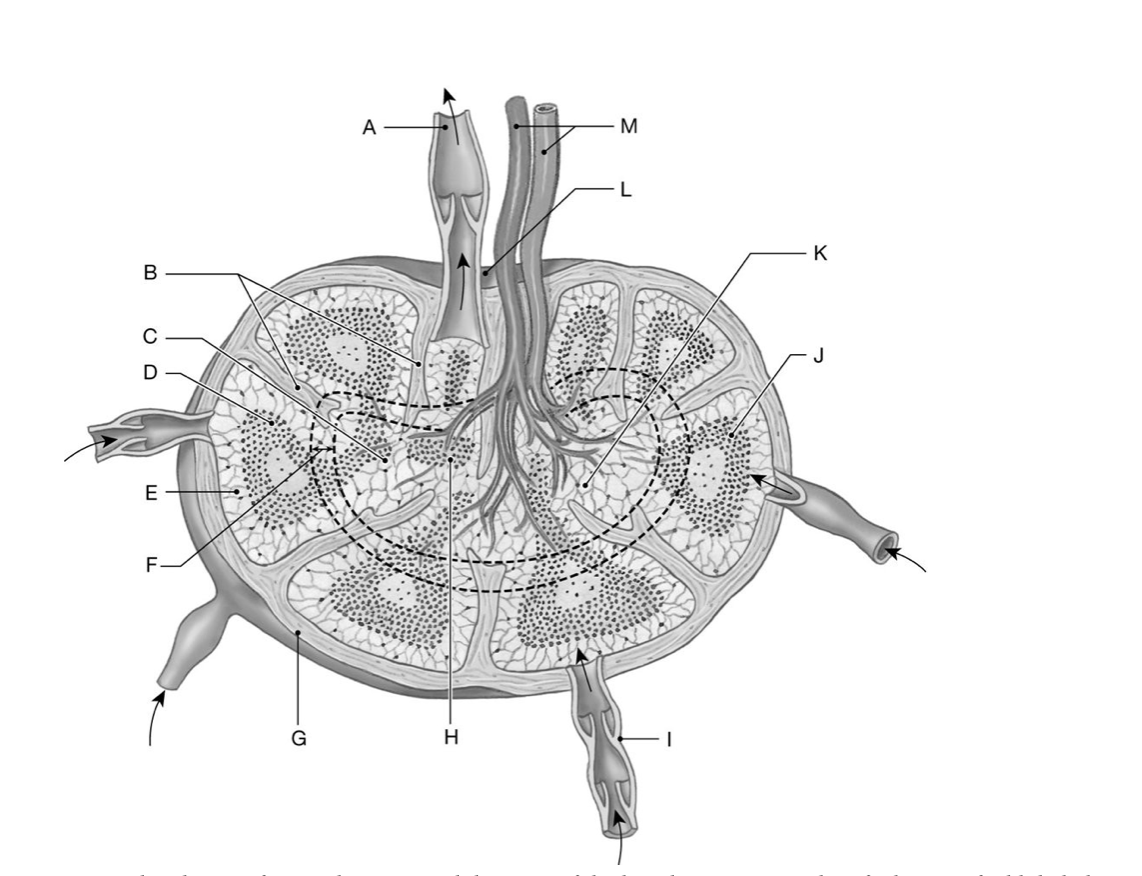
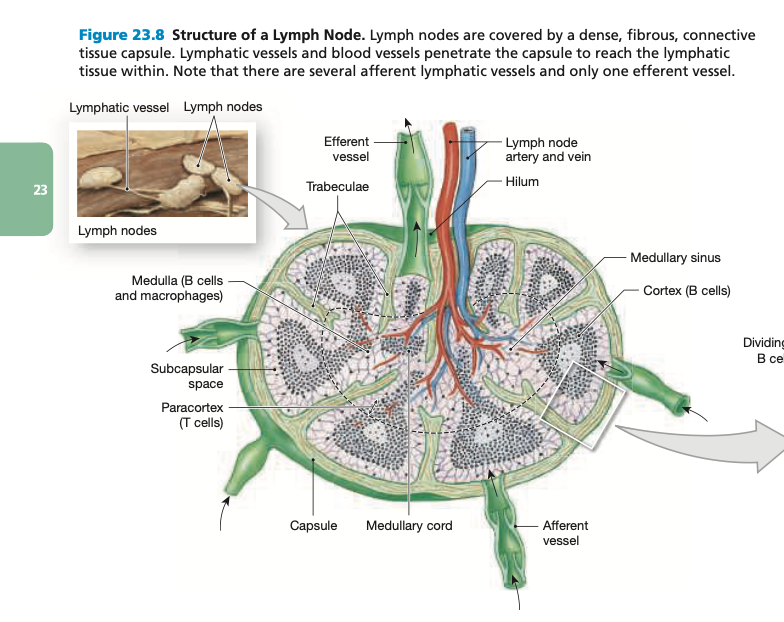
Identify the structure(s) indicated by Label A.
A) Hilum
B) Afferent vessel
C) Trabeculae
D) Medullary cord
E) Efferent vessel
7) Identify the structure(s) indicated by Label B.
A) Afferent vessel
B) Trabeculae
C) Efferent vessel
D) Medulla
E) Cortex
8) Identify the structure(s) indicated by Label C.
A) Cortex
B) Efferent vessel
C) Medulla
D) Capsule
E) Trabeculae
Identify the structure(s) indicated by Label D.
A) Medulla
B) Trabeculae
C) Cortex
D) Capsule
E) Afferent vessel
10) Identify the structure(s) indicated by Label F.
A) Afferent vessel
B) Medulla
C) Capsule
D) Deep cortex (T cells)
E) Trabeculae
11) Identify the structure(s) indicated by Label M.
A) Lymph node artery and vein
B) Afferent lymphatic vessel
C) Medullary cord
D) Trabeculae
E) Efferent lymphatic vessel
The increased incidence of ________ in the elderly reflects the fact that surveillance by the lymphatic system declines.
A) heart attacks
B) strokes
C) cancer
D) muscle injury
E) gallstones
13) Lymphatic vessels originate in peripheral tissues and deliver lymph to the venous system. TRUE
14) Larger lymphatics are similar in size to small veins. TRUE
15) Superficial lymphatics are more numerous than deep veins, and have very few anastomoses. FALSE
16) Antigens are usually associated with pathogens, parts or products of pathogens, or other foreign compounds. TRUE
17) With advancing age, the number of helper T cells is increased, making B cells more responsive. FALSE
18) ________ collect antigens from the lymph and present them in their cell membranes.
A) Lymphocytes
B) Dendritic cells
C) Plasmocytes
D) Erythrocytes
E) Microglia
19) B cells are clustered into elongated masses in the medulla of a lymph node, also known as ________.
A) medullary cords
B) corpuscles
C) the deep cortex
D) paracortical areas
E) the outer cortex
________ attack foreign cells or body cells infected by viruses by direct contact, and are said to confer cell-mediated immunity on the body tissues they defend.
A) Helper T cells
B) NK cells
C) Suppressor T cells
D) B cells
E) Cytotoxic T cells
21) B cells can differentiate into plasmocytes, which are responsible for the production and secretion of ________.
A) lymphocytes
B) antibodies
C) erythrocytes
D) platelets
E) antigens
22) Large granular lymphocytes are also known as ________.
A) NK cells
B) memory B cells
C) suppressor T cells
D) cytotoxic T cells
E) plasmocytes
A typical B cell spends about ________ in a lymph node before moving to another location.
A) 20 minutes
B) 12 hours
C) 30 hours
D) 1 week
E) 2 months
24) Lymphatics carry lymph only from peripheral tissues to the ________.
A) fourth ventricle
B) venous system
C) renal system
D) digestive system
E) arterial system
25) The lymphatic network begins with the ________, also called terminal lymphatics.
A) lymph nodes
B) Peyer's patches
C) lymphatic capillaries
D) cisterna chyli
E) lymphatic nodules
26) Interstitial fluid resembles blood, but with a lower concentration of ________.
A) lipids
B) proteins
C) nucleic acids
D) macrophages
E) lymphocytes
27) Which of the following is not an aging-dependent problem of the lymphatic system?
A) appendicitis
B) T cells become less responsive
C) increased susceptibility to infection
D) cancer incidence increases
E) reduced number of helper T cells
28) In which of the following is lymph already processed?
A) afferent lymphatic vessel
B) lacteals
C) efferent lymphatic vessel
D) interstitial fluid
E) outer cortex
If the medulla of a lymph node is damaged, what components of the lymphatic system will be affected?
A) NK cells
B) T cells
C) B cells
D) lacteals
E) None; this region does not produce any types of lymphocytes.
30) Blood vessels and nerves attach to a lymph node at the ________.
A) apex
B) base
C) cortex
D) medulla
E) hilus
31) Which cell types comprise approximately 10-15 percent of the circulating lymphocytes?
A) B cells
B) cytotoxic T cells
C) NK cells
D) macrophages
E) memory T cells
32) Lymphatic trunks collect lymph from ________.
A) lacteals
B) superficial lymphatics and veins
C) deep lymphatics and arteries
D) both superficial and deep lymphatics
E) arteries
33) Components of the lymphatic system include the:
(1) pancreas
(2) spleen
(3) lymphatic vessels
(4) thymus
(5) lymph nodes
(6) thoracic duct
A) 2, 3, 4, 5, 6
B) 1, 3, 5, 6
C) 1, 4, 6
D) 1, 2, 3, 4
E) 1, 4, 5, 6
How do lymphatic vessels differ from those of either the arterial or the venous system?
A) They do not run together with either the arteries or the veins.
B) The lymphatic valves are spaced close enough to give the vessel the appearance of a string of beads.
C) They have fewer valves than do the veins.
D) They have thicker walls than veins, but less thick than those of the arteries.
E) They have visibly delineated tunics.
35) Compared to regular capillaries, lymphatic capillaries ________.
A) are much less permeable
B) are smaller in diameter
C) have smaller gaps between endothelial cells
D) are more permeable
E) have a round, regular outline
Deep lymphatic vessels are found ________.
A) in the walls of organs
B) near deep arteries and veins
C) in the brain
D) under mucous membranes
E) in subcutaneous tissue
37) Most immune responses originate in ________.
A) primary lymphoid structures
B) macrophages
C) the skin
D) secondary lymphoid structures
E) the liver