Week 9 - Health & Well Being
What is the Global Health Policy?
WHO founded 1948 to develop new ideas around health at the highest level📊
Since 1980s WB to develop welfare states and support medical finance
Other key players are UN, WTO and OCED due to transporting medication as well as ensuring distribution
Issues: delayed emergency response, politically influenced with USA being the biggest contributor, lack of enforcement power, underfunded, complex 🤑
How to measure wellbeing?
Easterlin paradox: GDP rose but happiness did not 📉, income and GDP are not always true indicators of hapieness
Way of taking into account subjective preferences
Hapieness Index - measurement of many factors, seen as a better way to measure
Happy Planet Index - with more of a focus on environment and well rounded
Gross National Hapieness - developed by Bhutan, priorities the well being of people over purely economic growth 😁
What are the issues with attempting to measure happiness?
Lack of attempt to capture social context and psychology and economics, even HPI,GNH aren’t able to capture 🤷🏻♀️
How can you measure success?
Are qualitative measurements taken into account, or only quantative?👥
Individualistic approach - fits neo-liberal agenda
Agenda set by affluent societies 💸
Neglects social problems
Your Better Life Index - OCED
Launched by OCED May 2011
Index compares well-being of people in different countries on 11 categories
Covers economic, quality of life, sustainability indicators as well as subjective aspects 🚘
Quality of life, material living conditions are also measured
11 categories: housing, income, jobs, community, education, environment, governance, health, life satisfaction, safety, work-life balance 🌳
Quality of life 🕯
Measured by: life satisfaction/hapieness dimension
Objective/subjective indicators
Look beyond GDP as a measure 💶
Criticisms
Derives from psychological/economic perspectives but doesn’t account from 🧠social ones
Results in list of indicators
More affluent communities seen as more important
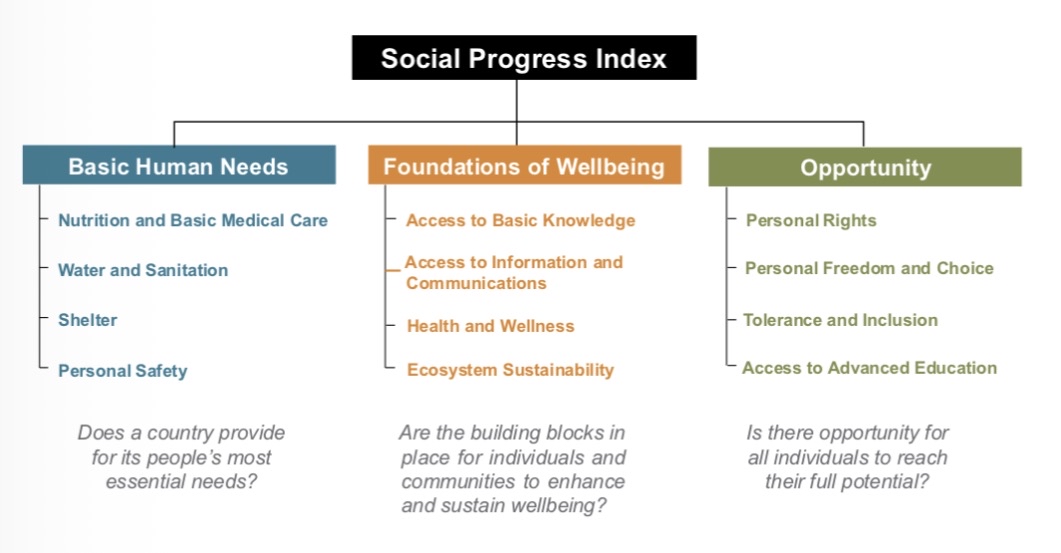
Social Progresss Index
Broader measure of national performance to social factors
Social progress is the capacity of a society to meet the basic humans needs of its citizens
CONCLUSIONS:
Latent structure analysis see how different dimensions relate to each other
Look at policy context/socil group in more detail
Levels of analysis, distinguish from aggregate results
Need for qualitative analysis
Understand digital transformations
Apply digital transformations across the world to non-affluent as well as affluent societies more systematically
KEY WORDS:
Global Health: health issues that transcend national boundaries and govt, call for actions on the global forces that determine health of people 🏥
Global Public Health:Activities within the health sector that address normative health issues, global disease outbreaks, pandemics as well as international agreements 🌎
Global Health Governance: Constitutional capability to ensure agenda coherence in global health, strengthen convening capabilities, transparency/accountability 🌾
Global health Diplomacy: Agreements reached in multilateral venues, new alliances in bilateral agreements 🗣
World Health Organisation (WHO)
World Bank (WB) 💷
International Labour Organisation (ILO)🕵
Organisation for Economic Co-operation and Development (OCED)
United Nations (UN)🌐
World Trade Organisation (WTO)™
Hapieness Index - measurement of many factors, seen as a better way to measure
Happy Planet Index - focus on environment and well rounded😁
Gross National Happiness - adopted by Bhutan prioritising well being over economic prosperity