11: Photosynthesis!
Metabolic reactions: Biochemical reactions carried out to maintain homeostasis.
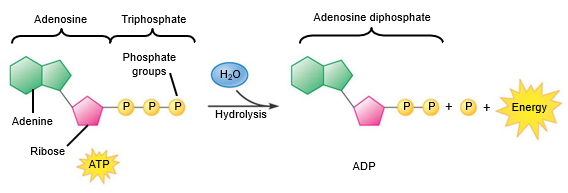
The importance of ATP: a denotive triphosphate → energy currency of cells
ATP → ADP + Pi diphosphate
The role of NADPH:
NADPH → NADP^+ + H + 2e (which can be donated to another molecule)
How much do you really know about this bulk reaction equation?
6 H2O + CO2 → 6O2 + C6H12O6
6 H2O → 6O2 is from light
CO2 → C6H12O6 is from chloroplasts
C6H12O6 = glucose. This NOT the first product of photosynthesis!
A. LIGHT AND PLANT PIGMENTS
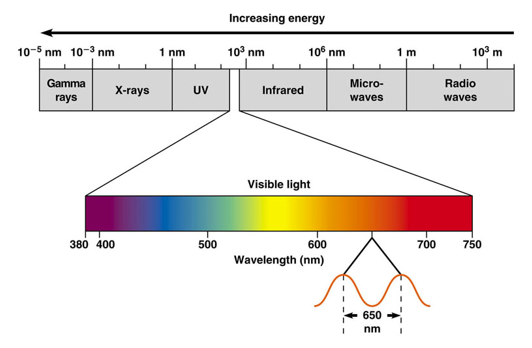
Sunlight-What is it?
electromagnetic energy → radiation that travels through space in waves
Artificial light
portion of spectrum → visible (mostly)
grow lamps → optimized for photosynthesis and far red light
Plant pigments:
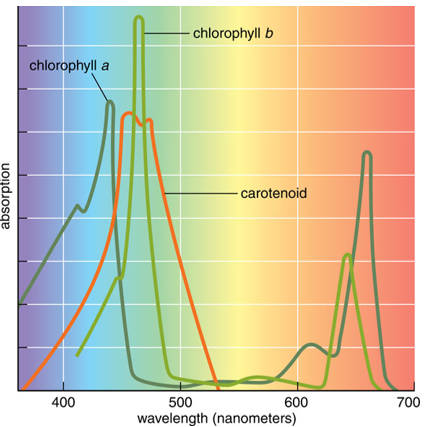
Chlorophyll a → primary pigment
Absorption spectra: blue/violet and red visible
Functions: convert light energy into chemical energy via loss of electrons
Chlorophyll b →
Absorption spectra: blue/green and orange
Functions: expands on spectrum of chl. a and can transfer energy to chl. a
Accessory pigments: multiple/variable
Absorption spectra: most absorb in UV spectrum of some green
Functions: carotenoids
Transfer light energy to chlorophyll → protection
Dissipate light energy excess short wave
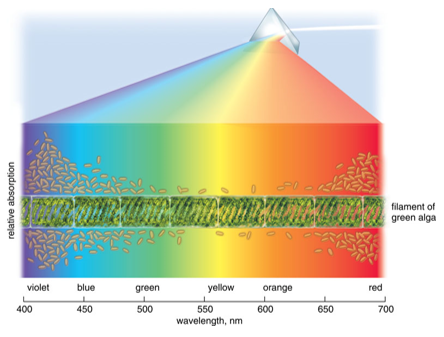
How did we first find out that photosynthesis is most active in the blue- and red-light spectra?
Red light is absorbed effectively by chlorophyll which ranges within this wavelength. It is utilized in the maximum amount. This red light is followed by blue light which falls next to red in the visible spectrum, thus it is also absorbed in a very effective way for photosynthesis.
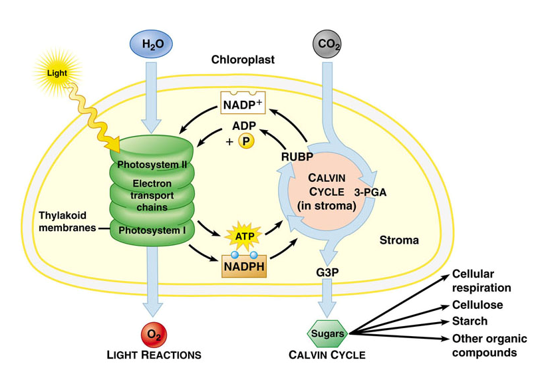
Photosynthesis reactions can be divided into 2 general “sets” of reactions:
Light-dependent reactions:
in and across thyaloid membranes of chloroplasts
H2O split
O2 byproduct
ATP and NADPH produced
Light-independent reactions
or “carbon reactions” or “dark reactions”
in chloroplast stroma
CO2 is input → ATP and NADPH used
3-carbon compounds produced
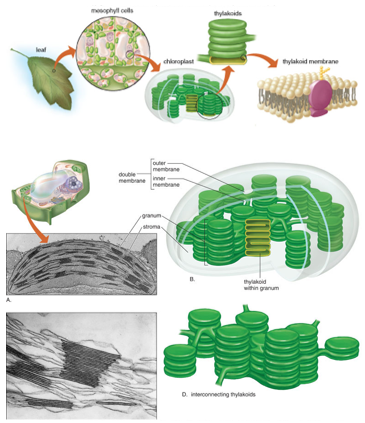
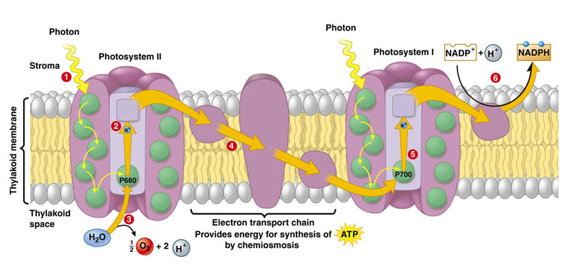
B. LIGHT-DEPENDENT REACTIONS
Chloroplast pigments are anchored to and occur throughout the thylakoid membranes.
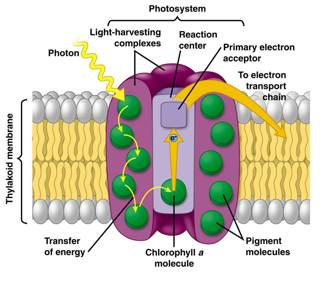
These pigments (primarily chlorophyll a and b) cluster together forming light-harvesting complexes and a reaction center.
Together, these complexes (proteins of 200-300 pigment molecules) and centers are called photosystems (PS). There are 2 of them. They work in order and simultaneously.
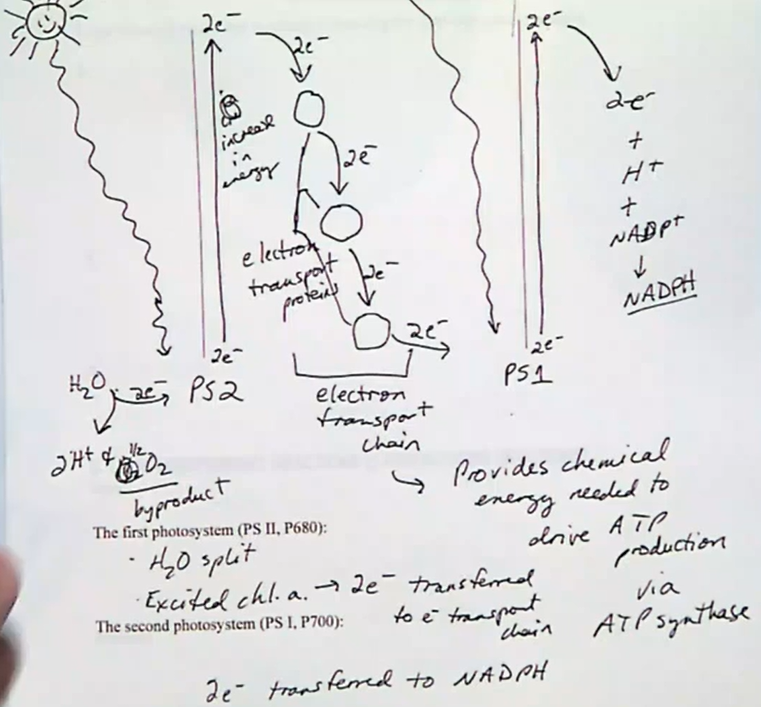
The first photosystem (PS II, P680):
H2O split
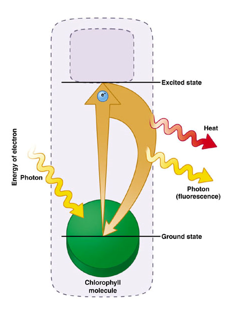
excited chl. a → 2 electrons transported to ETC (electron transport chain)
The second photosystem (PS I, P700): 2 electrons transferred to NADPH
The electron transport chain connecting them provides the energy that is required to synthesize ATP.
So the primary products of light reactions are O2, ATP, and NADPH.
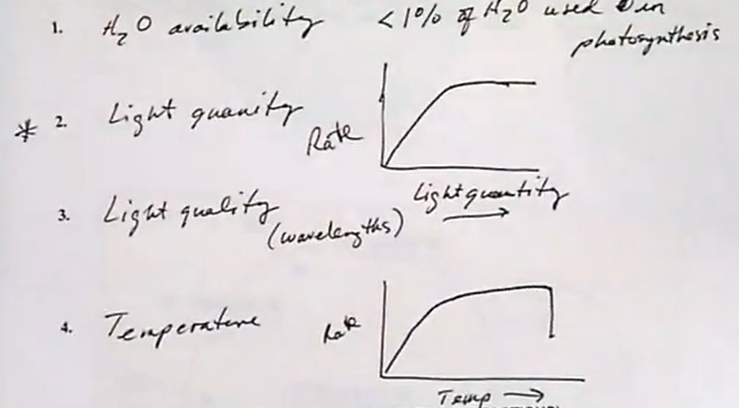
Some factors (internal and external) influencing the light-dependent reactions:
H2O availability: < 1% of H2O used in photosynthesis
light quantity
light quality
temperature
C. LIGHT-INDEPENDENT REACTIONS (CARBON-FIXING REACTIONS)
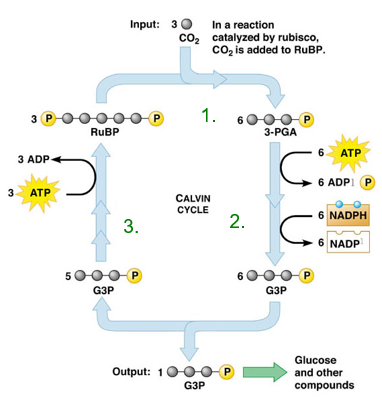
Inputs: CO2, ATP, NADPH
Products: 3-carbon compounds (more complex structures) → used to produce glucose
The Calvin-Benson cycle occurs in three general phases or steps:
Carbon fixation
The enzyme required to carry out this phase is called Rubisco (ribulose 1,5-bisphosphate carboxylase oxygenase). Rubisco “fixes” inorganic CO2 by incorporating it into organic compounds. Rubisco is likely the most abundant protein on Earth.
Reduction of 3-carbon compounds.
Regeneration of 5-carbon compounds.
Some factors (internal and external) influencing the light-independent reactions:
CO2 quantity
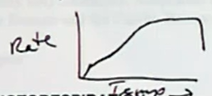
temperature
energy from light reactions (ATP + NADPH)
type of plant (C3, C4, CAM)
D. PHOTORESPIRATION
Photorespiration is a metabolic phenomenon that can occur when environmental conditions are hot and/or dry.
Stomata close to conserve water, thereby not allowing CO2 to enter for the Calvin cycle. How do most plants respond to a decline in internal CO2 concentrations?
CO2 < 50 ppm
Rucisco reacts with O2 instead of CO2
yields [2] 3 C compounds instead of 6
Drawbacks: requires time, energy input (ATP), other organelles
NOT energy efficient
E. VARIATIONS IN CARBON FIXATION STRATEGIES
C3 plants (account for 94% of all planetary biomass)
CO2 from air diffuses into plant cells and fixed direction into 3C compounds in Calvin cycle
Examples: tree species, bamboo, rice, soy, cotton, sweet potato, wheat, peanut
Climates in which C3 plants are prevalent: temperate to subtropical
Potential for photorespiration in these plants under hot or dry conditions: High! easily stressed!
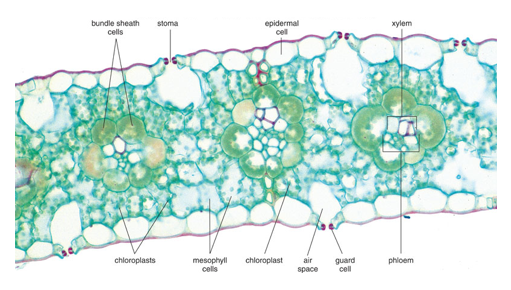
C4 plants (4-Carbon Pathway, 5% of all biomass)
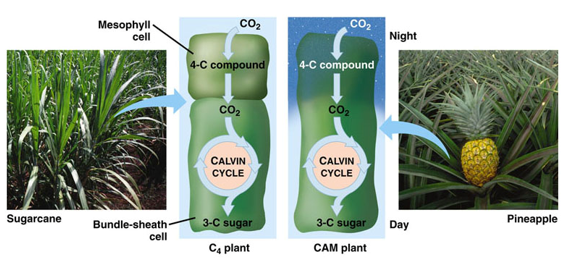
Adapted to carry out photosynthesis more efficiently under moderate-to-hot, drier (but not extremely hot) conditions. Adaptation comes in the form of a separation in space for initial carbon fixation and the Calvin-Benson Cycle.
Examples: 2/3 of all grasses including corn, sugarcane, sorgum
“warm/subtropical”
The “4” designation:
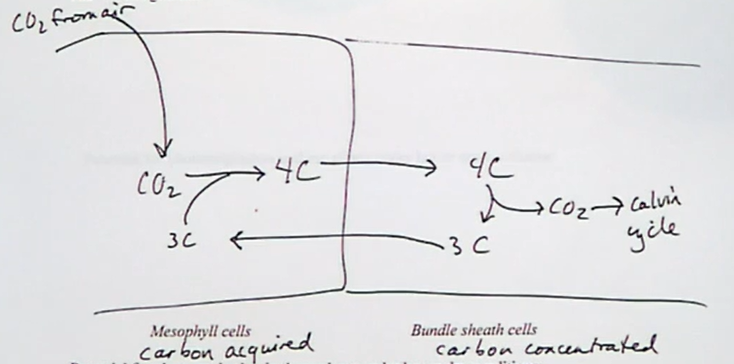
Potential for photorespiration in these plants under hot or dry conditions:
CAM plants (Crassulacean Acid Metabolism, 1% of biomass)
Adapted to carry about photosynthesis more efficiently under extremely hot and tropical conditions. Adaptation comes in the form of a separation in time for carbon fixated and cycling.
Example plants: jade, pineapple, orchids, cacti, “air plants” including Spanish moss
What’s with this name?
crassalaceae → succulent family
native to southern Africa of southern north America
The mechanism occurs in the same cell:
stomata open only at night → potential for water loss is lowest
At night, CO2 is fixed into 4C compounds and stand in vacuoles
during day, CO2 released from 4C compounds and transported to chloroplasts for use in Calvin cycle
Potential for photorespiration in these plants under hot or dry conditions:
low to zero
rarely occurs