📚 Water & Air Pollution Overview
Brief Overview
This note covering water and air pollution was created from a 34-page PDF presentation on water and air pollution. It walks through the main drivers and indicators of pollution, from Persistent Organic Pollutants (POPs) and bioaccumulation in aquatic systems to ozone formation, acid rain chemistry, and photochemical smog.
Key Points
Persistent Organic Pollutants (POPs) and their bioaccumulation/biomagnification pathways in fish.
Dissolved oxygen dynamics, BOD, and turbidity effects on aquatic communities.
Ozone chemistry, sources, and health impacts in the troposphere.
Acid rain formation and regulatory frameworks like the Clean Water Act and Clean Air Act.
Water Pollution 🌊
Persistent Organic Pollutants (POPs)
Definition: Synthetic chemicals that resist degradation, travel long distances, and accumulate in fatty tissues of organisms.
Do not break down – remain intact for years to decades.
Mobile – transported by wind, water currents, and migratory birds (e.g., plastic debris).
Fat‑soluble – dissolve in animal fat and are poorly eliminated by kidneys.
Toxic – can mutate DNA, cause cancer, and lead to birth defects.
Bioaccumulation & Biomagnification
Bioaccumulation: Net increase of a substance in an organism when absorption exceeds excretion.
Fish model (age 3 mo → 12 mo):
Rate of absorption =
Rate of excretion =
Net gain = → concentration rises as the fish grows.
Biomagnification: Amplification of a contaminant’s concentration at successive trophic levels.
As small fish accumulate POPs, predators that eat many fish inherit a higher total dose, leading to unsafe levels in top‑level consumers.
Source Types of Water Pollution
Source Type | Characteristics | Typical Examples |
|---|---|---|
Point Source | Single, identifiable origin | Oil spill, CAFO discharge, factory outfall |
Non‑Point Source | Diffuse, many origins | Farm runoff (fertilizer, pesticides), animal waste, construction‑site sediment, urban runoff, acid‑rain deposition |
Policies Protecting Water
Clean Water Act – sets standards for pollutant discharges into U.S. waters.
Safe Drinking Water Act – regulates contaminants in public drinking water supplies.
Dissolved Oxygen (DO) & Temperature
DO: Amount of oxygen dissolved in water; indicator of water quality.
High DO → High water quality; Low DO → Poor water quality.
Inverse relationship with temperature: As water warms, gas solubility drops; colder water holds more O₂.
Thermal Pollution
Causes:
Discharge of warm cooling water from power plants (e.g., nuclear).
Storm‑water runoff from heated urban surfaces.
Removal of riparian shade trees.
Soil erosion increasing suspended solids → turbidity → greater heat absorption.
Biological Oxygen Demand (BOD) & Oxygen Sag Curve
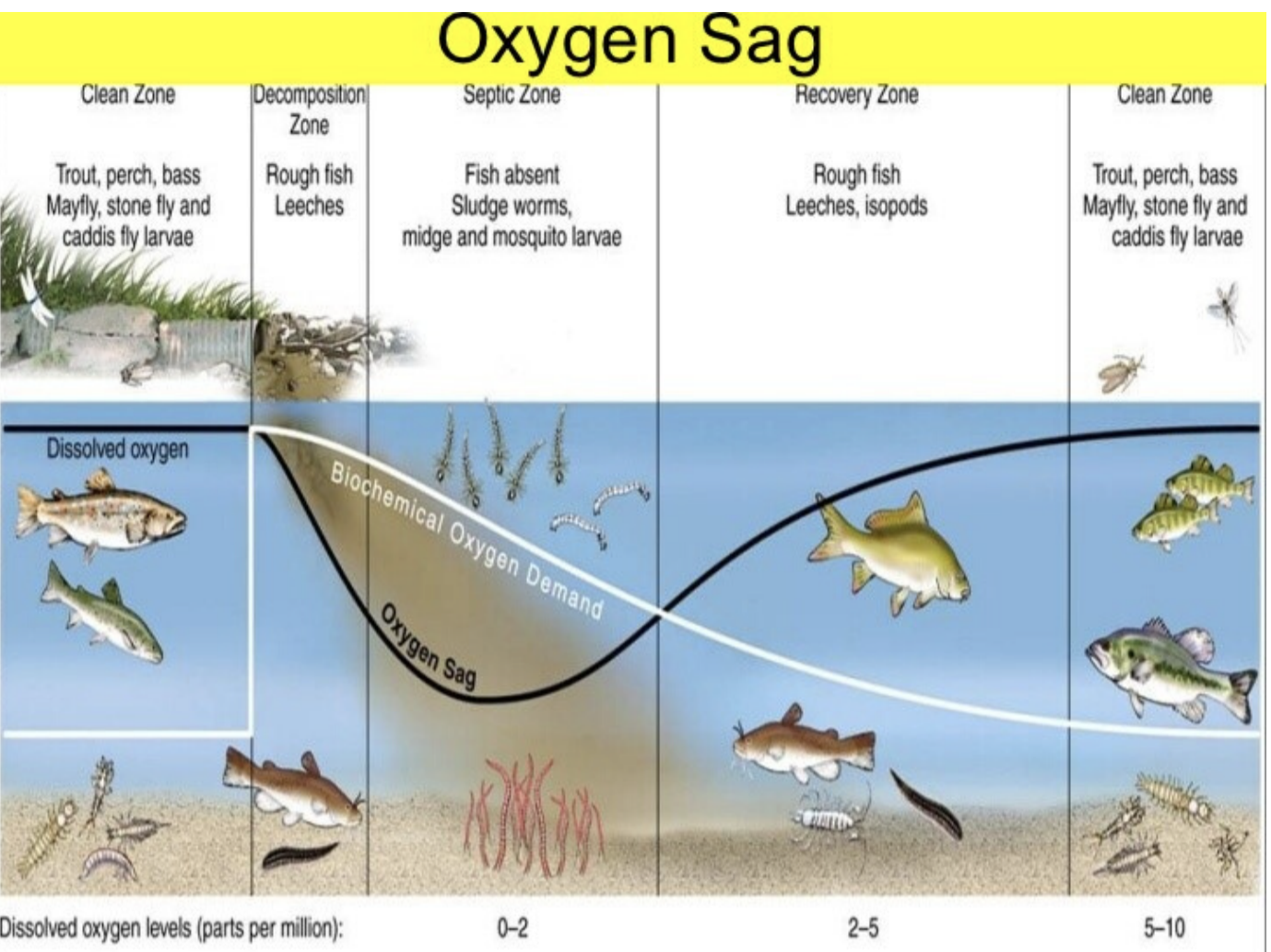
BOD: Amount of dissolved oxygen consumed by microorganisms decomposing organic waste.
Organic wastes (food, leaves, feces, etc.) enter water via sewage, agricultural runoff, food‑processing plants, etc.
Microbial respiration reduces DO, creating an oxygen sag downstream of the discharge point.
Oxygen Sag Curve: Plots DO decline along a river segment after pollutant input; the “sag” shows the zone of low oxygen.
Low DO shifts aquatic communities:
Pollution‑intolerant taxa (e.g., mayfly nymphs, caddisfly larvae) decline.
Pollution‑tolerant taxa (e.g., worms, fly larvae) become dominant.
Turbidity & Aquatic Community Structure
Turbidity: Measure of water clarity; higher values indicate more suspended particles.
Consequences of high turbidity:
Reduced light penetration → lower photosynthesis.
Increased heat absorption → warmer water, further lowering DO.
Lower biodiversity; tolerant species prevail.
Macroinvertebrate Indicators (by tolerance)
Tolerance Level | Representative Taxa |
|---|---|
Sensitive | Mayfly nymph, stonefly nymph, caddisfly larva |
Somewhat Sensitive | Damselfly, dragonfly nymph, riffle beetle |
Tolerant | Worms, fly larvae, beetle larva, leeches, midge larva |
Counting these groups provides a rapid bioassessment of water quality.
Air Pollution 🌬
Primary, Secondary, & Fugitive Emissions
Primary pollutants: Emitted directly from a source (e.g., CO from car exhaust).
Secondary pollutants: Formed in the atmosphere after chemical reactions (e.g., ozone).
Fugitive emissions: Released without passing through a stack (e.g., dust from mining, construction).
Major Criteria Pollutants (Clean Air Act)
Pollutant | Primary Sources |
|---|---|
Sulfur Dioxide () | Coal‑burning power plants, industrial processes |
Nitrogen Oxides () | Vehicle exhaust, fossil‑fuel combustion |
Carbon Monoxide () | Incomplete combustion (vehicles, furnaces) |
Ozone () | Photochemical reactions of VOCs & |
Volatile Organic Compounds (VOCs) | Solvents, gasoline vapors |
Particulate Matter (PM) | Combustion, dust, industrial processes |
Ozone
Stratospheric ozone shields Earth from harmful UV radiation.
Tropospheric (ground‑level) ozone is a pollutant formed by UV‑driven reactions of VOCs and .
A 1 % decrease in stratospheric ozone could cause ~1 million extra skin‑cancer cases worldwide, reduce agricultural yields, and diminish oceanic plankton populations.
Montreal Protocol (1987)
Phased out chlorofluorocarbons (CFCs); substituted with HCFCs that release less chlorine.
Result: CFC emissions cut by ~95 % since 1988; atmospheric levels projected to return to pre‑industrial values by 2049, also aiding greenhouse‑gas reduction.
Acid Rain Chemistry
Acid deposition forms when sulfur and nitrogen oxides react with atmospheric water.
(sulfuric acid)
(nitric acid)
These acids precipitate as rain, snow, or fog, acidifying soils and water bodies.
Photochemical Smog
Formation Reactions
VOCs + → peroxy radicals → regenerate → sustain ozone production
Contributing Factors
Hot summer temperatures
High VOC emissions (vehicles, factories)
Urban heat islands
Early‑morning traffic peaks
Mitigation Strategies
Reduce vehicle miles traveled (promote public transit, carpooling).
Shift to renewable energy sources to lower VOC and outputs.
Implement stricter emission standards for industry and gasoline formulations.
How Toxins & Pollutants Enter an Organism’s Body
POP’s and other pollutants can enter the body of a living organism and cause disease or death
Neurotoxin - Pollutant that causes brain related disease or death
Carcinogen - Pollutant that causes cancer
Teratogens - Pollutant that causes birth defects
Endocrine Disruptors - Pollutants that interferes with hormones
Why is LD50 Important?
-Lethal Dose or Toxic Dose - Dose of a pollutant that kills 50% of the organisms in a study
Environmental Protection Agency: Use LD50 to decide exposure limits for chemicals in consumer products, agriculture, and industry.
Wildlife and Ecosystems: Pesticides with known LD50 leak into lakes, predictions can be made on fish and amphibian impacts
Food Webs: When a predator consumes prey that has ingested a chemical, the predator faces higher toxic loads over time.
🧭 Overview Table for legislation
Law / Treaty | Year Passed / Signed | Main Goal | Type | Key Features / Focus |
|---|---|---|---|---|
Clean Air Act (CAA) | 1970 (amended 1990) | Protect and improve air quality in the U.S. | U.S. federal law | Regulates air pollutants, vehicle emissions, and industrial sources; authorized the EPA to set and enforce air quality standards. |
Clean Water Act (CWA) | 1972 | Restore and maintain the integrity of U.S. waters | U.S. federal law | Regulates pollutant discharges into surface waters (rivers, lakes, wetlands); requires permits for waste dumping; funds wastewater treatment. |
Montreal Protocol | 1987 | Protect the ozone layer | International treaty | Phases out ozone-depleting substances (CFCs, halons); global cooperation; highly successful and widely adopted. |
Kyoto Protocol | 1997 (took effect 2005) | Reduce greenhouse gas emissions to slow climate change | International treaty (under the UNFCCC) | Set legally binding emission reduction targets for developed nations; later replaced by the Paris Agreement (2015). |
🌫 What is Smog?
Smog is a type of air pollution that reduces visibility and harms health. It is often a mixture of smoke, fog, and chemical pollutants. There are two main types:
Industrial smog – caused by burning coal or fossil fuels, common in the early 20th century.
Photochemical smog – caused by chemical reactions in sunlight, very common in modern cities (like Los Angeles).
⚗ How VOCs Contribute
Emission: VOCs are released into the air from cars, factories, paints, etc.
Reaction with NOₓ: In sunlight, VOCs react with nitrogen oxides (NOₓ) from vehicle exhaust.
Ozone formation: This reaction creates ground-level ozone (O₃), a main component of photochemical smog.
Secondary pollutants: Other chemicals, like peroxyacetyl nitrates (PANs), are also formed, which irritate eyes and lungs.
🫁 Health and Environmental Effects
Human health: Coughing, throat irritation, asthma attacks, lung damage
Environment: Damages crops, trees, and reduces visibility
Climate: Some smog components can contribute to global warming
💡 Summary Diagram (Step-by-Step)
VOCs + NOₓ + Sunlight → Ground-level Ozone (O₃) → Smog
Think of it as sunlight “activating” VOCs and NOₓ to produce the visible and harmful haze in polluted cities.