Mapping the Celestial Sphere & Human Perception of the Sky
Human Interaction w/ the Sky
Light
The sun rises in the east
Shadows are cast to the west
The sun sets in the west
Shadows are cast to the east
Most light we see is from the sun
atmospheric scattering = the redirection of sunlight (or other electromagnetic radiation) by air molecules and particles in the atmosphere
The amount of scattering depends on the density in the amount of molecules in the atmosphere around the viewer
The more molecules in the atmosphere around the viewer, the more light can be reflected, while less molecules mean less light can be reflected
The central point in the sky where the sun is will always be stronger than reflected light from other sources
Space appears black because its molecular density is too low for any significant light to scatter towards a viewer
The atmosphere ends only ~60miles above the Earth’s surface
Because the atmosphere fades slowly away as height in relation to the earth increases, this definition is where 99.9% of molecules are condensed
Division of the Sky
The whole sky is divided into parcels
Each region of sky is called a constellation
There are 88 constellations
asterisms = individual patterns of noticeable stars that are not officially part of any constellation
Asterisms are celestial projections, meaning that only in 2d do the stars within them look related
The objects and pictures associated with asterisms are cultural and often have no real relation to the stars themselves
Mapping the Sky
The Celestial Sphere is a sphere of infinite radius centered around Earth
By using the Celestial Sphere coordinates can be applied to objects and bodies around the Earth
From Earth, only half of the celestial sphere can be observed at one time
The end of the half which can be observed is called the horizon line
relative motion = the motion of one object with respect to another object
celestial projections = objects which all appear equally on a spherical plane around Earth, regardless of their true distance from Earth or eachother
The North Celestial Pole is a celestial projection
Polaris is very close to the North Celestial Pole
The Equator is a celestial projection
The South Celestial Pole is a celestial projection
The Celestial Sphere is anchored by the connecting line between the North Celestial Pole and the South Celestial Pole
The points on this line never appear to move
Understanding Coordinates
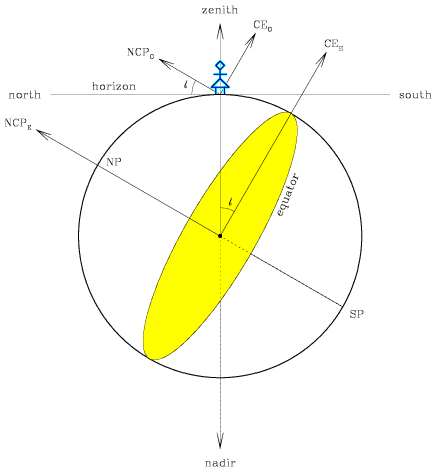
zenith = the imaginary point on the celestial sphere directly above an observer's head
meridian = the line connecting crossing through zenith due North and South
altitude = how many degrees above the horizon a star is, ranging from 0°–90°
Zenith sits at 90°
The horizon line is at 0°
azimuth = how many degrees along the horizon a star is in correspondence with compass direction
North = 0
East = 90
South = 180
West = 270