Quality-Gurus
Quality Gurus
Eliyahu M. Goldratt (1947–2011) was an Israel-born physicist who became a business management guru. He is the originator of the Theory of Constraints (TOC).
He authored several books, mainly on the application of theory of constraints to various manufacturing, engineering, and other business processes. The TOC is one of the most profound developments in the practical aspect of making organizational decisions in situations in which constraints exist. It provides a practical framework for managing enterprises with a holistic and a focused approach and does away with conflicts between local operating-level decisions and global objectives and goals of a company.
The five steps in applying TOC, also called the process of on-going improvement (POOGI) are as follows:
1. Identify the system’s constraint
2. Exploit the constraint
3. Subordinate everything to the constraint
4. Elevate the constraint
5. Prevent inertia from becoming the constraint
Goldratt has authored several books. Some noteworthy ones include:
The Goal (1984);
The Race (1986);
The Haystack Syndrome (1990);
What is This Thing called Theory of Constraints and How Should it be implemented? (1990);
It’s Not Luck; Critical Chain (1997);
Necessary But Not Sufficient (2000);
The Choice (2008); and
Isn’t it Obvious (2009).
Walter Shewart1 (1891–1967) was a statistician at Bell Labs and is considered by many to be the founder of the modern quality movement, and an innovator in the application of statistics to quality. His seminal contributions were based on his work at Bell Telephone Laboratories during the 1920s and the 1930s and were compiled in two books; Economic Control of Quality of Manufactured Product in 1931 and Statistical Method from the Viewpoint of Quality Control in 1939.
Walter Shewart was one among the giants in the quality movement during the first half of the 20th century. Walter Andrew Shewart was an American physicist, engineer and statistician, sometimes known as the father of statistical quality control and also developed the Shewart cycle.
Shewart is often referred to as the “grandfather of quality control.” He studied randomness and recognized that variability existed in all manufacturing processes. He developed what came to be known as the Shewart cycle; Plan-Do-Study-Act (PDSA) or Plan-Do-Check-Act (PDCA) to manage the effects of variation. He developed quality control charts that are presently used to identify whether the variability in the process is random or due to an assignable cause such as unskilled workers or equipment not being calibrated. He stressed that eliminating variability improved quality. His work created the foundation for statistical process control measures used today
W. Edwards Deming3 (1900–1993) is often referred to as the “father of quality control.” Deming is best known for initiating a transformation in the Japanese manufacturing sector in the aftermath of World War II, which enabled it to become a big player in the world market. The Deming Prize, the highest award for quality in Japan, is named in his honor. He is also known for his 14 Points (a new philosophy for competing on the basis of quality), for the Deming Chain Reaction and for the Theory of Profound Knowledge. He also modified the Shewhart PDSA (Plan, Do, Study, Act) cycle to what is now referred to as the Deming Cycle (Plan, Do, Check, Act).
William Edwards Deming (1900-1993) father of quality evolution is often referred as the “father of quality control”. He is widely acknowledged as the leading management thinker in the field of quality
The Deming Cycle: PDCA Cycle
Deming introduced the “Deming cycle,” one of the crucial QC tools for assuring continuous improvement. The Deming cycle is also known as the Deming wheel or the PDCA (Plan-Do-Check-Action) cycle. It is a problem-solving process adopted by firms engaged in continuous improvement. Deming stressed the importance of constant interaction among the four stages of Design, Production, Sales and Research for a company to arrive at better quality that satisfied customers. He stated that this wheel should be operated in accordance with quality first perceptions and responsibilities.
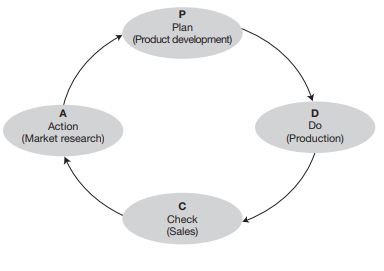
The Deming Cycle, or PDCA Cycle, is a continuous quality improvement model consisting of a logical sequence of four repetitive steps for continuous improvement and learning: Plan, Do, Check and Act.
The PDCA (or PDSA) cycle was originally conceived by Walter Shewart in the 1930s, and later adopted by W. Edwards Deming. The model provides a framework for the improvement of a process or system. It can be used to guide the entire improvement project, or to develop specific projects once the target areas requiring improvement have been identified.
Applications of the PDCA Cycle
It is used to satisfy the quality requirements of the customer. It may be used for the development of a new product based on the quality requirements of the customer. It develops teamwork between the company’s various functions and aids in product design and development, production, sales and market research. Box 2.1 discusses how the PDCA cycle can be applied to education.
Box 2.1 Deming’s PDCA Cycle Applied to Education
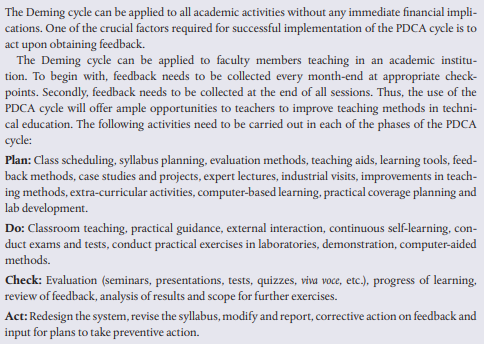
Design → Plan: When a problem is detected in product design and development, find the causes of the problem.
Production → Do: A pilot project is done, or implemented. In the Do phase, one collects correct data about the problem and sorts it out statistically. Then one identifies probable causes and verifies the most plausible ones and takes corrective action. At this stage, always make sure that the relevant job standards have been followed.
Sales → Check: The results of the effort are observed and analyze against the plan. In the Check phase, one evaluates the results after implementation of a corrective procedure. If the targets are not achieved, one goes back to the Plan or Do stage and starts all over again. Upon satisfactory achievement of the target, one proceeds to the next stage.
Research → Action: At this stage, the cycle starts again with planning an improvement. One documents and standardizes the process concerned and provides training to employees in the new procedures. The PDCA cycle is designed to be used as a dynamic model. The completion of one turn of the cycle flows into the initialization of the next. The cycle must be constantly rotating. Following in the spirit of continuous quality improvement, the process can always be reanalysed and a new test of change begun. This continual cycle of change is represented in the ramp of improvement. Using what we learn in one PDCA cycle, we can begin another more complex cycle
The Ramp of Improvement
This is a schematic representation of the use of the PDCA cycle in the improvement process. As each PDCA cycle reaches completion, a new and slightly more complex project is undertaken. This roll-over feature is integral to the continual improvement process. The ramp of improvement is shown in Figure
Plan: A change or a test aimed at improvement. 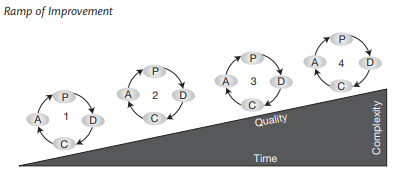
Do: Carry out the change or test (preferably on a small scale). The change that has been decided on in the plan phase needs to be implemented.
Check or study: The results need to be examined for lessons learned from the exercise.
Act: Adopt the change, abandon it or run through the cycle again.
The Deming Chain Reaction
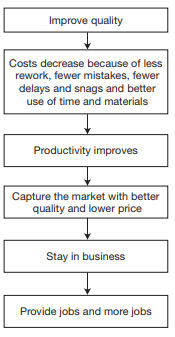
The Deming chain reaction was first presented in 1950 in Japan after World War II. It is shown in the Figure. It illustrated Shewart’s concept that productivity and quality improved as variation reduced. His book Out of the Crisis (1989) is considered a quality classic. Deming identified seven deadly sins affecting quality:
 1. Lack of constancy of purpose
2. Emphasis on short-term profits
3. Over-reliance on performance appraisals
4. Mobility of management
 5. Overemphasis on visible figures
6. Excessive medical costs for employee healthcare
7. Excessive costs of warranty and legal costs
Deming (1986) proposed his famous Chain Reaction Model to explain the relationships among quality, productivity, cost, and eventually sustainability.
Quality improvement in any organizational process, in terms of variability reduction, results in higher productivity.
Deming’s Chain Reaction has a potential for groups and teams to gain and establish continuous improvement understanding in daily routine work operations
Deming’s 14-Point Methodology
1. Constancy of purpose: Create constancy of purpose for continual improvement of products and service, and allocate resources to cater to long term needs rather than short-term profitability with a plan to become competitive, stay in business and provide jobs.
2. The new philosophy: Adopt the new philosophy for one can no longer accept delays, mistakes and defective workmanship. Transformation of the Western management style is necessary to halt the continued decline in the industry.
3. Cease dependence on inspection: Eliminate the need for mass inspection as a way to achieve quality by building quality into the product in the first place. Demand statistical evidence of built-in quality in both manufacturing and purchasing functions.
4. End lowest tender contracts: End the practice of awarding business contracts solely on the basis of price tags. Instead, go for meaningful measures of quality along with price. Reduce the number of suppliers for the same item by eliminating those that do not qualify against the statistical yardstick of quality. The aim is to minimize total cost, not merely the initial cost. Purchasing managers now have their task cut out and must learn their responsibilities.
5. Improve every process: Constantly improve every process involved in the stages of planning, production and service. Search continually for problems in order to improve every activity in the company because better quality leads to increased productivity and decreased costs. It is the management’s job to continually work on all aspects of the system (design, incoming materials, maintenance, improvement of machines, training, supervision, retraining, etc.)
6. Institute training on the job: Institute modern methods of training on the job, including management to make maximum use of all employees. New skills are required to keep up with changes in materials, methods, product design, machinery, techniques and service.
7. Institute leadership: Adopt and institute leadership, which is aimed at helping people do a better job. The responsibilities of managers and supervisors must be changed to emphasize on quality rather than quantity. This will automatically improve productivity. The management must ensure that immediate action is taken on reports of inherited defects, maintenance requirements, poor tools, fussy operational definitions and other conditions detrimental to quality.
8. Drive out fear: Encourage effective two-way communication and other means to drive out fear throughout the organization so that all employees are able to work effectively and ensure greater productivity for the company.
9. Breakdown barriers: Breakdown barriers between people in different divisions of the organization such as R&D, Sales, Administration and Production. They must work in teams to tackle problems that may be encountered.
10. Eliminate exhortations: Eliminate use of slogans, posters and exhortations demanding zero defects and new level of productivity from the workforce, without providing commensurate methods. Such exhortations only create adversarial relationships; the bulk of the cases of low quality and low productivity belong to the system and; thus, lie beyond the power of the workforce.
11. Eliminate arbitrary numerical targets: Eliminate work standards that prescribe numerical quotas for the workforce and numerical goals for people in the management. Substitute these with aids and helpful supervision and use statistical methods for continual improvement of quality and productivity.
12. Permit pride of workmanship: Remove the barriers that rob hourly workers and people in the management of their rights to pride of workmanship. This implies the abolition of the annual merit rating (appraisal of performance) and management by objectives. Again, the responsibility of managers, supervisors and foremen must be changed from sheer numbers to quality.
13. Encourage education: Institute a vigorous program of education and encourage self-improvement. What an organization needs is not just good people; it needs people who improve with education. A workforce rooted in knowledge will always enable an organization to be competitive.
14. Top management’s commitment: A clearly defined commitment by the top management to constantly improve quality and productivity and reinforcement of obligations to implement all these principles is always beneficial to the workforce and the organization. Create a structure in the top management whose main task will be to push these 13 points constantly and take action in order to accomplish the transformation.
Joseph Juran
Joseph Juran5 (1904–2008) assisted the Japanese in their reconstruction processes after World War II. Juran first became famous in the US as the editor of the Quality Control Handbook (1951), and later for his paper introducing the quality trilogy—quality planning, quality control and quality improvement
• Quality planning provides a system that is capable of meeting quality standards.
• Quality control is used to determine when corrective action is required.
• Quality improvement seeks better ways of doing things.
Joseph Juran’s major contribution to society was in the field of quality management and he is often called the father of quality.
In 1937, Dr. Juran created the “Pareto principle,” which millions of managers rely on to help separate the “vital few” from the “trivial many” in their activities. This is commonly referred to as the 80-20 principle.
Juran’s Quality Trilogy
Juran developed the idea of the quality trilogy to bring continuous improvement in the process. The elements of the trilogy are quality planning, quality improvement and quality control. These are broken into key constituents
The Juran Trilogy, published in 1986, identified and was accepted worldwide as the basis for quality management.
After almost 50 years of research, his trilogy defined three management processes required by all organizations to improve. Quality control, quality improvement, and quality planning have become synonymous with Juran and Juran Institute, Inc.
Juran is the founder of Juran Institute in Wilton, Connecticut. He promoted a concept known as Managing Business Process Quality, which is a technique for executive cross-functional quality improvement
Juran propounded the following message on quality
• Quality control must be an integral part of management
• Quality is no accident
• Quality must be planned
• There are no shortcuts to quality
• Use problems as sources of improvement
Juran’s Formula
1. Build an awareness regarding the need and offer an opportunity for improvement
2. Set goals for improvements
3. Organize paths to reach the goals (establish a quality council, identify problems, select projects, appoint teams, designate facilitators, etc.)
4. Provide training
5. Carry out projects to solve problems
6. Report progress
7. Give recognition
8. Communicate results
9. Keep score
10. Maintain momentum by making annual improvements part of the regular systems and processes of the company
Armand Feigenbaum
Armand Feigenbaum is credited with the creation of the idea of total quality control in his book Quality Control—Principles, Practice, and Administration (1961) and in his article “Total Quality Control” (1956). The Japanese version of this concept is called Company Wide Quality Control, while it is termed Total Quality Management (TQM) in the US and elsewhere. He was also the first to classify quality costs as costs of prevention, appraisal and internal and external failures. Feigenbaum’s philosophy is summarized in his “Three Steps to Quality,” which has been described below.
Quality leadership: This is evident when the management emphasizes on sound planning rather than reacting to failures. The management must maintain a constant focus and lead the quality effort.
Modern quality technology: The traditional quality development processes cannot resolve 80 to 90 per cent of quality problems. This task requires the integration of office staff, engineers as well as the shop-floor workers who continually evaluate and implement new techniques to satisfy customers in the future
Organizational commitment: Continuous training and motivation of the entire workforce as well as an integration of quality in business planning stage indicates the importance of quality and provides the means for including it in all respects of the organization’s activities.
Key Elements of Feigenbaum’s Philosophy of Quality Control
1. Total quality control refers to a system of integrating quality development, maintenance and improvement efforts in an organization that will enable engineering, marketing, production and service to function at optimal economic levels while achieving customer satisfaction.
2. The “control” aspect of quality control should involve setting quality standards, appraising performances relative to these standards, taking corrective action when the standards are not met and planning for improvement in the standards.
3. Factors that affect quality can be divided into two major categories—technological and human. The human factor is the more critical factor.
4. Operating quality costs can be divided into four categories: Prevention costs, appraisal costs, internal failure costs and external failure costs.
5. It is important to control quality at the source.
Philip Crosb
Philip Crosby10 (1926–2001) came to national prominence with the publication of his book Quality is Free (1979). He established the Absolutes of Quality Management, which states that the only performance standard (that makes sense) is zero defects, and the basic elements of improvement
While Crosby, like Deming and Juran, stresses on the importance of the management’s commitment and error-cause removal, some aspects of Crosby’s approach to quality are quite different from Deming’s. Zero defects, central to Crosby’s philosophy, was criticized by Deming as being directed at the wrong people (workers) and generating worker frustration and resentment. Goal setting, central to Crosby’s theory, was also criticized for leading to negative accomplishment. The reality is that Deming was probably reacting to the inappropriate use of slogans and goals. Deming may not have condemned them if they had always been used properly within the Crosby system.
The essence of Crosby’s teachings is contained in what he calls the “four absolutes of quality.”
The definition: Quality is conformance to requirements, not goodness.
The system: Prevention, not appraisal.
The performance standard: Zero defects.
The measurement: The price of non-conformance to requirements, not quality indices. Based on these premises, he developed a 14-step methodology
Crosby’s 14 Steps
1. Management commitment: To clarify the management’s stand on quality.
2. Quality improvement team: To run the quality improvement program.
3. Quality measurement: To display current and potential non-conformance problems in the manner that permits objective evaluation and corrective action.
4. Cost of quality: To define the ingredients of the cost of quality, and explain its use as a management tool.
5. Quality awareness: To provide a method of raising personal concern among the personnel in the company towards the conformance of the product and service, and the reputation of the company on the issue of quality.
6. Corrective action: To provide a systematic method of resolving the problems identified through actions taken previously.
7. Zero defects planning: To examine the various activities that must be conducted in preparation for formally launching the zero defects program.
8. Supervisor training: To define the type of training that supervisors need in order to actively carry out their roles with regard to the quality improvement program.
9. Zero defects day: To create an event that will let all employees realize, through a personal experience, that there has been a change.
10. Goal setting: To turn pledges and commitments into action by encouraging individuals to establish improvement goals for themselves and their groups.
11. Error cause removal: To give individual employees a method of communicating to the management, the situations that make it difficult for employees to meet the pledge to improve.
12. Recognition: To appreciate those who participate.
13. Quality councils: To bring together professionals in the domain of quality for planned communication on a regular basis with the workforce and management alike.
14. Do it over again: To emphasize that the quality improvement program never ends.
Kaoru Ishikawa
Professor Kaoru Ishikawa12 (1915–1989) is known as the “father of quality circles” for his role in launching Japan’s quality movement in the 1960s. Ishikawa advocated the following principles:
• Quality is a company-wide issue and must wield an all-pervasive influence on the way every issue of business is conducted.
• Seven simplified tools of quality control need to be used by all the people in an organization.
• Quality circles.
Kaoru Ishikawa a Japanese organizational theorist, Professor at the Faculty of Engineering at The University of Tokyo, noted for his quality management innovations. He is best known for: Ishikawa diagram; Seven basic quality tools; Quality circles and Companywide quality control.
Ishikawa emphasized on quality as a way of management. He influenced the development of participative, bottom-up view of quality, which became the trademark of the Japanese approach to quality management. Some of the key elements of his philosophy are:
- Quality begins with education and ends with education
- The first step in quality is to know the customers’ requirements
- The ideal state of quality control occurs when inspection is no longer necessary
- Remove the root cause, not the symptoms
- Quality control is the responsibility of all workers and all divisions
- Do not confuse means with the objectives
- Put quality first and set your sights on long-term profits
- Market is the entrance and exit of quality
- Top management must not show anger when facts are presented by subordinates
- Ninety-five per cent of problems in a company can be solved with simple tools for analysis and problem solving
- Data without dispersion information (variability) are false data
Genichi Taguchi
Dr Genichi Taguchi is a Japanese quality expert known for his work in the area of product design. He estimated that as much as 80 per cent of all defective items were caused by poor product design. Taguchi stressed that companies needed to focus their quality efforts on the design stage, as it was much cheaper and easier to make changes during this stage than later in the production process.
Taguchi developed approaches to assess outside influences (which he referred to as noise) on processes that he used to establish the signal-to-noise ratio as a measure of the quality of a process. He devised a quadratic function, referred to as the Taguchi Loss Function, which quantified the loss to society of the variation in processes which resulted in products not being produced exactly at the target values. He developed the Taguchi Method, an approach using orthogonal arrays and linear graphs to understand and to optimize the performance of processes. He also developed the idea of robustness, which is the ability of a process or product to perform even in the face of uncontrollable outside influences (noise).
Design of Experiments
Taguchi is known for applying a concept called design of experiments to product design. This method is an engineering approach that focuses on developing robust design that enables products to perform under varying conditions. He believed that it was more difficult to control the environmental conditions. Taguchi’s approach focuses on a statistical method that zeros in rapidly on the variations in a product that distinguish the bad parts from the good.
Taguchi’s Approach
1. Identify the main functions, side effects and failure modes.
2. Identify noise factors and the testing conditions for evaluating loss of quality.
3. Identify the quality characteristics to be observed and the objective functions to be optimized.
4. Identify the control factors and their alternate levels.
5. Design the matrix experiment and define the data analysis procedure.
6. Conduct the matrix.
7. Analyze the data, determine optimum levels for the control factors and predict performance under these levels.
8. Conduct the verification experiment and plan future actions.
Dr Shingo Shigeo
Dr Shingo Shigeo (1909–1990)15was perhaps the greatest contributor to modern manufacturing practices. While he is not as well known as the others in the field of quality, his teachings and principles have formed the backbone of efficient engineering practices. In applying his experience and expertise in the field of industrial engineering, Dr Shigeo Shingo was able to provide a better way of life for both the operators and the corporations. His policies have gained tremendous popularity because of the benefits received by companies in the manufacturing sector that implemented his teaching.
Shingo’s Key Teachings
The impact of Dr Shingo Shigeo’s teachings can be classified into three concepts listed below:
• Just in time (JIT)
• Single minute exchange of dies (SMED)
• Zero quality control
Masaaki Imai
Masaaki Imai, a quality management consultant, was born in Tokyo in 1930. In 1955, he received his bachelor’s degree from the University of Tokyo, where he also did graduate work in international relations. In 1962, he founded Cambridge Corp., an international management and executive recruiting firm based in Tokyo. As a consultant, he assisted more than 200 foreign and joint-venture companies in Japan in fields including recruiting, executive development, personnel management and organizational studies. From 1976 to 1986, Imai served as president of the Japan Federation of Recruiting and Employment Agency Associations.
Masaaki Imai is a Japanese organizational theorist and management consultant, known for his work on quality management, specifically on Kaizen.
SUMMARY
• Walter Shewart (1891–1967) was a statistician at Bell Labs and is considered by many to be the founder of the modern quality movement and an innovator in the application of statistics to quality. His work created the foundation for the statistical process control measures in use today, and he is often referred to as the “grandfather of quality control.”
• W. Edwards Deming (1900–1993) is often referred to as the “father of quality control.” He defined quality as a function of continuous improvement based on reduction in variation regarding the desired output. The highest quality award in Japan, the Deming Prize, is named in his honour. He is also known for his 14 principles of transformation, the seven point plan, the Deming Chain Reaction and the Theory of Profound Knowledge. He also modified the Shewart cycle (Plan, Do, Study, Act) to what is now referred to as the Deming Cycle (Plan, Do, Check, Act).
• Joseph Juran (1904–2008) also assisted the Japanese in the reconstruction of their economy after World War II. Juran first became well known in the quality field in the US as the editor of the Quality Control Handbook (1951) and later for his paper introducing the quality trilogy—quality planning, quality control and quality improvement. Juran defined quality as “fitness for use” and also developed the concept of cost of quality. He introduced the ten steps to quality improvement.
• Armand Feigenbaum is credited with the creation of the idea of total quality control in his 1961 book Quality Control—Principles. Practice, and Administration and in his 1956 article “Total Quality Control.” The Japanese version of this concept is termed Company Wide Quality Control, while it is called Total Quality Management (TQM) in the US and elsewhere.
• Philip Crosby (1926–2001) came to prominence with the publication of his book Quality is Free (1979). He established the Four Absolutes of Quality Management, which stated that “the only performance standard (that makes sense) is Zero defects,” and the basic elements of improvement. He introduced the 14-step quality program.
• Professor Kaoru Ishikawa (1915–1989) is known as the “Father of Quality Circles” for his role in launching Japan’s quality movement in the 1960s. Ishikawa advocated Company Wide Quality Control, instituted the seven quality control tools and quality circles. He is the author of the book What is Total Quality Control.
• Dr Genichi Taguchi is a Japanese quality expert known for his work in the area of product design. He applied the concept of Design of Experiments to product design. He is known for the prototyping method, the eight steps of parameter design and the quadratic loss function. Taguchi defines quality as the loss imparted to society from the time a non-quality product is shipped.
• Dr Shingo Shigeo was a Japanese industrial engineer and perhaps the greatest contributor to modern manufacturing practices. He defined quality as the defects in a process. He introduced the concept of poka-yoke (zero defects). The greatest impact of Dr Shingo Shigeo’s teachings can be classified into three concepts—just in time (JIT), single minute exchange of dies (SMED) and zero quality control (ZQC). The Shingo Prize for Operational Excellence is named after him because he distinguished himself as one of the world’s leading experts on improving manufacturing processes.
• Masaaki Imai’s concept of “Kaizen” has been largely responsible for Japan’s economic success. He established the Kaizen Institute to help Western companies introduce Kaizen concepts, systems and tools.