Democratic Deliberation - W9
Definition and Debates of Democracy
See (Sorenson 2010. pp. 3-4)
Democracy is when the public are involved heavily within the political and governing system of the state (ruled by the people). However, this brings about questions regarding the philosophy, theory, and practices of democracy:
→ What is meant and who is meant by 'the people’?
→ What participation specifically by the people is ingrained within a democratic society?
→ To what lengths and extents can ‘ruled by the people’ stretch to without losing its meaning?
→ In what field is democratic activity most appropriate?
Models of Democracy
This is adapted from works by David Held.
→ Minimalist
→ Representative / Indirect
Can be seen as Liberal / Substantive too
→ Direct
→ Participatory
→ Deliberative
→ E-Democracy
Minimalist:
Schumpeter (1950 / 208, p. 217) describes the minimalist approach to needing only a democratic process, despite what the outcomes may be.
Substantive:
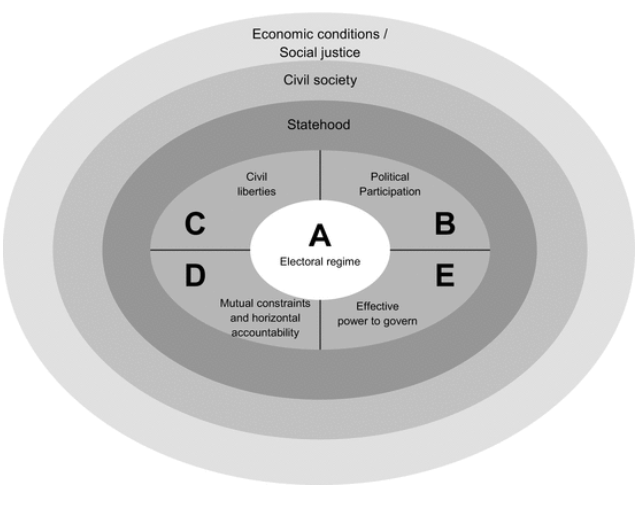
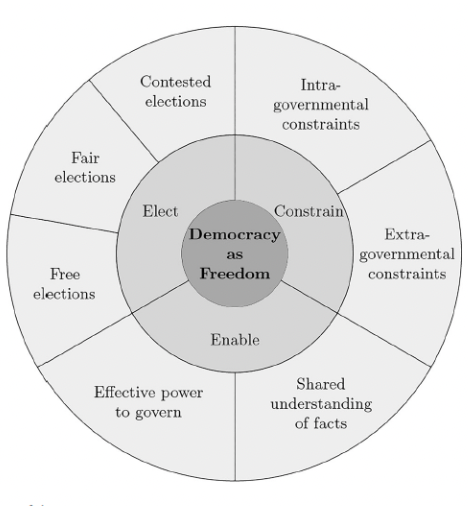
Merkel (2014) and Jee et al. (2021) see the substantive model to be made of two spheres
The first sphere has the electoral regime at the centre, with civil liberties, political participation, mutual constraints and horizontal accountability, and effective power to govern branching off it. Surrounding these branches and centre of electoral regime, is firstly the statehood, secondly the civil society, and lastly the economic conditions / social justice. From an ‘out-in’ approach, each of these factors one by one affect the rest until it all affects the electoral regime.
The second sphere shows the concept of democracy as freedom in the centre, with three actions branching off being to elect, to enable, and to constraint. Part of the electing process is having free, fair, and contested elections. Involved within the enabling process is having the effective power to govern and having a shared understanding of facts. Lastly, the constraining process sees having intra and extra governmental constraints. This sphere works as an ‘in-out’ approach with all these stemming from the concept of democracy as a freedom, rather than affecting it.
Deliberative
See (Dryzek, 2002, pp. 1 - 2)
Deliberative democracy takes shape when persuasion is at the forefront, allowing for judgements, preferences, and views to be vulnerable to change and suggestion. This happens within communicative environments that rely heavily on interaction from others. It is not supposed to be coercive, rather influential to come to a collective consensus and outcome.
This means that public opinion has more of a role in swaying political members views through discourse and the process in how it gets to the state / the state’s attention as political competition via voting can be seen as limiting to the scope in which the public has power. It allows for a reasoned and respective process where preferences are communicated. This can be done through the combination of random sampling and deliberative in-depth situations for communication.
However, when trying to balance political equality, deliberation, and participation, one is always left out if the other two is prioritised.
Differing from a deliberative democracy is a stealth democracy where all public involvement in political discussion, arguments, and debates are felt to best be avoided and left alone.
Methods of a deliberative democracy include:
→ Deliberative Polling
→ Citizens Juries / Assembly
→ Participatory Budgeting
Conditions for a deliberative democracy include:
→ Demographic representativeness
→ Attitudinal representativeness
→ Appropriate sample size
→ Opportunity to engage in political and policy arguments both for and against in order to propose for action but must be in an evidence-based manner
→ Gaining of knowledge
→ Changing of opinions
→ Distortions and misconstrues in dialogue are avoided
→ Identifiable and valid reasons for considered judgements after the process of deliberation
Criticisms of a deliberative democracy include:
→ Has potential to go from being influential / persuasive to coercive and manipulative
→ Either has to be voluntary or compulsory, not one or the other
→ Timely and costly
→ Unbalanced three sectors of political equity, deliberation, and participation,