22.6 Culturing microorganisms in the laboratory
To investigate microorganisms for the medical diagnosis of disease or for scientific experiments, you need to culture them, often involving growing large enough numbers for us to see them clearly with the naked eye.
Whenever they are cultured in the laboratory correct health and safety procedures must be followed even if they are harmless as
there is a risk of mutation taking place making the strain pathogenic
there may be contamination with pathogenic microorganism from the environment
Culturing microorganisms
They need food, right conditions of temperature, oxygen and pH. Food provided is known as the nutrient medium → can be in liquid form (broth) or solid form (agar).
Nutrients are often added to agar or broth to provide a better medium for microbial growth, some are enriched with good protein sources like blood, yeast extract or meat.
Enriched nutrient media → allows samples containing a small number or organisms to multiply rapidly. It must be kept sterile (free from contamination by microorganisms) until it is ready for use, so aseptic techniques are important.
Once the agar or nutrient broth is prepared the bacteria must be added in a process called inoculation.
Inoculating broth
Make a suspension of bacteria to be grown
Mix a known volume with the sterile nutrient broth in flask
Stopper the flask with cotton wool to prevent contamination from the air.
Incubate at a suitable temperature, shaking regularly to aerate the broth providing oxygen for the growing bacteria.
Inoculating agar
The wire inoculating loop must be sterilised by holding it in a Bunsen flame until it glows red hot, it mustn’t be allowed to touch any surfaces as it cools to avoid contamination.
Dip the sterilised loop in the bacterial suspension. Remove the lid of the Petri dish and make a zig-zag streak across the surface of the agar. Avoid the loop diffing into the agar by holding it almost horizontal, the surface of agar must be kept intact.
Replace the lid of the Petri dish, it should be held down with tape but not sealed completely so oxygen can get in, preventing the growth of anaerobic bacteria. Incubate at a suitable temperature.
Growth of bacterial colonies
-they can undergo asexual reproduction every 20 mins in optimum conditions, if a single bacterium had unlimited space and nutrients then at the end of the 48 hours there would be 2.2 × 10^43 bacteria.
However in a closed system, there is limited nutrients and a build up of waste products. Log are mainly used to represent bacterial population because the difference in numbers from initial is too great.
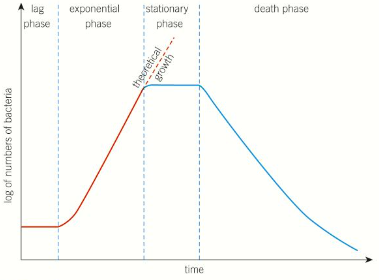
lag phase - when bacteria are adapting to their new environment. They are growing synthesising the enzymes they need and are not yet reproducing at their maximum rate.
log or exponential phase - is when the rate of bacterial reproduction is close to or at its theoretical maximum
stationary phase - when the total growth rate is 0 the number of new cells formed by binary fission is cancelled out by the number of cells dying.
decline/death stage - when reproduction has almost ceased and the death rate of cells is increasing.
Limiting factors that prevent exponential growth in a culture of bacteria
Nutrients available - initially there is plenty of food, but as they multiply it is used up and the nutrient level will become insufficient to support further growth and reproduction unless more is added.
Oxygen levels - the demand for respiratory oxygen rises
Temperature - the enzyme controlled reactions are affected by temperature of the culture medium, for most bacteria a low temp slows down growth and reproduction and a higher temp speeds it up. However if the temperature gets too high it will denature enzymes, even thermophiles have a maximum temperature.
Build up of waste - as they nice, the build up of toxic material may inhibit further growth and can even poison and kill the culture.
Change in pH - as co2 produced by the respiration of the cells increase, the pH of the culture falls until a point where low pH affects enzyme activity and inhibits population growth.
Investigating factors which affect the growth of microorganisms - serial dilations and bacterial counting
set up identical colonies in different conditions of temperature
set up serial dilations of nutrients or pH at a set temperature
Essential when carrying out these experiments that precautions are taken to ensure aseptic conditions, like using sterile equipment and fresh pipette after each dilution.
To see the effect of the conditions, you need to measure the number of microorganisms at the beginning and end of the investigation.
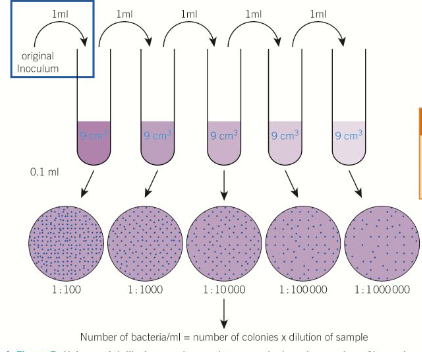
One method is another application of serial dilutions.
Assumption - each of the colonies on a agar plate grown from a single, viable microorganism.
In most cases, when a plate is inoculated a solid mass of microbial growth is present, you cannot count the individual colonies, this is overcome by carrying out a serial dilution or the original culture broth so you can count the number of colonies.
Multiple the colonies by the dilution factor to give you a total viable cell count per volume for original colony. as long as you count on two or more plates, you can calculate the mean number of organisms in a particular culture.